Flock Safety Camera Surveillance: Privacy and Protection

Table of Contents
The Rise of Flock Safety ALPR Surveillance and How to Protect Your Privacy
Introduction: The Silent Expansion of Automated Surveillance
In 2026, Flock Safety’s Automatic License Plate Recognition (ALPR) cameras have become one of the most pervasive forms of surveillance technology in the United States. What began as a niche security solution for gated communities has evolved into a nationwide network of cameras monitoring millions of vehicles daily. This comprehensive guide examines the prevalence of Flock Safety surveillance, the privacy implications of this technology, and practical strategies for protecting yourself against ubiquitous automated tracking.
Unlike traditional surveillance cameras, Flock Safety’s system doesn’t record video. It captures, analyzes, and stores license plate data along with vehicle characteristics, creating searchable databases that law enforcement and private entities can access. The scale of this surveillance infrastructure has raised significant questions about civil liberties, Fourth Amendment protections, and the right to privacy in public spaces.
Communities and civil liberties organizations are pushing back. The ACLU launched a national “Get the Flock Out!” campaign. Volunteers have mapped over 124,000 camera locations through the DeFlock.org project. And the Electronic Frontier Foundation defended the makers of that map when Flock Safety tried to silence them with a cease-and-desist letter.
What You Can Do Right Now
You do not have to be a security researcher or a lawyer to push back against ALPR surveillance. Here is a clear action plan from least to most involved:
1. See Where Cameras Are Near You
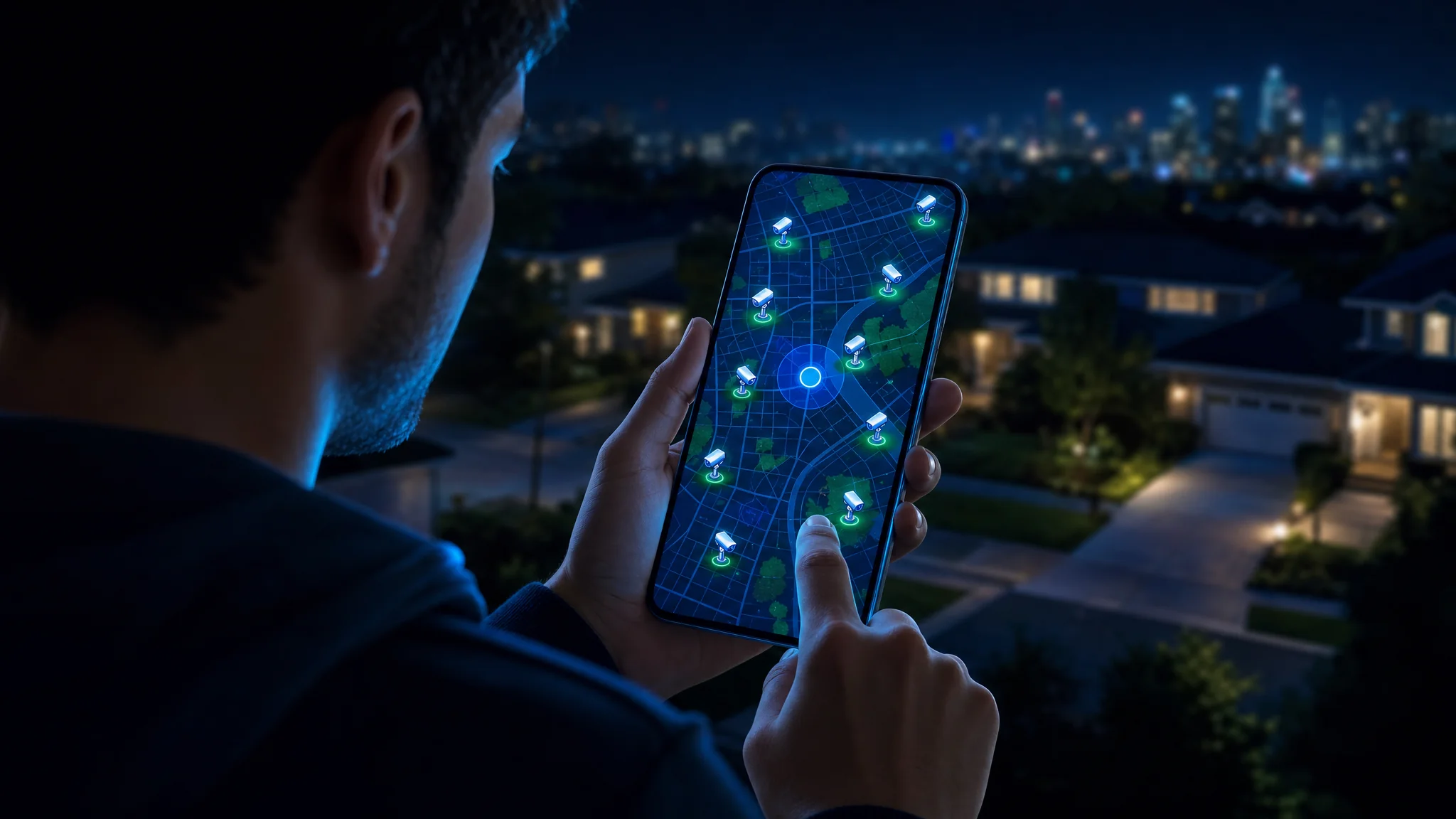
- Flock Finder — Open-source interactive map of 40,000+ suspected Flock cameras built from crowdsourced WiFi data. Updated daily. Source on GitHub .
- DeFlock.org — 124,186 community-mapped ALPR cameras. Submit locations, find local groups, and track city council votes.
- DontGetFlocked.com — Route planner that avoids known ALPR camera concentrations.
2. Carry a Real-Time Detector
Software maps show you where cameras have been seen. A hardware detector tells you when you are near one right now.
STS Collective makes pre-flashed, plug-and-play Flock detection devices. No technical setup required:
- FlockYou M5 Atom Lite ($49.99) — Compact detector, LED turns blue on detection. Plug into a USB power bank and put it in your cup holder.
- FlockYou Pro — Adds audio alerts so you never miss a camera while driving.
- FlockYou Atom VoiceS3R — Voice-spoken alerts for hands-free operation.
💰 Use code FLOCKFINDER for 20% off all FlockYou devices, or SIMEONONSECURITY for up to 20% off your entire STS Collective order: stscollective.com/discount/SIMEONONSECURITY
For a full technical comparison of all detection hardware (including the OUI-SPY and DIY ESP32 builds), read: Flock-You Detection Project: Counter-Surveillance Hardware and Setup Guide .
3. Know What’s in Your Neighborhood
- HaveIBeenFlocked.com — Check if your license plate has appeared in Flock searches by law enforcement in your area.
- ALPR.watch — Find out if your city council is voting on an ALPR contract soon so you can show up and speak.
- File a public records request for your local Flock contract using the DeFlock FOIA guide and the MuckRock template library .
4. Organize Your Community
- Download the ACLU Get The Flock Out Toolkit — sample emails, questions to ask your council, and model legislation all in one place.
- Use the ACLU model contract cancellation resolution to give your city council a ready-made vehicle to cancel an existing Flock contract.
- Connect with local organizers through DeFlock Groups in your city.
- Track national organizing at NoALPRs.com .
Start at step 1 today. Awareness costs nothing. The tools are free.
What is Flock Safety? Understanding ALPR Technology
The Flock Safety Platform
Flock Safety is a public safety technology company that manufactures and operates networks of Automatic License Plate Recognition (ALPR) cameras. Founded in 2017, the company markets its services to:
- Homeowner associations (HOAs) and gated communities
- Law enforcement agencies at local, state, and federal levels
- Private businesses and property owners
- Educational institutions and hospitals
- Municipal governments and “safe city” initiatives
The company’s flagship product is the Flock Safety Falcon camera, a solar-powered device with:
- 4G LTE connectivity for real-time data transmission
- High-resolution cameras capable of capturing plates in various conditions
- Vehicle analytics that identify make, model, color, and distinctive features
- Cloud storage with data retention typically ranging from 30 to 90 days
- Hotlist integration for wanted vehicles or persons of interest
Flock cameras capture more than just plate numbers. They record the make, model, color, body type, and distinguishing features of every vehicle that passes. The company markets these as vehicle “fingerprints.” This means every trip you take is catalogued, even when you have done nothing wrong.
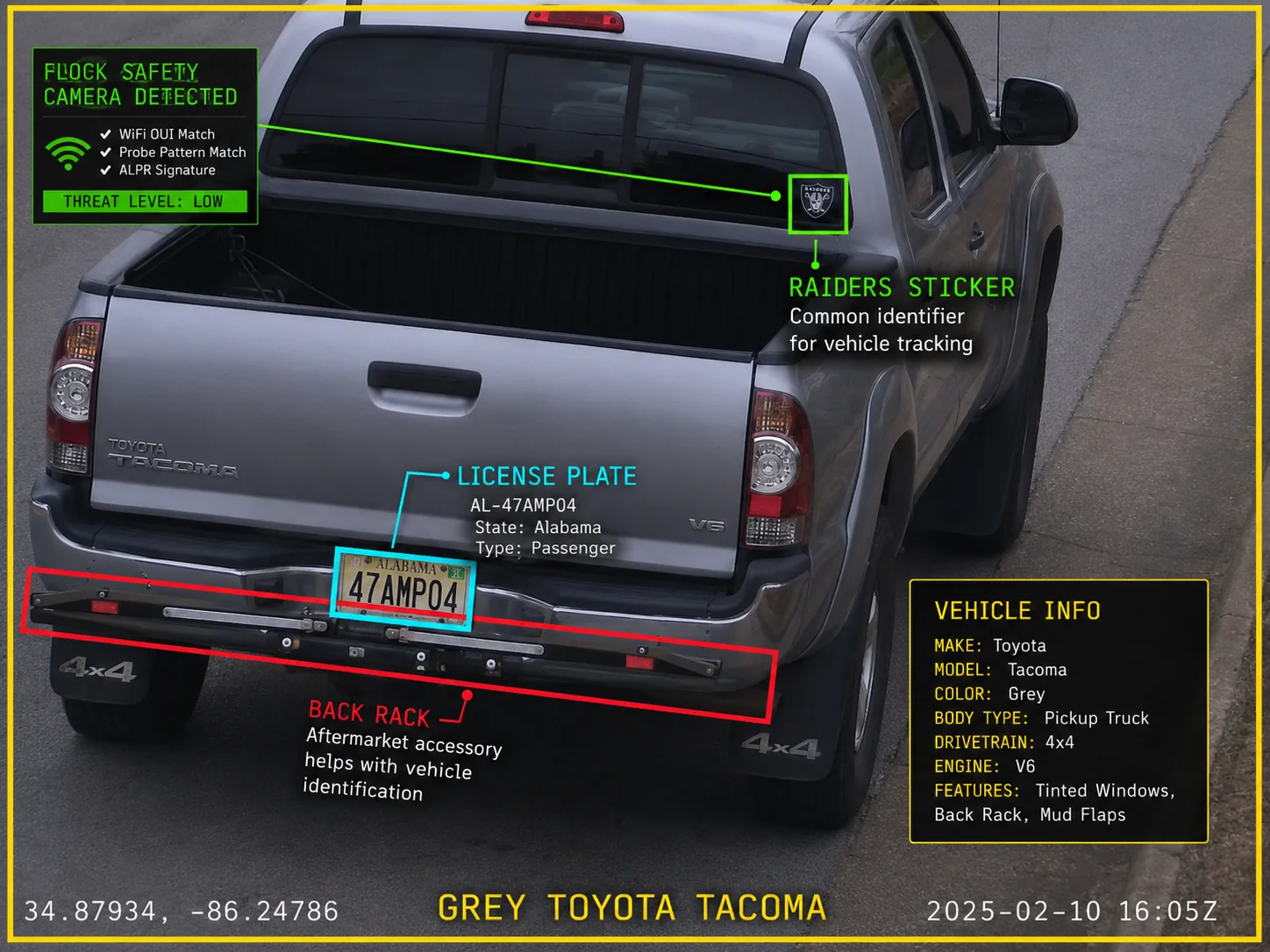
A typical ALPR camera installation. Image credit: DeFlock.org
How ALPR Technology Works
Flock Safety cameras employ sophisticated technology:
- Image Capture: High-speed cameras photograph every passing vehicle
- Optical Character Recognition (OCR): AI algorithms extract license plate numbers
- Vehicle Feature Extraction: System identifies make, model, color, body type, and modifications
- Timestamp and Location Data: GPS coordinates and precise time are recorded
- Database Storage: All information is uploaded to cloud servers
- Search and Alert System: Law enforcement can search for specific vehicles or receive alerts
This creates a searchable database of vehicle movements that can be queried to:
- Track a vehicle’s historical locations
- Identify patterns of life and associations
- Create geofences and alert on vehicle movements
- Reconstruct timelines for investigations
The Prevalence of Flock Safety Cameras in 2026
Nationwide Deployment Statistics
By mid-2026, Flock Safety’s surveillance network has reached unprecedented scale:
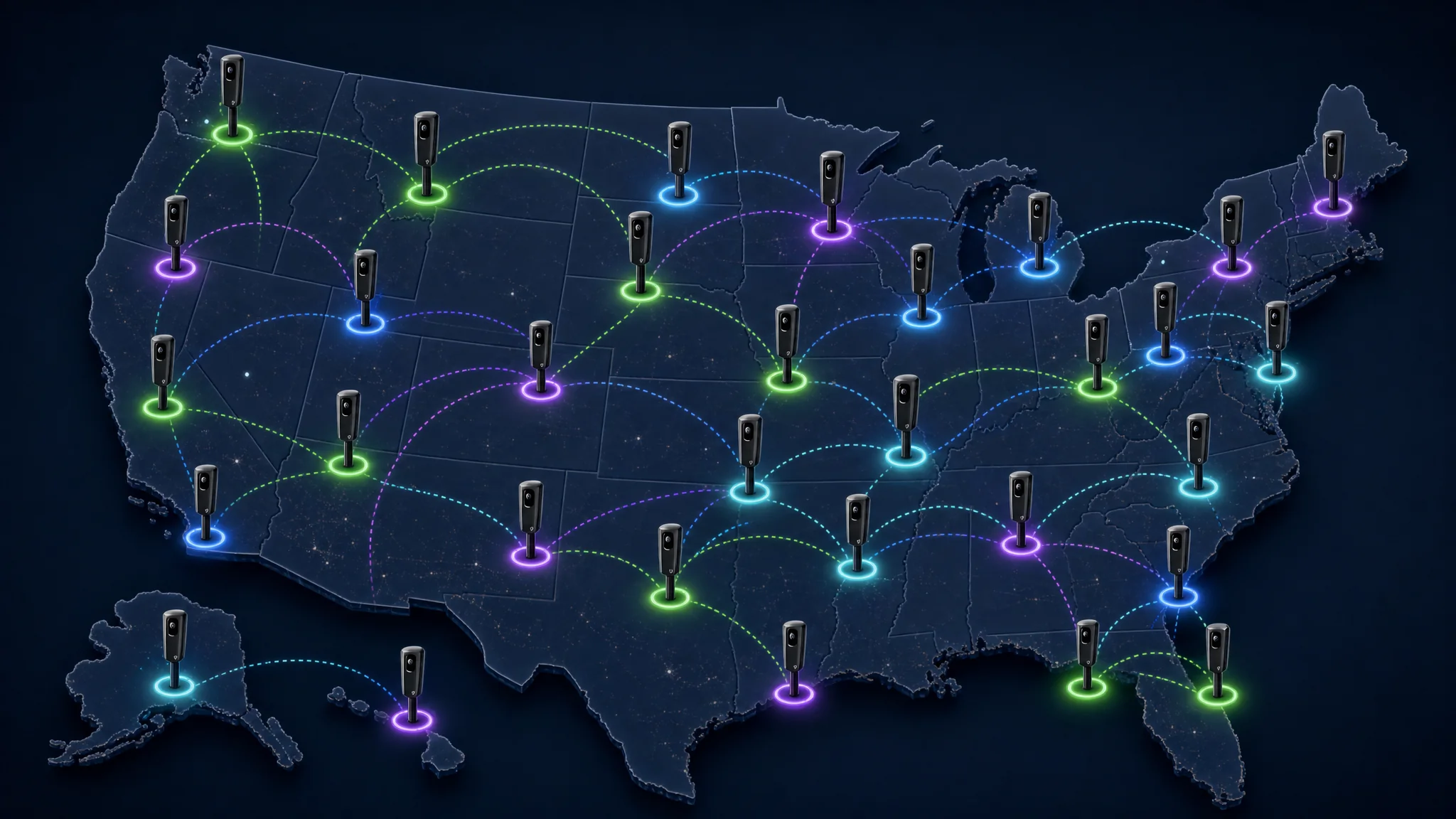
- Over 75,000 cameras deployed across all 50 states
- 3,500+ law enforcement agencies subscribe to Flock services
- Estimated 5,000+ cities and towns with active camera networks
- 150+ million vehicle scans daily across the network
- Billions of data points stored in searchable databases
The volunteer mapping project DeFlock.org has independently catalogued 124,186 ALPR cameras across the USA. That number grows daily as volunteers submit new locations. At the same time, 97 cities have formally rejected ALPR deployments after community organizing campaigns.
Geographic Concentration
Certain states and metropolitan areas show particularly high camera density:
Top States by Camera Deployment (2026):
- California - 12,000+ cameras
- Texas - 9,500+ cameras
- Florida - 7,800+ cameras
- Georgia - 5,200+ cameras
- North Carolina - 4,100+ cameras
Metropolitan Areas with Highest Density:
- Atlanta, GA - Over 1,200 cameras citywide
- Houston, TX - Over 1,000 cameras in metro area
- Los Angeles, CA - Extensive network across suburbs
- Charlotte, NC - Comprehensive city-wide coverage
- Phoenix, AZ - Growing network in residential areas
Some jurisdictions have become so dependent on the platform that the surveillance relationship is visible even on official websites. The Sussex County Sheriff’s website in Virginia lists only two menu items: Accident Reports and Flock Safety.
Private vs. Public Sector Deployment
A significant aspect of Flock’s prevalence is the public-private partnership model:
- ~40% of cameras are paid for by HOAs and private communities
- ~35% of cameras are funded by municipal police departments
- ~15% of cameras are purchased by private businesses
- ~10% of cameras are funded through federal grants or partnerships
This means many cameras are privately owned but accessible to law enforcement, creating a surveillance infrastructure that bypasses traditional oversight mechanisms.
Privacy Concerns and Civil Liberties Issues
Constitutional and Legal Concerns
The widespread deployment of ALPR surveillance raises serious Fourth Amendment concerns:
Expectation of Privacy
- Traditional doctrine: No reasonable expectation of privacy in public spaces
- Modern challenge: Technology enables tracking of all movements over extended periods
- Mosaic theory: Aggregated location data reveals intimate details of private life
- Supreme Court precedent: Carpenter v. United States (2018) recognized privacy interest in long-term location data
Probable Cause and Reasonable Suspicion
- Mass surveillance: Flock cameras scan all vehicles, not just suspects
- Lack of individualized suspicion: Data collected without reasonable belief of wrongdoing
- Dragnet operations: Entire population’s movements tracked and stored
- Chilling effect: Knowledge of surveillance deters lawful activities
Data Retention and Access Concerns
Flock Safety’s data practices present multiple privacy challenges:
Retention Periods
- Standard retention: 30-90 days depending on contract
- Some jurisdictions: Extended retention up to 1-2 years
- No standardized deletion policies across deployments
- Historical data is often retained longer than stated policies
Access and Sharing
- 22,000+ law enforcement users with system access (2026 data)
- Minimal oversight on who searches databases and why
- Inter-agency sharing: Data accessible across jurisdictions
- Federal access: DEA, FBI, ICE reportedly access Flock databases
- Third-party requests: Limited transparency on private entity access
Data Security
- Cloud storage vulnerabilities: Centralized databases are attractive targets for hackers
- Insider threats: Employees or law enforcement misuse access
- Data breaches: A 2024 incident exposed thousands of records
- No user notification: Individuals tracked are never informed of data collection
Function Creep and Mission Expansion: Documented Abuses
What began as a tool for solving property crimes has expanded dramatically. These are not hypothetical risks. They are documented patterns.
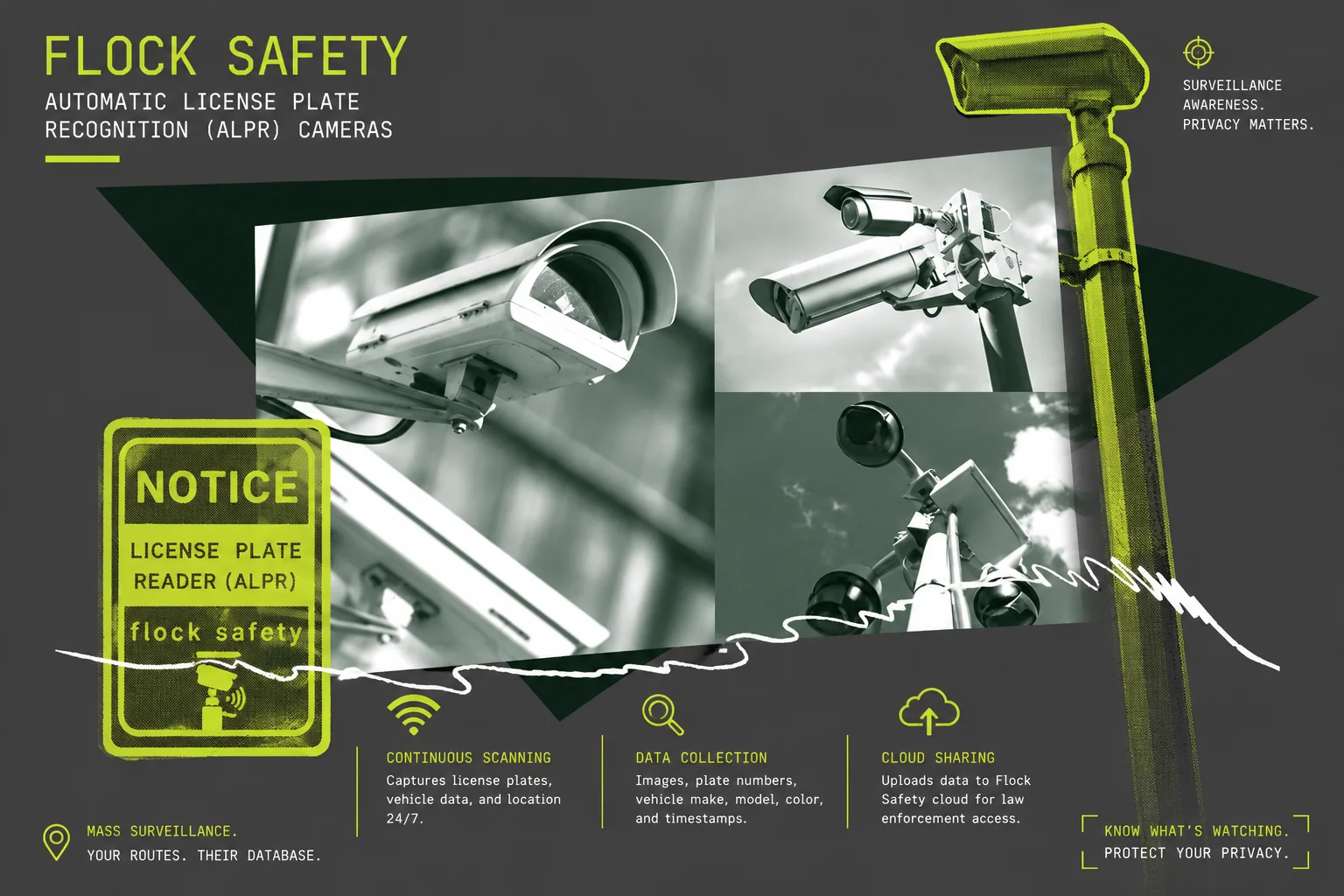
The ACLU’s ‘Get The Flock Out’ campaign has documented widespread misuse of ALPR systems. Image credit: ACLU
ICE and Immigration Enforcement
ICE has used Flock to locate and pursue undocumented immigrants without warrants. The platform’s nationwide network gives federal immigration enforcement a tool to track individuals across jurisdictions without any individualized probable cause. Many communities that funded their Flock networks for property crime recovery have discovered their cameras are part of federal immigration enforcement operations.
Political Retaliation
In Kansas, law enforcement officers used ALPR data to track and pursue a man who had written a critical op-ed about the police department. He had committed no crime. His license plate was flagged, and his movements were monitored. This is the surveillance state using crime-fighting infrastructure against protected political speech.
False Accusations and Wrongful Stops
In Colorado, a police officer wrongfully accused a woman of theft based on a Flock ALPR hit and then refused to look at evidence proving her innocence. The officer trusted the algorithm over the person. This case illustrates how automated systems can strip individuals of presumed innocence when police treat a database match as sufficient proof of guilt.
Other Documented Patterns
- Domestic surveillance: People with law enforcement access have used Flock data to track and spy on ex-partners and family members
- Social network analysis: Tracking associations between vehicles to map relationships
- Protest monitoring: Concerns have been raised about tracking vehicles at political demonstrations
- Traffic enforcement: Some jurisdictions use the data for non-criminal violations well outside the stated purpose of the system
Discriminatory Impact
Research indicates disproportionate surveillance of certain communities:
- Low-income neighborhoods often have higher camera density
- Communities of color experience elevated surveillance levels
- Pretextual stops: ALPR alerts used to justify stops for other purposes
- Systemic bias amplification: Existing law enforcement disparities get reinforced, not corrected
Legal Landscape and Regulation in 2026
State-Level Regulations
As of mid-2026, ALPR regulation remains highly fragmented:
States with Comprehensive ALPR Laws
- California: AB 2808 requires audits, limits retention to 60 days, restricts sharing
- Utah: HB 243 mandates warrants for real-time tracking, 30-day retention limit
- Vermont: Strict limitations on private ALPR use, transparency requirements
- Maine: Prohibits ALPR use except for specific criminal investigations
States with Limited or No Regulation
- 35 states have no comprehensive ALPR-specific statutes
- Many rely on outdated privacy laws predating modern surveillance technology
- Industry self-regulation often fills the vacuum left by absent legislation
Federal Oversight
Federal regulation remains minimal:
- No federal ALPR statute as of 2026
- Department of Homeland Security guidance lacks enforcement mechanism
- Pending legislation: Several congressional proposals remain in committee
- Constitutional challenges: Multiple lawsuits working through federal courts
Judicial Developments
Recent court decisions are shaping ALPR law:
- 2025 Fourth Circuit: Commonwealth v. Flock Safety limited warrantless long-term ALPR tracking
- 2024 Ninth Circuit: ACLU v. San Diego required disclosure of ALPR vendor contracts
- 2026 pending: Rodriguez v. Flock Safety class action regarding data retention practices
Municipal Policies
Many cities have enacted local ordinances:
- Transparency requirements: Public reporting on ALPR usage
- Audit mandates: Annual reviews of access logs and usage
- Community input: Public hearings before ALPR deployment
- Use limitations: Restrictions on what crimes justify ALPR searches
Community Organizing and Advocacy: The ACLU “Get The Flock Out” Campaign
Grassroots organizing is working. City councils across the country are canceling Flock contracts when residents show up and demand accountability. The ACLU has built a full infrastructure to help communities fight back.
Communities nationwide are pushing back against ALPR surveillance. Image credit: ACLU
The ACLU Toolkit
The ACLU Get The Flock Out Toolkit provides everything a community needs to challenge a Flock contract. It includes:
- Background on Flock’s abuses and documented harms
- Sample email templates to send to city council members and police chiefs
- Questions to ask about any existing or proposed ALPR contract, including retention periods, warrant requirements, who can access the data, and what audits exist
- A step-by-step guide to finding out if your community already has a contract
- Connections to local ACLU affiliates and organizers in your state
The ACLU has documented organizing victories in Washington, Iowa, Oregon, Rhode Island, and dozens of other states.
Model Legislation
The ACLU has published ready-to-use legal templates for advocates working at every level of government:
| Document | Purpose |
|---|---|
| Model State ALPR Bill | Comprehensive state-level privacy protections for ALPR systems |
| Model Local ALPR Bill | Municipal ordinance template limiting ALPR deployment and use |
| Model Contract Cancellation Resolution | Ready-to-introduce resolution for city councils to cancel existing Flock contracts |
These templates have been used successfully by community advocates who brought them directly to local elected officials.
Key Questions to Ask Your Local Government
If your city or HOA has or is considering a Flock contract, ask these questions in writing:
- What is the data retention period, and who can extend it?
- Which agencies have access to the database?
- Is a warrant required before law enforcement can search the data?
- Can federal agencies including ICE access the data?
- Are there audit logs showing who searched what, and when?
- Has any ALPR data been used in immigration enforcement?
- What is the false positive rate and what recourse exists for wrongful stops?
DeFlock.org: Mapping the Surveillance Network
DeFlock.org is a crowdsourced mapping project that has catalogued the physical locations of ALPR cameras across the country.
- 124,186 LPRs mapped in the USA
- 97 cities that have formally rejected ALPR deployments
- Submit a camera location if you spot one in your area
- Find local groups organizing in your city
- City council tracker following ALPR votes and hearings
- National week of action coordinated through NoALPRs.com
DeFlock is the most comprehensive public database of ALPR camera locations in existence. Using detection hardware and community submissions, it gives residents a clear picture of the surveillance infrastructure in their own neighborhoods.
ALPR.watch: Track Public Meetings
ALPR.watch tracks upcoming local government meetings where ALPR contracts and policies are on the agenda. If you want to show up and speak, this is how you find out when and where to be.
EFF Defends DeFlock: Flock Safety’s Trademark Bullying
In February 2025, Flock Safety sent a cease-and-desist letter to Will Freeman, the creator of DeFlock.me, a mapping tool that tracked Flock camera locations. Flock claimed the name “DeFlock” constituted trademark dilution and demanded the site be taken down.
The Electronic Frontier Foundation stepped in and rejected the demand on Freeman’s behalf. EFF’s position was clear: the name “DeFlock” communicates a goal of ending ALPR surveillance. It is protected political speech, and no trademark claim can silence it. EFF told Flock to flip them the bird.
At the time of the C&D letter, DeFlock had mapped over 16,000 individual camera locations. That number has since grown to over 124,000 as the community rallied in response to the legal threat.
Flock Safety’s attempt to silence a public mapping project through legal pressure backfired. It brought more attention to the project and demonstrated that the company views transparency about its surveillance network as a threat.
EFF’s own Atlas of Surveillance has independently identified more than 1,700 agencies using ALPR systems across the country. You can search it at atlasofsurveillance.org .
How Flock Safety Cameras Can Be Detected

Understanding Flock Camera Signatures
Flock Safety cameras have distinctive characteristics that enable detection:
Physical Characteristics
- Solar panel configuration: Black panel typically on top of unit
- Cylindrical housing: Weather-resistant enclosure ~18 inches tall
- Dual camera lenses: Front-facing configuration
- 4G LTE antennas: Small antenna protrusions
- Mounting: Typically on light poles, traffic signals, or dedicated poles
- Absence of traditional power lines: Solar/battery operation
Network Signatures
The breakthrough in Flock detection comes from WiFi networking characteristics:
- 31 known WiFi OUIs (Organizationally Unique Identifiers) associated with Flock cameras
- Continuous WiFi broadcasting: Cameras maintain network connectivity
- Distinctive probe requests: Wildcard SSID probes with signature patterns
- 802.11 management frames: Specific frame patterns identifiable in promiscuous mode
- Predictable network behavior: Regular beacon intervals and connection attempts
The Flock-You Detection Project
The open-source Flock-You project has transformed counter-surveillance capabilities. Developed by security researchers and catalogued in the GitHub repository colonelpanichacks/flock-you, this project enables:
Flock Finder extends this work by querying the WiGLE crowdsourced WiFi database for the same 31 OUIs, plotting 40,000+ suspected Flock cameras on an interactive map updated daily. Source on GitHub .
- Real-time detection of Flock Safety cameras via WiFi signatures
- Affordable hardware platforms ($40-$110) for consumer-level detection
- Mobile and stationary detection modes
- Data logging and mapping of camera locations
- Community-driven OUI database continuously updated with new signatures
WiFi OUI Detection Methodology
The project leverages 31 WiFi OUIs discovered by researchers @NitekryDPaul and the DeFlockJoplin community:
D4:AD:FC - Espressif (ESP32 modules in cameras)
AC:67:B2 - Espressif (Common in Flock deployments)
84:F3:EB - Espressif (ESP32-S3 variants)
[... 28 additional OUIs ...]
When a Flock camera is operating, it broadcasts WiFi frames containing these OUIs, which can be detected by devices operating in promiscuous WiFi monitoring mode.
Detection Techniques
Flock-You detection employs multiple strategies:
- OUI Matching: Scanning for known manufacturer addresses
- Wildcard Probe Detection: Identifying signature probe request patterns
- Frame Analysis: Examining 802.11 management frame structures
- SSID Pattern Recognition: Detecting characteristic network names
- Signal Strength Mapping: Triangulating camera locations
Detection Hardware Options
For detailed technical specifications and purchasing information, see our comprehensive guide: Flock-You Detection Project: Counter-Surveillance Hardware and Setup Guide .
Three primary hardware platforms are available for Flock detection:
1. OUI-SPY by Colonel Panic Tech ($85)
- Purpose-built Flock detection device
- ESP32-S3 based with optimized firmware
- Real-time alerts via LED and buzzer
- Data logging to SD card
- Rechargeable battery for mobile use
2. M5 Atom Lite with FlockYou Firmware ($49.99)
- Most affordable option
- Compact form factor
- Requires firmware flashing
- Community-supported platform
- Expandable with accessories
3. mesh-detect v2 by STS Collective ($110)
- Advanced detection capabilities
- Extended battery life
- Enhanced display with GPS
- Professional-grade enclosure
- Multi-mode detection including RayHunter signatures
💰 Exclusive Discount: Save up to 20% on STS Collective products including the mesh-detect v2 — use code SIMEONONSECURITY at checkout or shop with the discount applied .
Where to Purchase Detection Devices
Authorized Vendors:
- Colonel Panic Tech: colonelpanic.tech - OUI-SPY and DIY kits
- STS Collective: stscollective.com/discount/SIMEONONSECURITY — FlockYou M5 Atom Lite , mesh-detect v2, and accessories
💰 Two codes work at STS Collective: FLOCKFINDER saves 20% off all FlockYou detectors specifically, and SIMEONONSECURITY saves up to 20% off your entire order. Use whichever gets you a better deal.
Protection Strategies Against ALPR Surveillance
Legal and Policy Advocacy
Community organizing remains the most effective long-term protection:
Municipal Engagement
- Attend city council meetings when ALPR contracts are discussed
- File public records requests for ALPR policies and usage data
- Advocate for transparency ordinances requiring public reporting
- Support local legislation limiting ALPR use and data retention
- Use the ACLU model resolution to give your council a ready-made cancellation vehicle
State-Level Advocacy
- Contact state legislators about comprehensive ALPR regulation
- Use the ACLU model state bill as a starting point for your state
- Participate in comment periods for proposed regulations
- Build coalitions across the political spectrum on surveillance concerns
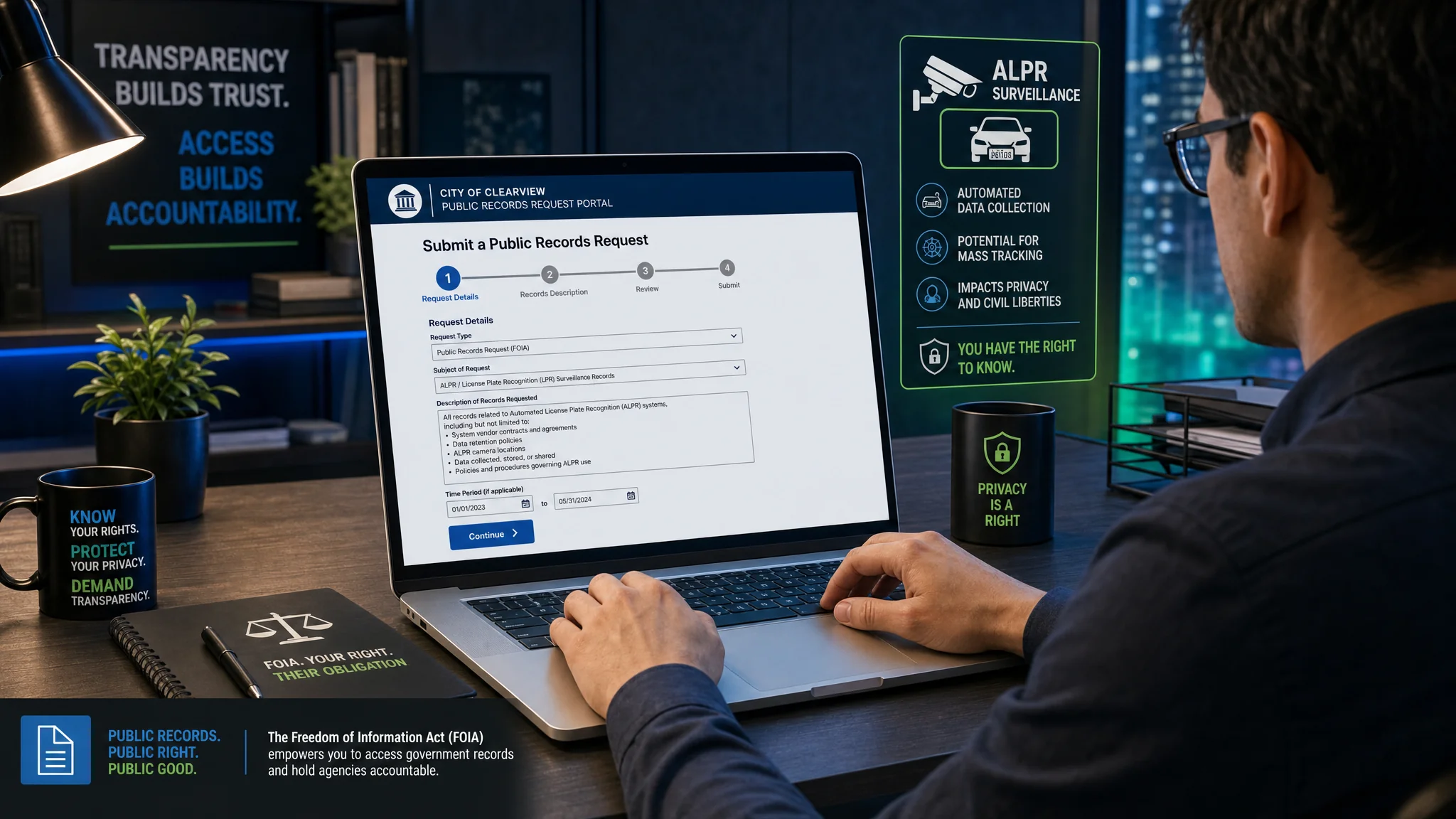
How to File a Public Records Request for ALPR Data
Filing a Freedom of Information Act (FOIA) or state public records request is one of the most powerful tools available. You can request records without identifying yourself in many states.
DeFlock’s FOIA guide walks through the process step by step:
- Find the agency: Identify which police department or HOA operates cameras in your area
- Find the records portal: Most agencies have an online portal; many states require one
- Use MuckRock as a guide: Search MuckRock’s Flock database for hundreds of example requests and responses from other jurisdictions
- Request these specific records:
- Right-of-Way Installation Permits for camera locations
- Invoices and contracts with Flock Safety
- Email correspondence about data sharing with federal agencies
- Access logs showing which officers searched the database and when
- Any data retention policy or waiver documents
The MuckRock database already contains hundreds of successful FOIA requests about Flock contracts nationwide. Start there to see exactly what records other people have obtained and adapt those request templates for your jurisdiction.
Additional resources for public records:
- HaveIBeenFlocked.com/pd — check which law enforcement agencies have Flock transparency portals
- HaveIBeenFlocked.com/news/transparency-portals — crowdsourced list of agencies with public-facing ALPR portals
Technical Counter-Surveillance
Beyond detection devices, several technical measures can reduce ALPR effectiveness:
License Plate Obscuration (Legal Considerations)
Warning: Many jurisdictions prohibit obscuring license plates. Research local laws before attempting.
- Reflective covers: Some claim to interfere with camera capture (effectiveness is disputed)
- Anti-photo coatings: Specialized sprays (often illegal and ineffective)
- Physical obstructions: Any obstruction is illegal in most jurisdictions
- IR-reflective materials: Legality is questionable in most states
Recommendation: These methods are generally not recommended due to legal risks and questionable effectiveness.
Vehicle Choice and Usage Patterns
- Older vehicles: Less distinctive, fewer trackable features
- Common makes/models: Blend in with high-volume vehicles
- Avoid distinctive modifications: Unique features aid tracking
- Rental vehicles: Breaks continuity of tracking, but only temporarily
- Alternative transportation: Bicycles, public transit, carpooling
Digital Hygiene
- Separate vehicle registration from residence: Use PO box where legal
- Limit vehicle-identity associations: Avoid parking at sensitive locations
- Awareness of camera locations: Use detection devices to map surveillance
- Strategic routing: Avoid known camera concentrations when possible
Operational Security Practices
For individuals concerned about surveillance:
Threat Modeling
- Assess your risk level: Are you a likely target of enhanced surveillance?
- Identify critical locations: Home, workplace, medical facilities, places of worship
- Map camera networks: Use detection devices to create personal awareness
- Develop alternative routes: Plan travel that minimizes camera exposure
Defensive Driving
- Vary routines: Unpredictable patterns are harder to profile
- Time-shift activities: Travel during different periods
- Use counter-surveillance techniques: Identify following vehicles
- Multi-vehicle households: Alternate which vehicle is used
Privacy-Enhancing Technologies
- Tor and VPNs: Protect digital tracking parallel to physical
- Encrypted communications: Prevent correlation of physical and digital surveillance
- Faraday bags for devices: Prevent location tracking via smartphones
- Cash transactions: Reduce financial tracking that correlates with vehicle movements
Legal Responses to ALPR Tracking
If you discover you’ve been tracked:
Access Your Data
- Public records requests: Some jurisdictions allow requesting your own ALPR data
- Data subject access rights: California CCPA and similar laws provide access
- Freedom of Information Act: Federal and state FOIA for government-operated systems
Legal Challenges
- Consult privacy attorneys: If you believe surveillance is unlawful
- Document surveillance: Keep records of detected camera locations
- Join class actions: Participate in collective legal challenges
- File complaints: Report policy violations to oversight bodies
Ecosystem of Anti-Surveillance Tools and Organizations
A growing ecosystem of tools and projects supports individuals and communities fighting ALPR surveillance. Use these alongside the detection hardware described above.
| Tool | What it does |
|---|---|
| DeFlock.org | Crowdsourced map of 124,000+ ALPR cameras; city council tracker; FOIA guide |
| HaveIBeenFlocked.com | Check if your plate has appeared in Flock searches; law enforcement audit tool |
| DontGetFlocked.com | FlockHopper route planner that avoids known camera concentrations |
| ALPR.watch | Tracks upcoming public government meetings where ALPR is on the agenda |
| EyesOnFlock.com | Dashboard analyzing Flock usage patterns across agencies |
| ALPRwatch.org/flock/map | Recent community-submitted camera location reports |
| AtlasOfSurveillance.org | EFF’s comprehensive database of surveillance technology by agency |
| PlatPrivacy.com | Institute for Justice analysis of ALPR laws and privacy |
| NoALPRs.com | National week of action coordination for ALPR abolition campaigns |
| MuckRock Flock requests | Hundreds of example FOIA requests and responses about Flock contracts |
This ecosystem works best as a whole. Use DeFlock to map your neighborhood, ALPR.watch to find your next council meeting, and the ACLU toolkit to show up prepared.
The Future of ALPR Surveillance and Privacy
Technology Trends
ALPR technology continues to evolve:
- Facial recognition integration: Some systems are adding driver identification
- Predictive analytics: AI predicting future locations based on historical data
- Cross-platform fusion: Integration with other surveillance technologies
- Real-time tracking: Moving from database searches to live pursuit capabilities
- International networks: Cross-border data sharing agreements
Privacy Technology Counter-Developments
The privacy community is responding with innovation:
- Advanced detection methods: Beyond WiFi OUI to acoustic and RF analysis
- Crowdsourced mapping: Public databases of camera locations growing rapidly
- Automated legal tools: AI-assisted public records requests and policy analysis
- Privacy-preserving alternatives: Proposals for surveillance systems with built-in privacy protections
Policy Trajectory
The regulatory landscape will shift:
- Federal legislation: Growing bipartisan support for ALPR regulation
- Judicial rulings: Courts are increasingly skeptical of warrantless long-term tracking
- Corporate accountability: Pressure on companies like Flock for transparency
- International standards: GDPR-style frameworks influencing U.S. policy debates
- Municipal victories: The 97 cities that have rejected ALPRs demonstrate that organizing works
Conclusion: Balancing Security and Privacy
The proliferation of Flock Safety ALPR cameras represents a fundamental shift in the surveillance capacity of both public and private entities. Proponents argue these systems enhance public safety by solving crimes and recovering stolen vehicles. The privacy implications are profound and far-reaching, and that tradeoff deserves scrutiny.
As of 2026, 75,000+ cameras are scanning 150+ million vehicles daily, creating searchable databases of Americans’ movements without warrant, probable cause, or individualized suspicion. This infrastructure enables:
- Tracking of law-abiding citizens
- Reconstruction of intimate details of private life
- Potential for discriminatory enforcement
- Chilling of free movement and association
- Immigration enforcement without warrants
- Retaliation against political speech
Protection strategies range from policy advocacy to technical counter-surveillance. The open-source Flock-You detection project has democratized awareness of surveillance infrastructure, enabling individuals to understand when and where they’re being monitored. The ACLU’s “Get The Flock Out” campaign has given communities the tools to fight back through their city councils. And DeFlock.org has built a public map of the surveillance network that Flock Safety tried to suppress with legal threats and failed.
For technical details on detection devices and step-by-step setup instructions, read our companion guide: Flock-You Detection Project: Counter-Surveillance Hardware and Setup Guide .
The question isn’t whether technology can enable pervasive surveillance. It clearly can. The question is whether a free society should permit such surveillance without robust safeguards, transparency, and accountability. The answer will shape privacy rights for generations to come.
Related Articles
This article is part of a series on Flock Safety ALPR surveillance and counter-surveillance tools:
| Article | What it covers |
|---|---|
| Flock Finder: Map Flock Safety ALPR Cameras | Open-source interactive map of 40,000+ suspected Flock cameras via WiGLE WiFi data — see the scale of deployment in your area before you drive |
| Flock-You Detection Project: Counter-Surveillance Hardware Guide | Complete technical guide to building or buying ESP32-based Flock detectors — firmware setup, hardware comparison, step-by-step instructions |
| How to Flash Rayhunter Devices: Complete Guide | Detect IMSI catchers (cell-site simulators) alongside ALPR cameras for full counter-surveillance awareness |
| DagShell Custom Firmware for Orbic RCL400 | Turn a mobile hotspot into a security research platform — pairs well with Flock detection hardware |
| Rayhunter Device Comparison 2026 | Compare detection hardware options across ALPR and cellular surveillance threat categories |
References
- Flock Safety Official Website
- Electronic Frontier Foundation - Automated License Plate Readers
- EFF - Anti-Surveillance Mapmaker Refuses Flock Safety’s Cease-and-Desist (Feb 2025)
- ACLU - You Are Being Tracked
- ACLU - Get The Flock Out Campaign
- ACLU - Get The Flock Out Toolkit
- ACLU - Model State ALPR Bill
- ACLU - Model Local ALPR Bill
- ACLU - Model Resolution for Local Flock Contract Cancellation
- DeFlock.org - Crowdsourced ALPR Camera Map
- DeFlock.org - How to File a Public Records Request
- DeFlock.org - What is an ALPR?
- DeFlock.org - Community Groups
- DeFlock.org - City Council Tracker
- HaveIBeenFlocked.com
- HaveIBeenFlocked.com - Law Enforcement Transparency Portals
- ALPR.watch - Upcoming Public Meetings
- MuckRock - Flock Safety FOIA Requests
- Atlas of Surveillance - EFF
- Flock-You GitHub Repository by colonelpanichacks
- Colonel Panic Tech - OUI-SPY Detection Device
- STS Collective - mesh-detect v2
- Carpenter v. United States, 585 U.S. ___ (2018)
- NIST - Privacy and Civil Liberties Framework
- National Conference of State Legislatures - ALPR Policy
- DeFlockJoplin Community Research
- NoALPRs.com - National Week of Action
- DontGetFlocked.com - FlockHopper Route Planner
- PlatPrivacy.com - Institute for Justice ALPR Analysis

Disclosure and Affiliate Statement:
Affiliate Disclosure: We may earn a commission from links on this page. These commissions support our website and the content we provide. Rest assured, we only recommend products/services we believe in. Thank you for your trust! Click Here to Learn More
Related Posts