
Eye Spy: ESP32 Passive Surveillance and Tracker Detector
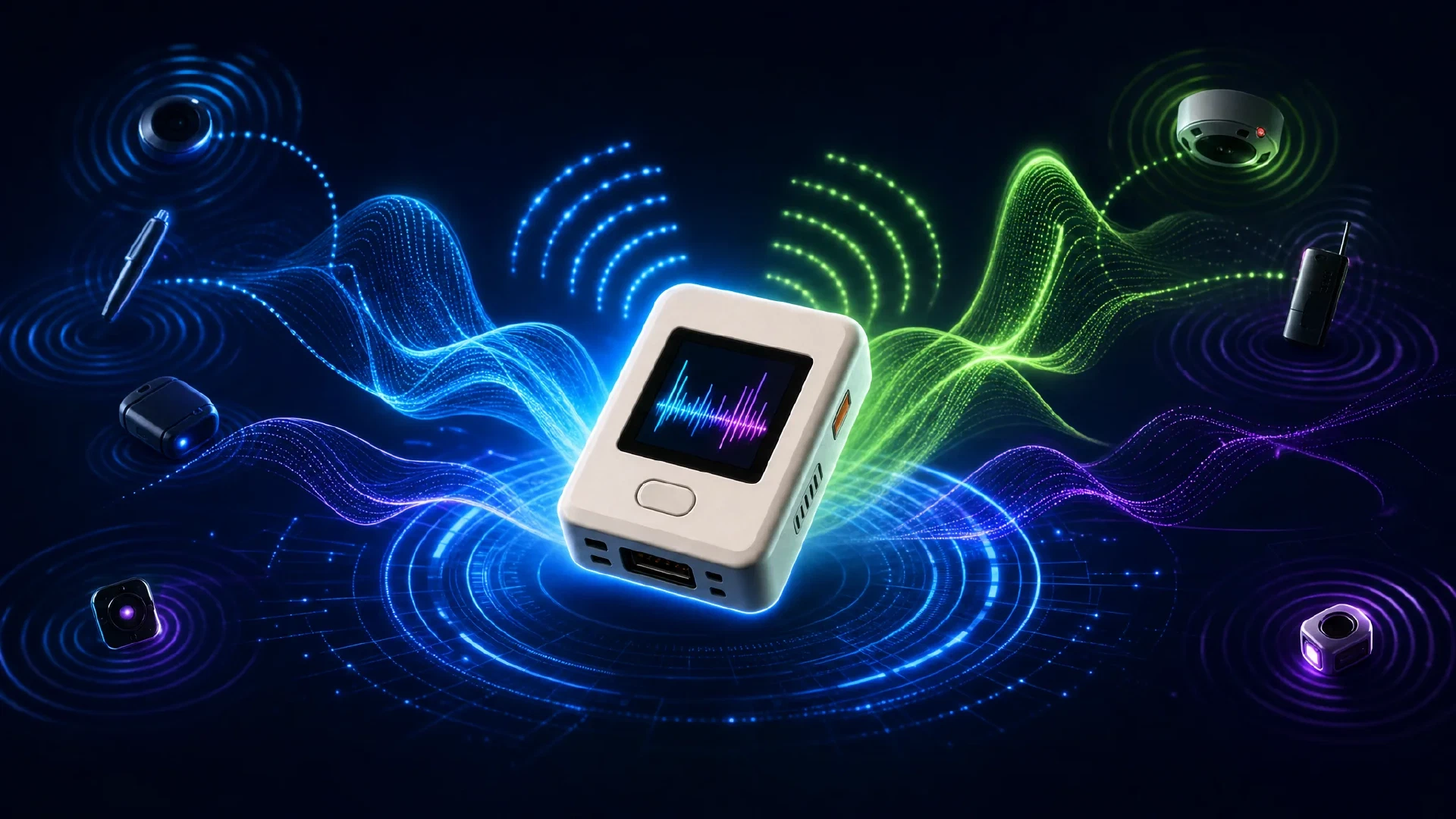
Table of Contents
A Thumb-Sized Passive Sensor That Tells You When Something Is Watching
Introduction: The Surveillance Landscape You Can’t See
The physical world is increasingly instrumented with devices that watch, record, and track - license-plate readers on street corners, body cameras on law enforcement, rental property cameras, commercial AirTag-style trackers hidden in bags or cars, and commercial surveillance cameras at every retail entrance. Most of these devices communicate wirelessly over Bluetooth LE or WiFi, and most of those communications are broadcast into the open air for anyone with the right receiver to detect.
Eye Spy is a passive surveillance detection tool that exploits exactly this fact. Running on the M5Stack Atom Lite - an ESP32-PICO-D4 development board roughly the size of a sugar cube - Eye Spy continuously monitors the BLE and WiFi spectrums for the electronic signatures of recording devices, surveillance cameras, ALPR (automatic license plate reader) systems, drones, and personal trackers. When it finds something, its RGB LED changes color.
It doesn’t connect to anything. It doesn’t transmit. It watches, scores, and lights up.
This article is a complete technical reference: what Eye Spy detects, how the confidence-score system works, the engineering behind each detection engine, how to build and flash it, and what its practical limitations are.
Prefer not to build one yourself? Pre-flashed, ready-to-use Eye Spy detectors are available from STS Collective, and reader code SIMEONONSECURITY takes up to 20% off.

LED Indicators: The Entire User Interface
Like the ESP32 WiFi Canary , Eye Spy’s entire output is a single SK6812 RGB NeoPixel on GPIO 27 of the M5Stack Atom Lite. The LED communicates a four-state threat level at all times:
| Color | Meaning | Score Range |
|---|---|---|
| 🔵 Blue pulse | Startup / first scan | – |
| 🟢 Green solid | Clear - nothing detected | 0–2 |
| 🟡 Yellow solid | Caution - possible recording device nearby | 3–5 |
| 🔴 Red flashing | Alert - definite surveillance / tracking device detected | 6+ |
A single high-confidence detection (Axon body camera, Flock Safety camera, ALPR OUI match, AirTag) scores enough points to immediately push the LED to red in a single detection cycle. Multiple medium-confidence detections accumulate to yellow and can combine toward red.
Hardware
Primary Target: M5Stack Atom Lite
| Component | Detail |
|---|---|
| Board | M5Stack Atom Lite |
| MCU | ESP32-PICO-D4 |
| LED | SK6812 NeoPixel on GPIO 27 |
| Button | GPIO 39 (input only) |
| Flash | 4 MB |
The Atom Lite is a complete self-contained platform. No soldering, no breadboard, no external components. Plug it into USB and it runs.
Generic ESP32 DevKit
A second PlatformIO build environment (esp32dev) targets any standard ESP32 DevKit with an onboard LED on GPIO 2. All detection logic runs identically. The DevKit build is useful for development, testing detection logic, and deployment when the Atom Lite form factor isn’t required.
The Scoring System
Eye Spy uses a confidence-score model that aggregates signals from all detection engines into a single integer. The score drives LED state (green / yellow / red) and is subject to two automatic management mechanisms:
Score Decay
The score drops −1 point every 60 seconds without new detections. If you move away from a detected device, the LED returns to green within a few minutes without any user intervention.
Re-Score Cooldown
Each detection type has a 120-second cooldown before it can add points again from the same source. This prevents a single persistent device from infinitely stacking the score - a Flock Safety camera that remains in range adds +5 once, then waits 120 seconds before it can contribute again.
These two mechanisms together mean:
- Transient detections (a car with an AirTag driving past) resolve automatically
- Persistent surveillance (a fixed body-cam deployment) keeps the LED at alert as long as you remain in range
- No runaway scoring from one device seen repeatedly
Detection Engines
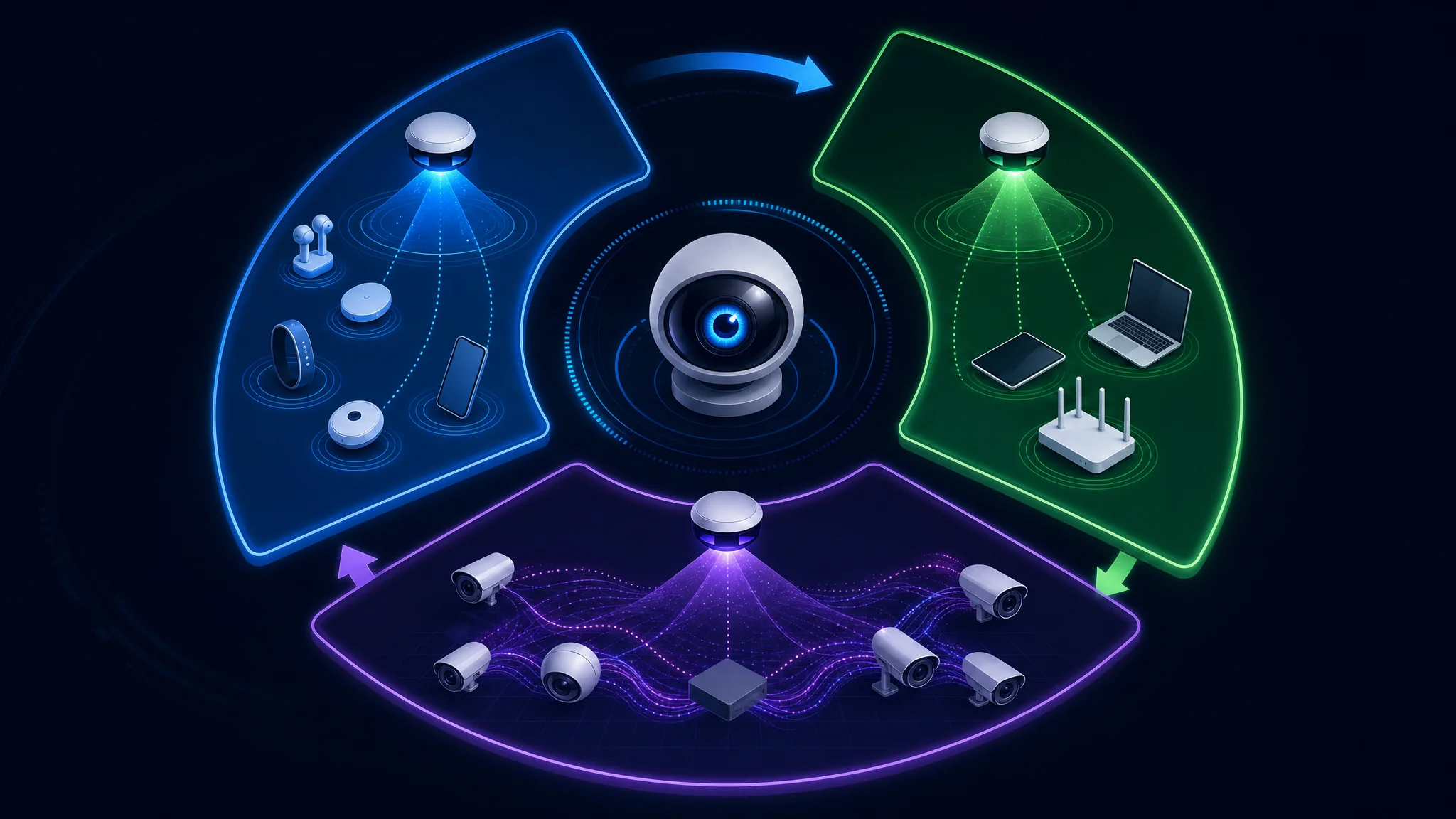
Eye Spy operates three distinct scanning phases in a continuous rotation:
BLE passive (9 s) → WiFi scan (~3 s) → Promiscuous sniff (5 s) → repeat
BLE is explicitly stopped before any WiFi operations to respect the shared ESP32 radio. It restarts cleanly at the beginning of each new cycle.
Engine 1: BLE - Passive Scanning
BLE scanning is implemented using NimBLE with no scan requests transmitted. The device listens for BLE advertising packets without sending any response. This makes Eye Spy electronically invisible to the equipment it is scanning for - a passive scanner can’t be detected by the target.
Devices weaker than −90 dBm are ignored to reduce false positives in dense environments.
BLE Detection Table
| # | Target | Detection Method | Score |
|---|---|---|---|
| 1 | Axon body camera | BLE MAC OUI 00:25:df (Axon - body cams, tasers, LE equipment) | +5 🔴 |
| 2 | Ray-Ban Meta smart glasses | BLE service UUID 0xFD5F | +5 🔴 |
| 3 | Flock Safety BLE | BLE device name containing Flock, Penguin, Pigvision, or FS Ext Battery | +5 🔴 |
| 4 | Card skimmer (HC-03/05/06) | BLE device name exact match - Bluetooth modules commonly found in payment-terminal skimmers | +5 🔴 |
| 5 | Apple AirTag | Manufacturer data 0x004C subtype 0x12/0x1E, or raw payload 1E FF 4C 00 / 4C 00 12 | +4 🔴 |
| 6 | Drone (OpenDroneID BLE) | BLE service UUID 0xFFFA, or raw AD service-data payload with app code 0x0D | +4 🔴 |
| 7 | Samsung SmartTag | BLE service UUID 0xFD5A | +3 🟡 |
| 8 | Tile tracker | BLE service UUID 0xFEED or 0xFEEC | +3 🟡 |
| 9 | MeshCore node | BLE device name prefix MeshCore- | +2 🟡 |
| 10 | iBeacon (retail/venue tracking) | Manufacturer data 0x004C 0x02 0x15 - deployed in stores, airports, and stadiums to track movement | +2 🟡 |
| 11 | Unknown persistent device | Any unclassified BLE MAC seen ≥3× over ≥5 minutes (device scout / follower detection) | +2 🟡 |
Notable BLE Detections in Depth
Axon Body Camera (+5): Axon (formerly TASER International) manufactures the most widely deployed body camera systems for law enforcement in the United States. The OUI 00:25:df is registered to Axon and appears in their wearable hardware. A single detection immediately reaches the Alert threshold.
Ray-Ban Meta Smart Glasses (+5): The Ray-Ban Meta collaboration produces consumer smart glasses capable of video and photo recording. The BLE service UUID 0xFD5F is the characteristic advertisement used by these devices. Notably, these are a consumer product and may appear in crowded public spaces - any detection at this score level is worth awareness regardless of the wearer’s intent.
Card Skimmer Bluetooth Modules (+5): HC-03, HC-05, and HC-06 are cheap commodity Bluetooth serial modules frequently discovered in payment terminal overlays and ATM skimmer hardware. Detection uses exact device name matching against known module firmware default names. A red alert here warrants immediate physical inspection of nearby payment terminals.
Apple AirTag (+4): AirTags advertise using Apple’s proprietary Nearby Interaction protocol. The detection targets the manufacturer-specific data header (0x004C = Apple) with the AirTag-specific subtypes (0x12 for the standard advertisement, 0x1E for the lost-item advertisement). Raw payload patterns provide redundant detection coverage.
OpenDroneID BLE (+4): The ASTM F3411 Remote ID standard (also adopted by FAA for commercial drones in the US) defines a broadcast protocol for drones to announce their identity and position. Eye Spy looks for the GATT service UUID 0xFFFA (the designated Remote ID service) and the application code 0x0D in AD service-data payloads. Any compliant commercial drone operating nearby will trigger this detection.
Unknown Persistent Device (+2): This is the follower detection engine. Any BLE MAC not classified by the specific detections above is tracked. If the same unclassified MAC appears three or more times over five or more minutes, it scores. The device persistence tracker watches up to 50 unknown MACs simultaneously, with entries purged after 30 minutes of absence. This catches custom or modified trackers that don’t match any known service UUID or manufacturer pattern.
iBeacon (+2): Apple’s iBeacon format (0x4C 0x00 0x02 0x15) is used by retailers, airports, and stadiums to track device movement through physical spaces. The detection fires on the standard advertisement format regardless of UUID - targeting the deployment type, not any specific UUID. A hit here means you’re likely in a location that is actively tracking Bluetooth device presence.
Engine 2: WiFi Scan - Active Channel Scan
The WiFi scan engine uses the ESP32’s standard AP scanning interface to enumerate nearby access points and compare their BSSIDs and SSIDs against known surveillance device fingerprints.
WiFi Scan Detection Table
| # | Target | Detection Method | Score |
|---|---|---|---|
| 12 | Flock Safety camera (OUI) | BSSID matches 22-entry Flock Safety OUI table (d4:bb:e6, 3c:61:05, FS-Ext-Battery prefixes) | +5 🔴 |
| 13 | ALPR / LPR camera (OUI) | BSSID matches Motorola Solutions / Vigilant Solutions OUI 00:0e:58 | +5 🔴 |
| 14 | Flock keyword SSID | SSID contains: flock, flocksafety, fs ext, penguin, pigvision | +5 🔴 |
| 15 | ALPR keyword SSID | SSID contains: alpr, lpr, vigilant, plateread, licenseplat, motorola, automate | +4 🔴 |
| 16 | Surveillance camera vendor (OUI) | BSSID matches 31-entry camera OUI table - Hikvision, Dahua, Axis, Ring, Nest, Arlo, Wyze, Reolink, FLIR, Amcrest, Vivotek, Hanwha, Mobotix, Ubiquiti UniFi | +3 🟡 |
| 17 | Camera keyword SSID | SSID contains: cam, ipcam, cctv, nvr, dvr, doorbell, surv, blink, lorex, protect, genetec, and more | +2 🟡 |
The Flock Safety OUI Table
The 22-entry FLOCK_OUIS table is the most detailed lookup in the project. It covers:
d4:bb:e6- IEEE-registered Flock Safety OUI3c:61:05- IEEE-registered Flock Safety OUI- 20 additional MAC prefixes observed on Flock FS-Ext-Battery and Flock Wi-Fi camera hardware in the field
These 22 entries represent hardware MAC ranges that have been observed on deployed Flock Safety ALPR camera systems. Detection via OUI is independent of SSID - a Flock camera with a non-keyword SSID still scores +5 if its BSSID OUI matches.
Flock Safety and Vigilant Solutions OUIs are in separate tables specifically so both can score independently in the same scan cycle. A location with both vendor types could accumulate +10 in a single WiFi scan pass.
Surveillance Camera Vendor OUI Table
The 31-entry surveillance camera table covers the major IP camera manufacturers whose hardware is likely to appear in retail, commercial, and residential surveillance deployments:
- Enterprise/commercial: Hikvision, Dahua, Axis, Vivotek, Hanwha (Samsung Techwin), Mobotix, Genetec
- Consumer/SOHO: Ring, Nest, Arlo, Wyze, Reolink, Blink, Lorex, Amcrest
- Infrastructure: Ubiquiti UniFi (access points and cameras share OUI space), FLIR
A match here scores +3 (Caution-range) without any keyword confirmation. Combined with a keyword SSID match, the same camera network scores +5 on the OUI alone, then +2 more from the SSID, reaching Alert in a single scan cycle.
Engine 3: WiFi Promiscuous - Passive Frame Sniffing
The promiscuous engine drops the ESP32 radio into monitor mode and captures raw 802.11 management frames. This enables detection of devices that don’t advertise an SSID - specifically, drones using the Remote ID protocol over WiFi Neighbor Awareness Networking (NaN).
During the promiscuous phase, the radio channel-hops across {1, 6, 11, 3, 8, 13} every 400 ms to maximize coverage of the drone NaN frame broadcast channels.
Promiscuous Detection Table
| # | Target | Detection Method | Score |
|---|---|---|---|
| 18 | Drone (OpenDroneID WiFi NaN) | 802.11 Management frame to destination 51:6f:9a:01:00:00 - ASTM F3411 Remote ID broadcast | +4 🔴 |
OpenDroneID WiFi NaN (+4): The ASTM F3411 standard defines a multicast destination address 51:6f:9a:01:00:00 for all Remote ID WiFi NaN frames. Any commercially regulated drone broadcasting its position and identity over WiFi will send frames to this destination. Eye Spy simply watches for management frames addressed to this multicast MAC - passive, reliable, and unpatchable by the drone operator short of disabling Remote ID entirely (which would itself be a regulatory violation).
This detection complements the BLE OpenDroneID engine (detection #6). A drone may advertise over BLE, WiFi, or both depending on its hardware and configuration. Eye Spy covers both.
Phase Schedule and Radio Management
BLE passive (9 s) → WiFi scan (~3 s) → Promiscuous sniff (5 s) → repeat
The ESP32-PICO-D4 has a single shared 2.4 GHz radio that handles both BLE and WiFi. Eye Spy manages this carefully:
- BLE phase (9 seconds): NimBLE stack active, passive scan running, no scan requests transmitted
- BLE shutdown: BLE stack explicitly stopped before touching WiFi
- WiFi scan (~3 seconds): Active AP scan across all channels, OUI and SSID matching
- Promiscuous sniff (5 seconds): Passive 802.11 frame capture with channel hopping
- WiFi shutdown: WiFi stopped, BLE restarted for the next cycle
This explicit phase management prevents radio conflicts and ensures both BLE and WiFi engines get clean access to the radio every cycle.
Serial Output
All output is prefixed with [eyespy] for easy filtering. The serial monitor runs at 115200 baud.
Startup
[eyespy] Eye Spy v1.1 starting
[eyespy] init OK
Normal Cycle
[eyespy] BLE scan start
[eyespy] WiFi scan
[eyespy] WiFi done  score=0
[eyespy] promisc ON
[eyespy] status  score=0  CLEAR  phase=PROMISC  tracked=3
Detection Events
[eyespy] Flock-cam OUI d4:bb:e6  "Flock_CAM_0032"
[eyespy] +5 (Flock-cam-OUI)  score=5
[eyespy] WiFi done  score=5
[eyespy] promisc ON
[eyespy] status  score=5  CAUTION  phase=PROMISC  tracked=12
[eyespy] Axon-cam  RSSI=-62
[eyespy] +5 (Axon-cam)  score=10
[eyespy] status  score=10  ALERT  phase=BLE  tracked=12
[eyespy] decay  score=9
The tracked=N field shows how many unique BLE MACs are currently in the persistence tracker - useful for understanding the density of the BLE environment.
Score Fields
Each status line includes:
- score - current threat score
- state -
CLEAR/CAUTION/ALERT - phase - which engine is currently active (
BLE/WIFI/PROMISC) - tracked - number of unique BLE MACs in the persistence table
Build and Flash
Requirements
- PlatformIO (CLI or VS Code extension)
- M5Stack Atom Lite or any ESP32 DevKit
- USB-C cable
Dependencies
PlatformIO installs these automatically:
lib_deps =
    adafruit/Adafruit NeoPixel @ ^1.15.1
    h2zero/NimBLE-Arduino @ ^1.4.3
Adafruit NeoPixel drives the SK6812 RGB LED. NimBLE-Arduino provides the passive BLE scanning stack - it is preferred over the default ESP32 BLE library because it supports passive scan mode cleanly, avoids sending scan request packets, and has lower memory overhead.
Flash to M5Stack Atom Lite
git clone https://github.com/simeononsecurity/eye-spy.git
cd eye-spy

# Build and flash for Atom Lite
pio run -e atom-lite -t upload

# Serial monitor at 115200 baud
pio device monitor -b 115200
Flash to Generic ESP32 DevKit
pio run -e esp32dev -t upload
Project Structure
eye-spy/
├── src/
│   └── main.cpp          # All firmware logic
├── platformio.ini         # Build environments (atom-lite, esp32dev)
├── partitions_4mb.csv     # 4 MB flash partition table
└── README.md
platformio.ini
[env:atom-lite]
platform = espressif32
board = m5stick-c
framework = arduino

[env:esp32dev]
platform = espressif32
board = esp32dev
framework = arduino
The atom-lite environment uses the m5stick-c board definition - same ESP32-PICO-D4 silicon with a compatible pin mapping for GPIO 27 NeoPixel.
Detection Notes and Practical Limitations
What Eye Spy Cannot Do
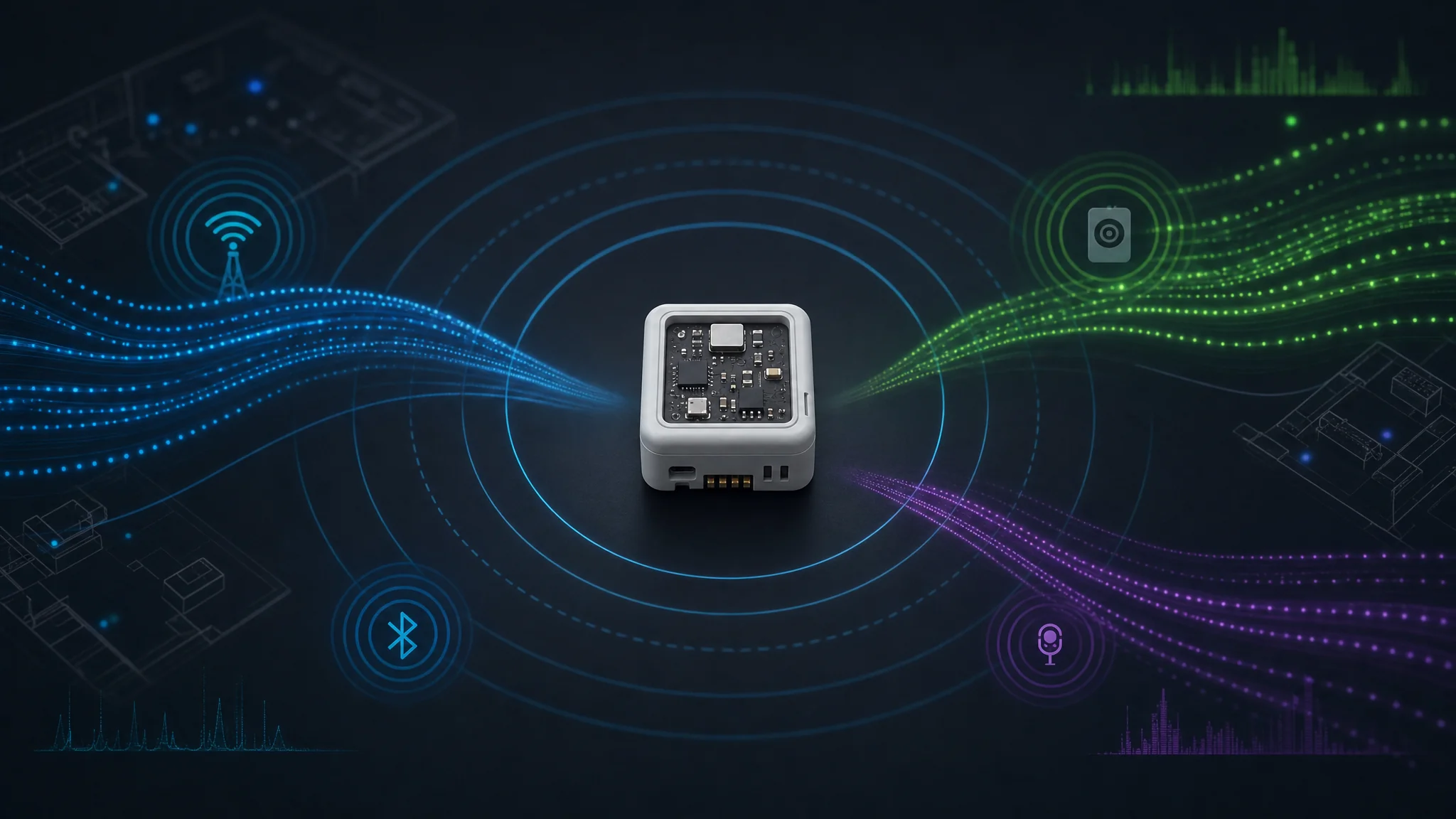
5 GHz WiFi: The ESP32 is a 2.4 GHz-only device. Any surveillance camera, ALPR system, or access point operating exclusively on 5 GHz bands won’t be visible to the WiFi scan or promiscuous engines. Many modern IP cameras are 2.4 GHz capable even if they also support 5 GHz, but dedicated 5 GHz-only deployments will be missed.
Encrypted BLE: Several high-end surveillance products encrypt or obfuscate their BLE advertisements. Eye Spy detects devices that broadcast identifiable signatures - OUIs, service UUIDs, manufacturer data - in plaintext. Devices that rotate MAC addresses (a privacy feature increasingly common in consumer trackers) will evade MAC-based detection and may only be caught by the persistence tracker if they rotate on a schedule slower than 5 minutes.
Wired cameras: IP cameras connected via Ethernet and not running a WiFi radio will produce no wireless emissions for Eye Spy to detect. Hidden cameras without network connectivity (purely local recording) similarly produce no RF signature.
Range limitations: The ESP32 antenna has practical indoor receive range of 20–40 meters for strong signals, less for weak or obscured signals. Devices at the edge of range or behind significant RF shielding may score zero or fail the −90 dBm RSSI threshold filter.
False Positives to Expect
Consumer cameras at neighbors’ homes: Ring, Nest, Wyze, Arlo, and Reolink cameras are ubiquitous in residential neighborhoods. Their OUIs appear in the 31-entry camera table. In residential environments, expect some yellow (Caution, +3) hits from neighbors’ doorbell cameras. These aren’t false positives in the technical sense - the device is detecting a camera - but context matters.
Retail iBeacon deployments: Major retailers deploy iBeacon infrastructure in virtually every store. Any detection trip to a mall or grocery store will likely trigger the iBeacon detection (+2). Again, the device is doing its job - the retail tracking infrastructure really is there.
Ubiquiti UniFi infrastructure: UniFi access points appear in the surveillance camera OUI table because Ubiquiti manufactures both networking and security camera products under overlapping OUI ranges. A deployment that uses UniFi networking gear will score +3 on OUI matches from the WiFi scan engine.
Samsung SmartTag vs. consumer devices: The SmartTag UUID (0xFD5A) is a Samsung-registered service. Samsung SmartTags are consumer product trackers with legitimate personal use. Any Samsung SmartTag owner in vicinity will trigger this detection.
What Each Score Level Actually Means in Practice
| Score | Likely Real-World Situation |
|---|---|
| 6–10 (🔴) | Credible high-confidence detection: Axon camera within ~30m, Flock Safety camera with matching OUI, confirmed AirTag following pattern, or drone broadcasting Remote ID |
| 3–5 (🟡) | Multiple consumer trackers, neighbor cameras accumulating, possible Flock camera, or a single OpenDroneID detection |
| 0–2 (🟢) | No significant surveillance signatures detected; normal consumer device chatter present but scored below threshold |
Comparison to Related Projects
Eye Spy targets physical surveillance in the environment; the ESP32 WiFi Canary targets network-layer WiFi attacks against your own devices. They are complementary tools addressing different threat models.
| Capability | Eye Spy | ESP32 WiFi Canary |
|---|---|---|
| AirTag / tracker detection | ✅ | ❌ |
| ALPR / Flock camera detection | ✅ | ❌ |
| Body camera detection | ✅ | ❌ |
| Drone (Remote ID) detection | ✅ | ❌ |
| Evil-twin AP detection | ❌ | ✅ |
| Deauth attack detection | ❌ | ✅ |
| Security downgrade detection | ❌ | ✅ |
| Baseline learning | ❌ | ✅ |
| Passive BLE | ✅ | ❌ |
| Same hardware platform | ✅ | ✅ |
Both projects run on the same M5Stack Atom Lite hardware using the same LED indicators and PlatformIO build system. For a comprehensive physical + network surveillance awareness kit, both can be flashed to different Atom Lite units and carried simultaneously.
Eye Spy also complements the Flock You detection project for users specifically concerned about ALPR surveillance infrastructure.
Use Cases
Counter-Surveillance Awareness
The primary audience for Eye Spy is anyone who wants ambient awareness of surveillance infrastructure in their immediate vicinity. Walking through a neighborhood, driving past a traffic intersection, or attending a public event - Eye Spy provides a real-time signal that collapses complex RF analysis into a single LED state.
AirTag Stalking Detection
AirTag-based stalking is a documented problem. Eye Spy’s follower detection engine (unknown persistent BLE MAC seen ≥3× over ≥5 minutes) specifically addresses modified or custom trackers that don’t match Apple’s known advertisement format. Combined with the direct AirTag detection, it provides two independent paths to catching a tracker that’s following you.
Rental Property / Hotel Room Inspection
Entering a new hotel room or rental property with Eye Spy running gives a first-pass indication of unexpected BLE and WiFi-broadcasting devices. A camera keyword SSID match or surveillance OUI in the WiFi scan engine adds Caution-level points. This isn’t a substitute for a proper RF sweep, but it adds a passive ambient layer to any physical inspection.
ALPR Deployments / Privacy Research
For researchers documenting surveillance infrastructure, journalists working in surveilled environments, or privacy advocates mapping ALPR deployments, Eye Spy provides field-portable detection hardware at minimal cost. The serial output provides a log of every detection with RSSI, making it suitable for use as a simple data collection device.
Travel Security
Like the WiFi Canary, Eye Spy is designed for travel form factor. The Atom Lite fits in any pocket or attaches to a bag. During travel through airports, train stations, or public events with known surveillance density, it provides continuous passive monitoring without requiring any interaction.
Architecture Notes
Why Passive BLE Matters
The choice of passive BLE scanning (no scan request packets) has meaningful security consequences. In standard BLE scanning, a scanner transmits a SCAN_REQ packet requesting additional advertising data from each advertiser. This means active BLE scanning is mutually observable - the device being scanned sees the scanner’s address in the scan request.
NimBLE passive mode listens only to undirected advertising packets (ADV_IND, ADV_NONCONN_IND, ADV_SCAN_IND) without ever transmitting a SCAN_REQ. The eye-spy device produces zero BLE transmission during the scan phase. An Axon body camera, Flock device, or AirTag being detected can’t observe or react to the scanner’s presence.
The Persistence Tracker Design
The unknown-device persistence tracker maintains a table of up to 50 BLE MAC addresses with first-seen and last-seen timestamps. Detection fires when a MAC has been seen three or more times across a window of five or more minutes.
The 50-entry limit and 30-minute purge window are engineering choices that balance detection sensitivity against RAM constraints on the ESP32. In a dense BLE environment (transit, conference, mall), the table may fill quickly with consumer devices. The −90 dBm RSSI threshold reduces this by filtering out distant devices, keeping the tracker focused on nearby persistent sources.
Score Decay and Cooldown Interaction
The 120-second re-score cooldown prevents a device that permanently stays in range from continuously stacking points every 9-second BLE cycle. Without the cooldown, a single Flock camera would add +5 every 15 seconds, reaching hundreds of points in minutes.
The 60-second score decay means that once a device leaves range (and its cooldown expires without re-triggering), the score drops by 1 per minute. A single +5 detection that doesn’t re-trigger will decay to zero in 5 minutes. This gives the device a natural “all clear” time that matches plausible transit scenarios.
Contributing and Project Status
Eye Spy is available at github.com/simeononsecurity/eye-spy under the Apache-2.0 license.
Potential areas for extension include:
- Additional OUI entries: The Flock Safety and camera OUI tables can be extended as new hardware MACs are documented in the field
- Additional BLE service UUIDs: New Smart Glasses, cameras, or trackers entering the market introduce new UUIDs
- Persistence tracker tuning: The 50-entry limit, 3-sighting threshold, and 5-minute window are adjustable constants
- Serial data logging: The serial output format is designed for programmatic parsing - an external logger could aggregate detection events from multiple Eye Spy units
The firmware is a single main.cpp in the src/ directory, making it straightforward to read, audit, and modify.
Conclusion
Eye Spy addresses a narrow but meaningful problem: the physical surveillance environment around you is increasingly instrumented, and most of that instrumentation broadcasts detectable RF signatures. A $15 M5Stack Atom Lite running the Eye Spy firmware becomes a continuous ambient scanner that turns the complexity of BLE packet analysis and WiFi OUI lookups into a single RGB LED.
The confidence-scoring model reflects realistic threat weighting: an Axon body camera at law enforcement density scores +5 and immediately illuminates red; a retail iBeacon scores +2 and contributes to a broader awareness picture without triggering a false alarm on its own. Score decay and re-score cooldowns keep the device from crying wolf on transient or persistent low-level signals.
For counter-surveillance work, travel security, AirTag detection, or simply wanting to know whether something nearby is watching - Eye Spy is a practical, open-source, passively-operating tool that earns its place in any security practitioner’s kit.
GitHub: github.com/simeononsecurity/eye-spy

Disclosure and Affiliate Statement:
Affiliate Disclosure: We may earn a commission from links on this page. These commissions support our website and the content we provide. Rest assured, we only recommend products/services we believe in. Thank you for your trust! Click Here to Learn More
Related Posts