

Fortinet vs Cisco: Complete Network Security Comparison…
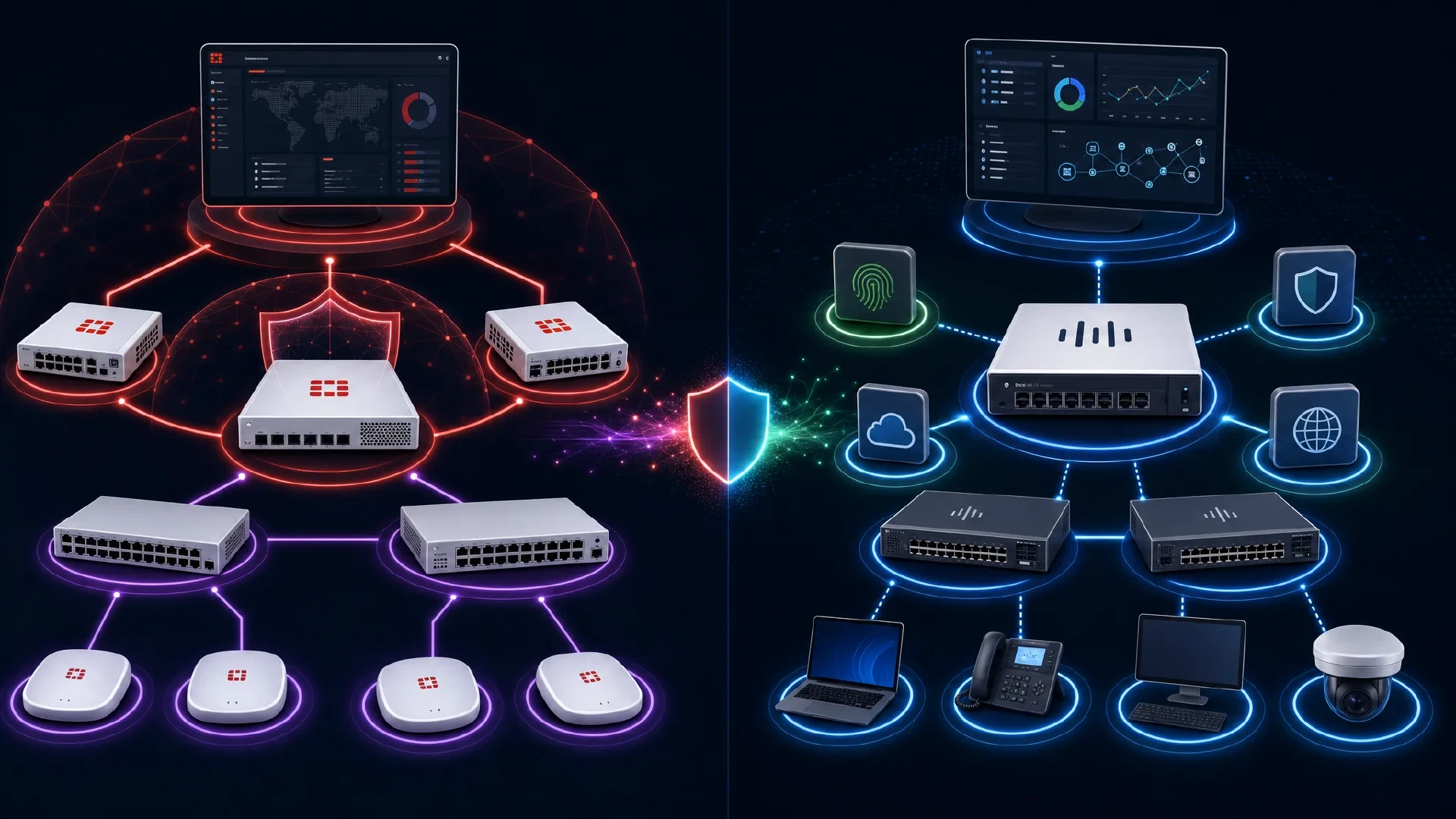
Table of Contents
Introduction: Fortinet vs Cisco Network Security Showdown
Choosing between Fortinet and Cisco network security solutions is one of the most critical infrastructure decisions enterprises face in 2026. Both vendors dominate the enterprise network security market, but they take fundamentally different approaches to security architecture, management, and pricing.
Fortinet has captured significant market share with its integrated Security Fabric approach and aggressive pricing, while Cisco maintains its reputation for enterprise-grade reliability and comprehensive ecosystem integration. According to the latest Gartner Magic Quadrant for Network Firewalls (2026), both vendors hold leadership positions, but with distinct strengths.
This comprehensive guide compares Fortinet FortiGate firewalls, FortiSwitch, and Security Fabric against Cisco ASA, Firepower NGFW, Catalyst switches, and Cisco Secure platforms. We’ll analyze performance benchmarks, pricing, features, and provide deployment recommendations based on real-world scenarios.
What You’ll Learn
- Architecture comparison between Fortinet Security Fabric and Cisco Secure ecosystem
- Performance benchmarks for firewalls, switches, and SD-WAN solutions
- Pricing analysis including licensing models and total cost of ownership
- Feature-by-feature comparison of security capabilities
- Use case recommendations for different organization sizes and requirements
- Migration considerations when switching between platforms
- 2026 updates including FortiOS 7.6 and Cisco Secure Firewall 7.4
Market Position and Vendor Background
Fortinet: The Challenger Leading Innovation
Fortinet was founded in 2000 and has grown to become the second-largest network security vendor globally by revenue. In 2026, Fortinet commands approximately 28% market share in the enterprise firewall market.
Key Fortinet Strengths:
- Purpose-built security processors (SPUs): FortiGate firewalls use custom ASICs for hardware-accelerated security
- Integrated Security Fabric: Single-pane-of-glass management across all security components
- Aggressive pricing: Typically 30-40% lower than Cisco for comparable performance
- High performance: Leads industry in firewall throughput-per-dollar metrics
- Simplified licensing: Bundled security subscriptions reduce complexity
Fortinet Product Portfolio (2026):
- FortiGate: Next-generation firewalls (60+ models from FortiGate 40F to FortiGate 3980E)
- FortiSwitch: Managed switches (40+ models integrated with Security Fabric)
- FortiAP: Wireless access points with integrated security
- FortiManager: Centralized management platform
- FortiAnalyzer: Security analytics and logging
- FortiEDR: Endpoint detection and response
- FortiSASE: Secure Access Service Edge platform
Cisco: The Enterprise Standard
Cisco Systems has dominated enterprise networking since 1984 and remains the market leader with approximately 35% market share in enterprise networking overall. While Cisco’s firewall market share (19%) trails Fortinet, their ecosystem integration remains unmatched.
Key Cisco Strengths:
- Industry-leading ecosystem: smooth integration across networking, security, and collaboration
- Enterprise support: Gold-standard TAC (Technical Assistance Center) and professional services
- Advanced routing: Superior BGP, MPLS, and routing protocol support
- Brand reputation: Default choice for Fortune 500 companies
- Comprehensive portfolio: End-to-end solutions from data center to branch
Cisco Security Product Portfolio (2026):
- Cisco Secure Firewall (Firepower): Next-generation firewalls (FPR models and ASA with FirePOWER)
- Cisco ASA: Traditional stateful firewalls (still widely deployed)
- Cisco Catalyst Switches: Enterprise switching with Security Group Tags
- Cisco SD-WAN: Viptela-based software-defined WAN
- Cisco Secure Endpoint: Advanced endpoint security
- Cisco SecureX: Integrated security platform
- Cisco Umbrella: Cloud-delivered security (DNS filtering, SWG, CASB)
Architecture Comparison
Fortinet Security Fabric Architecture
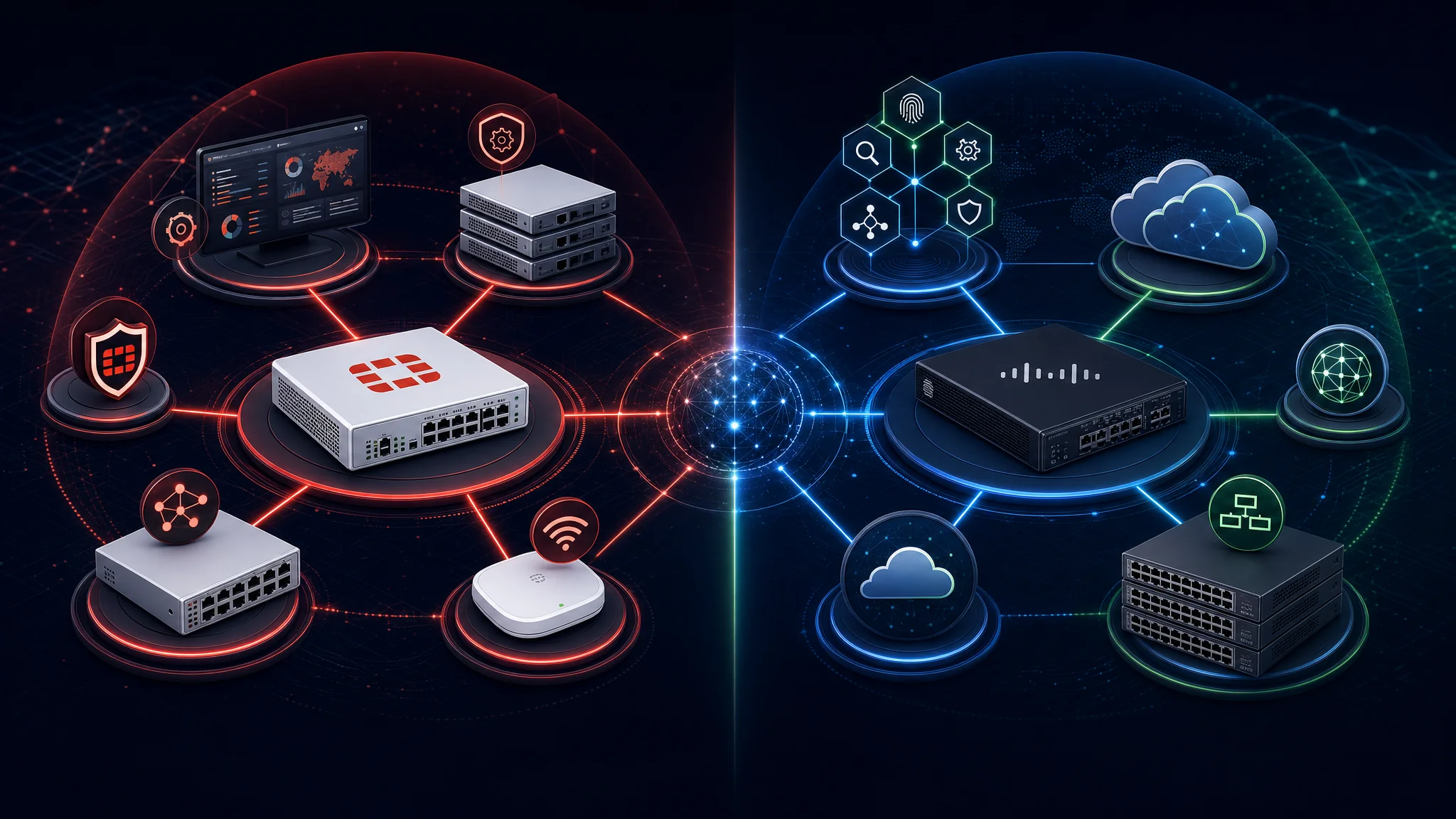
Fortinet’s Security Fabric is a comprehensive cybersecurity platform that integrates all Fortinet security products into a unified architecture. This approach provides centralized visibility, automated threat response, and coordinated security policies across the entire infrastructure.
Security Fabric Core Components:
┌─────────────────────────────────────────────────────────┐
│              FortiManager (Management)                  │
│              FortiAnalyzer (Analytics)                  │
└────────────────────┬────────────────────────────────────┘
                     │
        ┌────────────┴────────────┬─────────────┐
        │                         │             │
┌───────▼────────┐    ┌──────────▼──────┐  ┌───▼────────┐
│  FortiGate FW  │    │  FortiSwitch    │  │ FortiAP    │
│  (Perimeter)   │    │  (Network)      │  │ (Wireless) │
└───────┬────────┘    └──────────┬──────┘  └───┬────────┘
        │                        │             │
        └────────────┬───────────┴─────────────┘
                     │
            ┌────────▼─────────┐
            │   FortiClient    │
            │   (Endpoint)     │
            └──────────────────┘
Security Fabric Key Features:
- Single Fabric Connector: APIs integrate third-party tools into Security Fabric
- Automated Threat Response: FortiGate detects threat → automatically isolates infected endpoint via FortiClient
- Unified Policy: Security policies apply consistently across all fabric components
- Fabric Telemetry: Real-time security ratings and risk scores across infrastructure
- Zero-Touch Provisioning: FortiSwitch auto-discovered and configured via FortiGate
Security Fabric Advantages:
- Reduces security management complexity by 60-70% (Fortinet internal studies)
- Automated threat containment reduces incident response time from hours to minutes
- Single vendor integration eliminates compatibility issues
- Predictable licensing costs with bundled subscriptions
Security Fabric Limitations:
- Vendor lock-in: Best value achieved when using all Fortinet components
- Limited third-party integration compared to open platforms
- Fabric requires FortiManager/FortiAnalyzer for full capabilities (additional cost)
Cisco Secure Ecosystem Architecture
Cisco’s approach emphasizes best-of-breed integration across a broader ecosystem that includes networking, security, collaboration, and cloud services. Rather than requiring all Cisco components, Cisco platforms integrate extensively with third-party security tools.
Cisco Secure Architecture:
┌─────────────────────────────────────────────────────────┐
│                   Cisco SecureX                         │
│         (Unified Threat Response Platform)              │
└────────────────────┬────────────────────────────────────┘
                     │
        ┌────────────┴────────────┬─────────────┐
        │                         │             │
┌───────▼────────┐    ┌──────────▼──────┐  ┌───▼────────┐
│ Firepower NGFW │    │ Catalyst Switch │  │  Umbrella  │
│   (Firewall)   │    │   (Network)     │  │   (Cloud)  │
└───────┬────────┘    └──────────┬──────┘  └───┬────────┘
        │                        │             │
        └────────────┬───────────┴─────────────┘
                     │
        ┌────────────┴────────────┐
        │  Cisco Secure Endpoint  │
        │  Cisco Duo (MFA)        │
        │  Third-party tools      │
        └─────────────────────────┘
Cisco Secure Key Features:
- SecureX Integration Platform: Aggregates data from 300+ security vendors
- Flexible Architecture: Mix Cisco and third-party security tools as needed
- Talos Threat Intelligence: Industry-leading threat research feeds all Cisco security products
- Identity Services Engine (ISE): Advanced network access control and segmentation
- SD-Access: Software-defined campus networking with security policy automation
Cisco Secure Advantages:
- Superior third-party integration: Works with existing security investments
- Advanced network segmentation: ISE + TrustSec provide industry-leading micro-segmentation
- Proven at scale: Deployed in world’s largest enterprises and service providers
- Comprehensive routing: Best choice when advanced routing protocols required
Cisco Secure Limitations:
- Higher complexity: More components to manage and integrate
- Licensing complexity: Multiple licensing models across product portfolio
- Higher total cost: Premium pricing for Cisco brand and support
- Integration overhead: Multi-vendor ecosystems require more expertise to maintain
Firewall Performance Comparison
FortiGate vs Cisco Firepower: Key Models
| Model | Throughput (Firewall) | Throughput (IPS) | Throughput (NGFW) | Concurrent Sessions | New Sessions/sec | Price Range |
|---|---|---|---|---|---|---|
| FortiGate 100F | 20 Gbps | 2.5 Gbps | 1.2 Gbps | 500,000 | 50,000 | $2,500-$3,500 |
| FortiGate 200F | 40 Gbps | 5 Gbps | 2.5 Gbps | 1,000,000 | 100,000 | $5,000-$7,000 |
| FortiGate 600F | 80 Gbps | 10 Gbps | 6 Gbps | 10,000,000 | 350,000 | $18,000-$22,000 |
| FortiGate 1800F | 300 Gbps | 75 Gbps | 35 Gbps | 60,000,000 | 1,200,000 | $75,000-$95,000 |
| Cisco FPR1140 | 16 Gbps | 3 Gbps | 1.5 Gbps | 500,000 | 45,000 | $4,500-$6,000 |
| Cisco FPR2140 | 28 Gbps | 6 Gbps | 3 Gbps | 2,000,000 | 90,000 | $9,000-$12,000 |
| Cisco FPR4145 | 48 Gbps | 12 Gbps | 7 Gbps | 15,000,000 | 280,000 | $28,000-$35,000 |
| Cisco FPR9300 | 160 Gbps | 40 Gbps | 25 Gbps | 65,000,000 | 950,000 | $125,000-$160,000 |
Key Performance Notes:
- Throughput types: Firewall (stateful inspection), IPS (intrusion prevention), NGFW (all security features enabled)
- NGFW performance is most realistic metric for production deployments
- FortiGate typically delivers 30-40% better price/performance in NGFW mode
- Cisco models have recently improved with Snort 3 engine in Firepower 7.4 (2026)
Real-World Performance Testing (2026)
Independent testing by NSS Labs and CyberRatings.org (2026) reveals important performance characteristics:
FortiGate Performance Characteristics:
- Consistent performance: Hardware SPUs ensure security features don’t degrade throughput
- Low latency: Average 3-5ms latency even with all security features enabled
- TLS inspection efficiency: Minimal performance impact (10-15% throughput reduction)
- HTTP/3 and QUIC support: Native hardware acceleration for modern protocols
- Best throughput-per-dollar: Leads industry in this metric across all size categories
Cisco Firepower Performance Characteristics:
- Improved with Snort 3: 2026 updates reduced CPU use by 40% vs older versions
- Moderate latency: Average 6-10ms with full security stack
- TLS inspection overhead: 25-30% throughput reduction (typical for x86-based platforms)
- Advanced threat detection: Superior detection rates vs FortiGate (Talos intelligence)
- Flexible platform options: Can run on UCS servers, cloud instances, or dedicated hardware
SSL/TLS Inspection Performance
TLS inspection is critical for modern security but impacts firewall performance significantly. Here’s how both vendors compare:
| Metric | FortiGate 600F | Cisco FPR4145 | Notes |
|---|---|---|---|
| HTTPS throughput (no inspection) | 6.5 Gbps | 7.2 Gbps | Both handle modern TLS 1.3 |
| HTTPS throughput (deep inspection) | 5.5 Gbps | 5.0 Gbps | FortiASIC provides advantage |
| Certificate processing | 45,000 TPS | 35,000 TPS | Transactions per second |
| TLS 1.3 support | Full support | Full support | Both updated for modern TLS |
| Performance degradation | 15% | 30% | Impact of enabling TLS inspection |
TLS Inspection Recommendations:
- FortiGate: Enable TLS inspection without significant performance concerns on most models
- Cisco Firepower: Size appliance 50% larger than throughput requirements if TLS inspection needed
- Both vendors: Use certificate pinning exclusions for known-good applications (Office 365, etc.)
Feature Comparison: Security Capabilities
Core Security Features Matrix
| Feature Category | FortiGate | Cisco Firepower | Winner |
|---|---|---|---|
| Stateful Firewall | ✓ Full | ✓ Full | Tie |
| IPS/IDS | ✓ FortiGuard IPS | ✓ Snort 3 IPS | Cisco (detection) |
| Application Control | ✓ 6,000+ apps | ✓ 4,500+ apps | Fortinet (coverage) |
| Web Filtering | ✓ FortiGuard Web Filter | ✓ Cisco Talos Web Filter | Fortinet (performance) |
| Anti-Malware | ✓ FortiGuard AV | ✓ AMP for Networks | Cisco (advanced detection) |
| Sandboxing | ✓ FortiSandbox (add-on) | ✓ Threat Grid (included) | Cisco |
| SSL/TLS Inspection | ✓ Hardware accelerated | ✓ Software-based | Fortinet (performance) |
| VPN (IPsec) | ✓ High performance | ✓ High performance | Tie |
| VPN (SSL/TLS) | ✓ FortiClient VPN | ✓ AnyConnect | Cisco (features) |
| SD-WAN | ✓ Integrated | ✓ Viptela integration | Fortinet (integration) |
| Cloud Integration | ✓ Good (AWS, Azure, GCP) | ✓ Excellent (native APIs) | Cisco |
| Zero Trust Architecture | ✓ Via Security Fabric | ✓ Via ISE integration | Cisco (maturity) |
| Threat Intelligence | FortiGuard Labs | Cisco Talos | Cisco (breadth) |
Advanced Features detailed breakdown
SD-WAN Capabilities
Both vendors have made significant SD-WAN investments, but with different architectural approaches:
FortiGate SD-WAN (Integrated):
- Native integration: SD-WAN functionality built into FortiOS (no separate appliance needed)
- Performance routing: Application-aware path selection based on latency, jitter, packet loss
- Security integration: Apply security policies consistently across all WAN links
- Simplified deployment: Single appliance for firewall + SD-WAN reduces complexity
- Hub-and-spoke scalability: Proven deployments with 10,000+ sites
FortiGate SD-WAN Use Cases:
Branch Office Configuration:
- FortiGate 60F as branch firewall/SD-WAN device
- Dual WAN links (ISP + LTE backup)
- IPsec tunnels to headquarters FortiGate
- Application steering (VoIP → low latency, bulk data → high bandwidth)
- Cost savings: $2,500 device replaces $2,000 firewall + $3,000 SD-WAN appliance
Cisco SD-WAN (Viptela Platform):
- Purpose-built: Separate Viptela vEdge devices for optimal SD-WAN performance
- Advanced orchestration: vManage controller provides sophisticated policy management
- Multi-tenant: Service provider-grade capabilities for MSP deployments
- Cloud-first architecture: Excellent integration with AWS, Azure, GCP networking
- Flexible deployment: Virtual, physical, or cloud-hosted controllers
Cisco SD-WAN Use Cases:
Enterprise WAN Deployment:
- vEdge routers at all branch locations
- vSmart controllers in data centers (HA pair)
- vManage centralized management
- Integration with existing Catalyst switching
- Firepower firewalls at data center perimeter
- Cost: Higher but superior for complex topologies
SD-WAN Verdict:
- Fortinet wins for simple branch deployments and cost-conscious implementations
- Cisco wins for large-scale enterprise WAN replacements and service provider use cases
Network Segmentation
FortiGate Segmentation Approaches:
- VLAN-based: Traditional VLAN segmentation with inter-VLAN firewall policies
- Policy-based: FortiGate acts as internal segmentation firewall (ISFW)
- Security-driven Networking (SDN): FortiSwitch fabrics with automated policy
- Fabric automation: Security tags automatically applied across Security Fabric
Cisco Segmentation (TrustSec + ISE):
- Security Group Tags (SGT): Assign tags to users/devices via ISE, enforce at any point
- Software-Defined Access (SD-Access): Automated campus segmentation with DNA Center
- Micro-segmentation: Workload-level segmentation in data centers (ACI integration)
- Dynamic VLAN assignment: ISE assigns VLANs based on user identity/posture
Segmentation Scenario:
Requirement: Isolate guest WiFi, employee devices, IoT devices, and servers

Fortinet Approach:
- FortiGate defines security zones (guest, employee, IoT, server)
- FortiAP assigns users to VLANs based on SSID
- FortiSwitch enforces VLAN isolation
- FortiGate policies control inter-zone traffic
- Complexity: Moderate
- Cost: Lower (included in Security Fabric)

Cisco Approach:
- ISE profiles devices and assigns SGT tags
- TrustSec policies enforce SGT-based access control
- Enforcement at Catalyst switches (hardware TCAM)
- Firepower provides perimeter security
- Complexity: Higher (requires ISE deployment)
- Cost: Higher (ISE licensing + TrustSec-capable switches)
- Benefit: More granular, scales better in very large environments
Segmentation Verdict:
- Fortinet is easier to deploy and more cost-effective for SMB/mid-market
- Cisco provides superior granularity and scale for large enterprises
Management and Operations
Management Platform Comparison
| Capability | FortiManager | Cisco FMC (Firepower Management Center) |
|---|---|---|
| Management capacity | Up to 10,000 devices | Up to 1,000 devices (per FMC) |
| Deployment options | Hardware, VM, cloud | Hardware, VM, cloud |
| Interface | Web GUI (modern) | Web GUI (feature-rich) |
| Policy management | Configuration templates | Policy inheritance hierarchy |
| Reporting | Basic (FortiAnalyzer for advanced) | Integrated (comprehensive) |
| Device provisioning | Zero-touch (FortiSwitch, FortiAP) | Manual initial config required |
| API | REST API | REST API |
| Multi-tenancy | Administrative domains (ADOMs) | Multi-instance or separate FMCs |
| High availability | Active-passive clusters | Active-standby pairs |
| Typical cost | $5,000-$30,000 (VM free for <10 devices) | $8,000-$50,000 (VM licensing required) |
Day-to-Day Operations Comparison
Typical Administrative Tasks:
FortiGate Administration
Policy Creation (FortiOS CLI):
config firewall policy
    edit 10
        set name "Allow-Web-Outbound"
        set srcintf "internal"
        set dstintf "wan1"
        set srcaddr "internal-network"
        set dstaddr "all"
        set service "HTTP" "HTTPS"
        set action accept
        set schedule "always"
        set utm-status enable
        set av-profile "default"
        set webfilter-profile "default"
        set ips-sensor "default"
        set ssl-ssh-profile "certificate-inspection"
        set logtraffic all
    next
end
FortiGate Strengths:
- Consistent CLI syntax: Similar across all FortiOS versions and products
- Configuration backup: Single file contains entire device config
- Fast policy lookup: Optimized policy engine handles thousands of rules efficiently
- Integrated SD-WAN: Simple CLI commands for complex SD-WAN configurations
FortiGate Weaknesses:
- Limited granular debugging: Less detailed packet capture than Cisco
- GUI limitations: Some advanced features only accessible via CLI
- Policy optimization: No automatic policy cleanup or optimization suggestions
Cisco Firepower Administration
Policy Creation (Firepower Management Center GUI):
GUI Workflow:
1. Navigate to Policies → Access Control → [Policy Name]
2. Add Rule:
   - Name: "Allow-Web-Outbound"
   - Source Networks: internal-network
   - Destination Networks: any
   - Ports: HTTP, HTTPS
   - Action: Allow
   - Inspection: Enable IPS (balanced policy)
   - File Policy: Block malware (AMP)
   - URL Filtering: Enable (custom category list)
   - TLS/SSL: Decrypt known key, inspect
3. Deploy changes to managed devices
4. Verify deployment completion
Cisco Firepower Strengths:
- Powerful GUI: Most features accessible without CLI expertise
- Detailed logging: Comprehensive connection events and forensic data
- Advanced troubleshooting: Packet Tracer for policy simulation
- Integration with SecureX: Unified threat response across security portfolio
Cisco Firepower Weaknesses:
- Deployment latency: Policy changes require deployment process (1-5 minutes)
- FMC dependency: Firewall can’t be managed effectively without FMC
- Licensing complexity: Must track multiple license types (base, threat, malware, URL)
- Resource intensive: FMC requires substantial RAM and CPU for large deployments
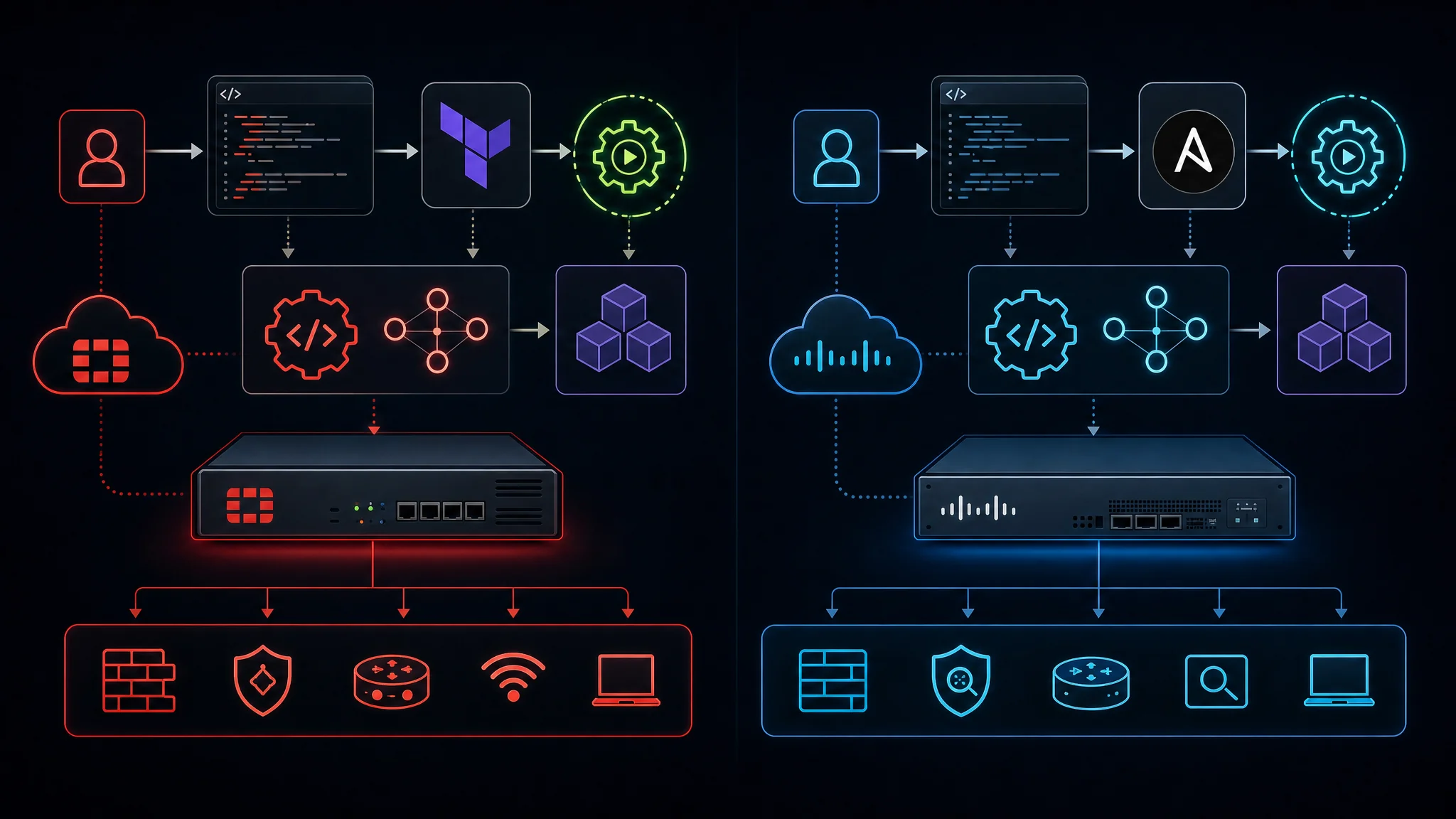
Automation and API Integration
Both platforms support modern automation, but with different maturity levels:
FortiGate Automation:
# Python example: Create firewall policy via FortiOS API
import requests
import json

fortios_api = "https://fortigate.example.com/api/v2/cmdb/firewall/policy"
api_token = "your_api_token_here"

headers = {
    "Authorization": f"Bearer {api_token}",
    "Content-Type": "application/json"
}

policy_data = {
    "name": "Allow-Web-Outbound",
    "srcintf": [{"name": "internal"}],
    "dstintf": [{"name": "wan1"}],
    "srcaddr": [{"name": "internal-network"}],
    "dstaddr": [{"name": "all"}],
    "service": [{"name": "HTTP"}, {"name": "HTTPS"}],
    "action": "accept",
    "schedule": "always",
    "utm-status": "enable"
}

response = requests.post(fortios_api, headers=headers, data=json.dumps(policy_data), verify=False)
print(f"Policy creation status: {response.status_code}")
FortiGate Automation Maturity:
- REST API coverage: 95%+ of configuration accessible via API
- Ansible modules: Official FortiOS Ansible collection (200+ modules)
- Terraform provider: Mature Fortinet provider for infrastructure-as-code
- Fabric Connectors: Pre-built integrations with AWS, Azure, GCP, ServiceNow, Splunk
- Python SDK: Official Python libraries (fortigate-api)
Cisco Firepower Automation:
# Python example: Create access control policy via FMC API
from fireREST import FMC

fmc = FMC(hostname='fmc.example.com', username='admin', password='password')
fmc.login()

# Create network object
network_obj = fmc.create_network_object(
    name='internal-network',
    value='10.0.0.0/8',
    description='Corporate internal network'
)

# Create access control rule
rule = fmc.create_access_rule(
    policy_name='Corporate-Access-Policy',
    name='Allow-Web-Outbound',
    action='ALLOW',
    source_networks=[network_obj['id']],
    destination_networks=['any'],
    destination_ports=['HTTP', 'HTTPS'],
    ips_policy='Balanced Security and Connectivity',
    file_policy='Block Malware'
)

# Deploy changes
deployment = fmc.deploy(device_list=['firewall01', 'firewall02'])
print(f"Deployment status: {deployment}")
Cisco Firepower Automation Maturity:
- FMC REST API: Comprehensive API for all management functions
- Ansible modules: Official Cisco FTD/FMC Ansible modules (60+ modules)
- Terraform provider: Community-maintained provider (moderate maturity)
- SecureX integration: Automated threat response workflows
- Python SDK: Community libraries (python-fireREST, fmcapi)
Automation Verdict:
- FortiGate has more mature infrastructure-as-code support (Terraform especially)
- Cisco provides better security orchestration integration (SOAR platforms)
Switching and Network Infrastructure
While this article focuses on security, network switching integration is critical for both vendors’ ecosystems.
FortiSwitch Integration
FortiSwitch Architecture:
- Managed by FortiGate: FortiSwitch devices discovered and configured automatically via FortiGate
- No separate controller: FortiGate acts as centralized switching controller
- Security Fabric integration: Switch telemetry feeds into Security Fabric for threat detection
- Simple licensing: No per-switch licensing (management included with FortiGate)
FortiSwitch Deployment Models:
- Standalone Mode: Traditional switch with local management
- FortiLink Mode: Managed by FortiGate (recommended for Security Fabric)
FortiSwitch Pros:
- Zero-touch provisioning: Connect switch to FortiGate, automatic configuration
- Unified security policies: VLAN and security policies configured on FortiGate
- Lower cost: FortiSwitch models 30-40% less expensive than comparable Cisco Catalyst
- Simplified operations: One management interface for firewall and switching
FortiSwitch Cons:
- Limited advanced features: Missing some enterprise switching features (VSS, StackWise Virtual)
- FortiGate dependency: Switch management limited if FortiGate unavailable
- Smaller ecosystem: Fewer third-party integrations vs Cisco switching
Cisco Catalyst Switching
Cisco Catalyst Architecture:
- Industry standard: Default choice for enterprise campus networks
- Rich feature set: Comprehensive Layer 2/3 features, QoS, multicast
- DNA Center option: Modern intent-based network management (additional cost)
- TrustSec integration: Hardware-based Security Group Tag enforcement
Cisco Catalyst Deployment Models:
- Standalone: Individual switch management
- Stacking: Up to 9 switches in resilient stack (StackWise-480)
- VSS/StackWise Virtual: Two chassis acting as single logical switch
- SD-Access Fabric: DNA Center manages fully automated campus network
Cisco Catalyst Pros:
- Proven reliability: Industry-leading uptime and stability
- Advanced routing: Full BGP, OSPF, EIGRP support on Layer 3 switches
- Massive scale: Models support 384-768 ports in single logical switch
- Mature ecosystem: Decades of operational knowledge and tooling
Cisco Catalyst Cons:
- Higher cost: Premium pricing (2-3x FortiSwitch for similar port count)
- Complex licensing: DNA licensing, network stack features, security features separate
- Separate management: Different interface from security management (unless DNA Center)
Switching Integration Comparison:
| Factor | FortiSwitch + FortiGate | Catalyst + Firepower |
|---|---|---|
| Management complexity | Single interface (FortiGate) | Separate interfaces (or DNA Center) |
| Initial configuration time | 15 minutes (auto-discovery) | 2-4 hours (manual config) |
| Security policy consistency | Enforced by FortiGate | Requires ISE for dynamic policies |
| Total cost (48-port switch) | $2,000-$3,500 | $5,000-$12,000 |
| Best use case | SMB, branch offices | Large enterprise campuses |
Pricing and Licensing Comparison
FortiGate Pricing Model (2026)
Hardware Appliance Costs:
| Model | MSRP | Typical Street Price | Performance (NGFW) |
|---|---|---|---|
| FortiGate 60F | $1,200 | $800-$1,000 | 500 Mbps |
| FortiGate 100F | $3,500 | $2,500-$3,000 | 1.2 Gbps |
| FortiGate 200F | $7,000 | $5,000-$6,000 | 2.5 Gbps |
| FortiGate 400F | $13,000 | $9,000-$11,000 | 4 Gbps |
| FortiGate 600F | $25,000 | $18,000-$22,000 | 6 Gbps |
| FortiGate 1800F | $110,000 | $75,000-$90,000 | 35 Gbps |
FortiGuard Security Subscription Bundles (Annual):
- UTM Bundle: AV, Web Filtering, IPS, Application Control (~25% of hardware cost/year)
- Enterprise Bundle: UTM + Advanced Malware Protection + Security Rating (~35% of hardware cost/year)
- UTP Bundle: Enterprise + FortiSandbox Cloud (~40% of hardware cost/year)
- ATP Bundle: Enterprise + FortiSandbox + FortiClient EMS (~50% of hardware cost/year)
Example FortiGate Total Cost (3-Year):
FortiGate 600F Deployment:
- Hardware: $20,000 (one-time)
- Enterprise Bundle: $7,000/year × 3 years = $21,000
- FortiCare Premium Support: $2,000/year × 3 years = $6,000
- Total 3-year cost: $47,000
- Effective annual cost: $15,667/year
FortiGate Licensing Pros:
- Bundled subscriptions: Single SKU includes multiple security services
- Predictable costs: Consistent percentage of hardware cost
- No per-device endpoint licensing: FortiClient includes in ATP bundle
- Generous evaluation: 15-day full-feature trial on all new appliances
Cisco Firepower Pricing Model (2026)
Hardware Appliance Costs:
| Model | MSRP | Typical Street Price | Performance (NGFW) |
|---|---|---|---|
| FPR1140 | $7,500 | $4,500-$6,000 | 1.5 Gbps |
| FPR2140 | $15,000 | $9,000-$12,000 | 3 Gbps |
| FPR4145 | $45,000 | $28,000-$35,000 | 7 Gbps |
| FPR9300-SM-36 | $200,000 | $125,000-$160,000 | 25 Gbps |
Cisco Firepower Subscription Licensing (Per Appliance, Annual):
- Threat License: IPS, URL filtering, Security Intelligence (~$1,500-$8,000/year depending on model)
- Malware License: AMP for Networks, file analysis (~$1,000-$6,000/year)
- URL Filtering License: Category-based web filtering (~$500-$3,000/year)
- Cisco Plus Secure (bundled): All security features + DNA integration (~40-50% of hardware cost/year)
Example Cisco Firepower Total Cost (3-Year):
Cisco FPR4145 Deployment:
- Hardware: $32,000 (one-time)
- Cisco Plus Secure Bundle: $15,000/year × 3 years = $45,000
- FMC hardware/VM: $12,000 (one-time) or $2,000/year (VM subscription)
- Cisco SmartNet Support: $4,000/year × 3 years = $12,000
- Total 3-year cost: $101,000
- Effective annual cost: $33,667/year
Cisco Firepower Licensing Cons:
- A-la-carte complexity: Must track multiple separate license types
- FMC costs additional: Management platform requires separate purchase/subscription
- Smart Licensing: Requires internet connectivity or Smart Software Manager satellite
- Higher support costs: SmartNet typically 12-15% of hardware cost annually
Total Cost of Ownership (TCO) Comparison
Real-World TCO Scenario: Mid-Size Enterprise (500 employees)
Requirements:
- 5 Gbps firewall throughput (with all security features)
- Centralized management for 3 locations
- 5-year deployment lifecycle
- High availability (active-passive cluster)
Fortinet Solution TCO:
Hardware:
- 2× FortiGate 600F (HA pair): $40,000
- FortiManager VM (free for <10 devices): $0
- FortiAnalyzer 1000E: $8,000

Subscriptions (5 years):
- Enterprise Bundle licenses: $7,000/year × 2 firewalls × 5 years = $70,000
- FortiCare Premium Support: $2,000/year × 2 firewalls × 5 years = $20,000
- FortiAnalyzer log storage: $1,000/year × 5 years = $5,000

Professional Services:
- Initial deployment and training: $10,000

Total 5-year TCO: $153,000
Average annual cost: $30,600
Cisco Solution TCO:
Hardware:
- 2× Cisco FPR4145 (HA pair): $64,000
- Firepower Management Center 2500: $25,000

Subscriptions (5 years):
- Cisco Plus Secure (all licenses): $15,000/year × 2 firewalls × 5 years = $150,000
- SmartNet 8×5×NBD: $4,000/year × 2 firewalls × 5 years = $40,000
- FMC support: $2,500/year × 5 years = $12,500

Professional Services:
- Initial deployment and training: $20,000

Total 5-year TCO: $311,500
Average annual cost: $62,300
TCO Analysis:
- Cisco solution costs 103% more than Fortinet over 5 years ($158,500 difference)
- Cisco premium primarily in hardware costs (50% higher) and support (100% higher)
- Both solutions meet technical requirements (6 Gbps FortiGate vs 7 Gbps Firepower)
When Cisco’s Higher Cost is Justified:
- Existing Cisco campus network with ISE and TrustSec
- Requirement for advanced routing protocols (full BGP table, MPLS integration)
- Enterprise mandate for Cisco TAC support level
- Complex multi-tenant or service provider deployment
Use Case Recommendations
Small Business (10-100 Employees)
Scenario: Single office, basic security requirements, limited IT staff, budget-conscious
Recommended Solution: Fortinet
Rationale:
- Lower upfront cost: FortiGate 60F or 100F provides adequate performance at $1,000-$3,000
- Simpler management: Single-pane-of-glass Security Fabric reduces complexity
- All-in-one: Firewall, VPN, SD-WAN, and wireless controller in one device
- Predictable licensing: Bundled subscriptions easier to budget
Sample Configuration:
Equipment:
- 1× FortiGate 100F: $2,500
- 2× FortiSwitch 124F (48-port): $2,000 each
- 3× FortiAP 431F (WiFi 6): $600 each
- Enterprise Bundle subscription: $900/year
- FortiCare 8×5 Support: $300/year

Total first-year cost: $9,100
Annual renewal: $1,200
Mid-Size Enterprise (100-1,000 Employees)
Scenario: Multiple offices, compliance requirements (PCI-DSS, HIPAA), internal IT team, need for advanced features
Recommended Solution: Depends on Network Infrastructure
Choose Fortinet if:
- No existing Cisco campus network
- Branch offices need integrated SD-WAN
- Budget constraints (30-40% cost savings vs Cisco)
- IT team comfortable with unified security management
Choose Cisco if:
- Existing Cisco campus network with Catalyst switches
- ISE already deployed for network access control
- Advanced segmentation requirements (TrustSec/SGT)
- Compliance mandate for vendor support SLAs
Sample Configuration (Fortinet):
Headquarters:
- 2× FortiGate 600F (HA cluster): $40,000
- FortiManager 400E: $12,000
- FortiAnalyzer 1000E: $8,000

Branch Offices (5 locations):
- 5× FortiGate 100F: $12,500
- 10× FortiSwitch 124F: $20,000

Subscriptions (annual):
- Enterprise Bundle: $24,000
- FortiCare Premium Support: $8,000

Total first-year cost: $124,500
Annual renewal: $32,000
Sample Configuration (Cisco):
Headquarters:
- 2× Cisco FPR4145 (HA cluster): $64,000
- Cisco FMC 2500: $25,000
- Cisco ISE 3615 (2-node): $45,000

Branch Offices (5 locations):
- 5× Cisco FPR2140: $45,000
- 10× Catalyst 9200-48P: $80,000

Subscriptions (annual):
- Cisco Plus Secure licenses: $90,000
- SmartNet support: $30,000
- ISE Plus licenses: $15,000

Total first-year cost: $394,000
Annual renewal: $135,000
Cost Difference: Cisco solution costs 216% more ($269,500 first year, $103,000 annually)
Large Enterprise (1,000-10,000 Employees)
Scenario: Global operations, data center infrastructure, complex compliance, dedicated security team
Recommended Solution: Cisco (with considerations)
Rationale for Cisco:
- Proven at scale: Cisco TAC support critical for 24×7 operations
- Advanced integration: SecureX, ISE, ACI, SD-WAN work together smoothly
- Data center features: Integration with Nexus, ACI, Tetration for workload security
- Consulting support: Cisco Advanced Services for architecture and optimization
- Audit requirements: Many compliance frameworks expect Cisco infrastructure
However, Consider Hybrid Approach:
Data Center / Headquarters: Cisco
- Cisco Firepower 9300 series (high performance)
- Cisco ISE for network access control
- Integration with existing Cisco data center

Branch Offices: Fortinet
- FortiGate appliances for cost-effective branch security
- Integrated SD-WAN to headquarters
- Managed via FortiManager (centralized)

Savings: 40-50% reduction in branch office costs while maintaining Cisco core
Service Provider / MSP
Scenario: Multi-tenant environment, automation requirements, API integration critical
Recommended Solution: Fortinet for most MSPs, Cisco for specialized cases
Fortinet for MSPs:
- Administrative Domains (ADOMs): FortiManager supports true multi-tenancy
- Flexible licensing: Per-device licensing allows pay-as-you-grow
- API maturity: Excellent Terraform/Ansible support for automation
- Profit margins: Lower cost allows better margins on managed services
Cisco for Service Providers:
- Viptela SD-WAN: Purpose-built for service provider scale and multi-tenancy
- Multi-instance FMC: Separate FMC per customer or shared with tenancy
- Brand recognition: Enterprise customers often request Cisco by name
- Professional services: Cisco partner programs provide deal registration and margins
Migration Considerations
Migrating from Cisco to Fortinet
Common Migration Drivers:
- Cost reduction: 40-60% TCO savings over 5 years
- Simplified management: Security Fabric reduces operational overhead
- SD-WAN integration: Need integrated SD-WAN without separate appliances
Migration Challenges:
Configuration Translation:
- No automated Cisco → FortiOS conversion tool
- Policy logic must be manually recreated
- VPN configurations require reconfiguration (especially site-to-site IPsec)
Staff Training:
- FortiOS CLI syntax differs significantly from Cisco IOS
- Security Fabric concepts require major change
- Budget 2-3 weeks for admin team training
Integration Points:
- Third-party tools integrated with Cisco APIs require updates
- Monitoring systems (Splunk, ELK) need new log parsers
- Network management tools require reconfiguration
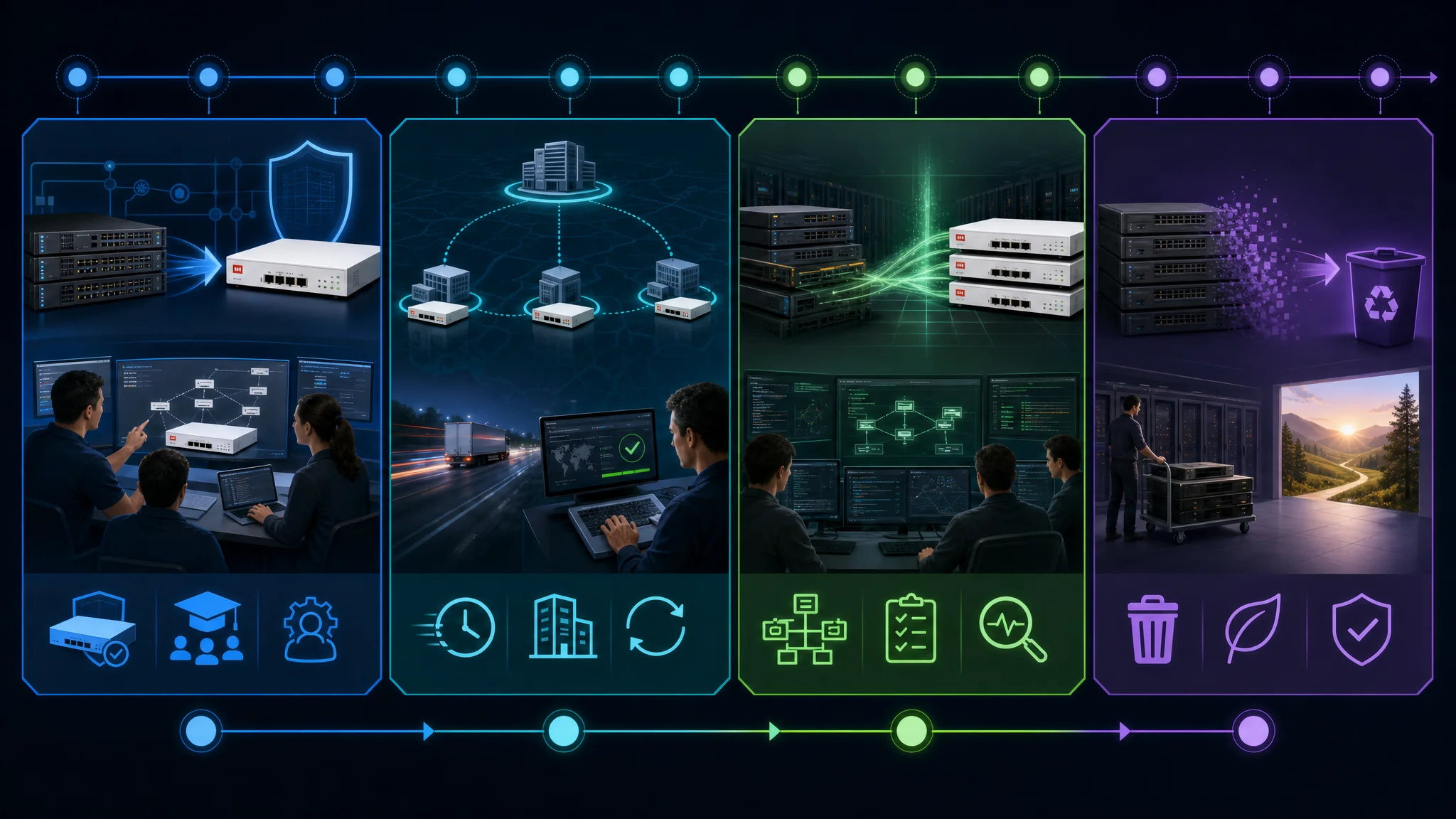
Migration Best Practices:
Phase 1: Pilot (Months 1-2)
- Deploy FortiGate in parallel at pilot site
- Replicate existing Cisco policies
- Train team on FortiGate management
- Validate performance and features

Phase 2: Branch Rollout (Months 3-6)
- Migrate branch offices first (simpler configurations)
- Use cutover windows to minimize downtime
- Keep Cisco policies documented for rollback

Phase 3: Data Center / HQ (Months 7-9)
- More complex configurations require careful planning
- Consider HA cutover to minimize downtime
- Extensive testing of all VPN connections

Phase 4: Decommission (Months 10-12)
- Remove Cisco equipment after stability period
- Return or repurpose hardware
- Cancel Cisco SmartNet subscriptions
Migrating from Fortinet to Cisco
Common Migration Drivers:
- Enterprise standardization: Corporate mandate for Cisco infrastructure
- Advanced features: Need for ISE integration or TrustSec segmentation
- Acquisition: Company acquired by larger Cisco-standardized enterprise
Migration Challenges:
Increased Complexity:
- FMC introduces additional management layer vs FortiManager simplicity
- Cisco licensing more complex (multiple SKUs vs bundled FortiGuard)
- Staff training required for FMC interface and Cisco CLI
Cost Impact:
- Hardware costs 50-100% higher for comparable performance
- Licensing and support approximately double
- Professional services often required for enterprise deployments
Feature Parity:
- Fortinet Security Fabric features don’t have direct Cisco equivalents
- May require additional Cisco products (ISE, Tetration) to match functionality
Migration Best Practices:
Phase 1: Design (Months 1-2)
- Assess current FortiGate features in use
- Design equivalent Cisco architecture
- Identify features requiring additional Cisco products (ISE, etc.)
- Validate licensing requirements with Cisco SE

Phase 2: Proof of Concept (Months 3-4)
- Deploy Cisco FMC and test firewall in lab
- Replicate critical policies and test thoroughly
- Train security team on FMC management
- Benchmark performance under realistic load

Phase 3: Phased Deployment (Months 5-12)
- Deploy Cisco firewalls at new locations first
- Cutover existing locations during maintenance windows
- Maintain FortiGate parallel for 30-60 days
- Extensive VPN and application testing

Phase 4: Optimization (Months 13-18)
- Leverage advanced Cisco features (TrustSec, etc.)
- Integrate with other Cisco products
- Optimize policies and rule bases
2026 Product Updates and Roadmap
Fortinet Updates (2026)
FortiOS 7.6 (Released Q1 2026):
- HTTP/3 and QUIC hardware acceleration: Native support for modern web protocols
- Enhanced AI/ML threat detection: FortiGuard AI engine identifies zero-day threats
- Improved SD-WAN: SLA templating for simplified multi-site deployments
- Kubernetes integration: Native security for containerized applications
- 5G integration: FortiExtender 5G WAN failover with embedded 5G modems
Security Fabric 3.0 (Released Q2 2026):
- Extended Detection and Response (XDR): Unified threats across network, endpoint, cloud
- Automated incident response: FortiSOAR Playbooks execute automatically on threats
- Improved telemetry: Real-time risk scoring for all devices and users
- Cloud-native security: Unified policies for on-prem and cloud workloads
Upcoming FortiGate Hardware (2026-2027):
- FortiGate 7000 series: New flagship platform (400 Gbps+ throughput)
- FortiGate Rugged series: Industrial and IoT-focused appliances
- FortiGate 5G series: Integrated 5G connectivity for mobile deployments
Cisco Updates (2026)
Cisco Secure Firewall 7.4 (Released Q1 2026):
- Snort 3 performance improvements: 40% reduction in CPU use vs Snort 2
- Enhanced cloud integration: Native AWS Gateway Load Balancer support
- Improved TLS 1.3 visibility: Better encrypted traffic analytics
- Adaptive policy recommendations: AI-suggested policy optimizations
- Multi-cloud management: Unified policies for AWS, Azure, GCP deployments
SecureX Platform Updates (Q3 2026):
- Expanded third-party integrations: 400+ security vendor integrations (up from 300)
- Enhanced automation: Low-code security orchestration workflows
- Threat hunting: Built-in threat hunting tools with Talos intelligence
- Compliance dashboards: Pre-built dashboards for PCI-DSS, HIPAA, NIST
Upcoming Cisco Firewall Hardware (2026-2027):
- Firepower 10000 series: Next-generation flagship (500 Gbps+ throughput)
- Firepower Embedded Services: Security modules for next-gen ISR routers
- Firepower Virtual improvements: Better performance on Azure and AWS
Competitive Analysis: Who’s Winning?
Market Share Trends (2024-2026):
- Fortinet: Growing market share (24% → 28%), especially in mid-market
- Cisco: Declining slightly (21% → 19% firewall market), but growing in SD-WAN
- Drivers: Fortinet’s aggressive pricing and SD-WAN integration winning deployments
Technology Leadership:
- Performance: Fortinet maintains throughput-per-dollar lead with SPU processors
- Threat intelligence: Cisco Talos still considered industry gold standard
- Innovation: Fortinet releasing major features faster (6-month vs 12-month cycles)
- Cloud integration: Cisco ahead in native cloud API integrations
Customer Satisfaction (Gartner Peer Insights, 2026):
- Fortinet: 4.5/5.0 stars (emphasis on value and performance)
- Cisco: 4.2/5.0 stars (emphasis on support and ecosystem)
Decision Framework: Choosing Your Solution
Decision Tree
┌─────────────────────────────────────────────────────────┐
│  Do you have existing Cisco campus network (ISE)?      │
└───────────────┬─────────────────────────────────────────┘
                │
        ┌───────┴───────┐
       YES             NO
        │               │
        │               │
        v               v
┌──────────────┐  ┌─────────────────┐
│ Need TrustSec │  │ Need integrated │
│ micro-seg?    │  │ SD-WAN?         │
└───┬──────────┘  └────────┬────────┘
    │                      │
  ┌─┴─┐                  ┌─┴─┐
 YES NO                 YES NO
  │   │                  │   │
  v   v                  v   v
┌────┐ ┌──────┐      ┌────┐ ┌──────┐
│Cisco│ │Either│      │Fort│ │Either│
│wins │ │works │      │inet│ │works │
└────┘ └──────┘      │wins│ └──────┘
                     └────┘
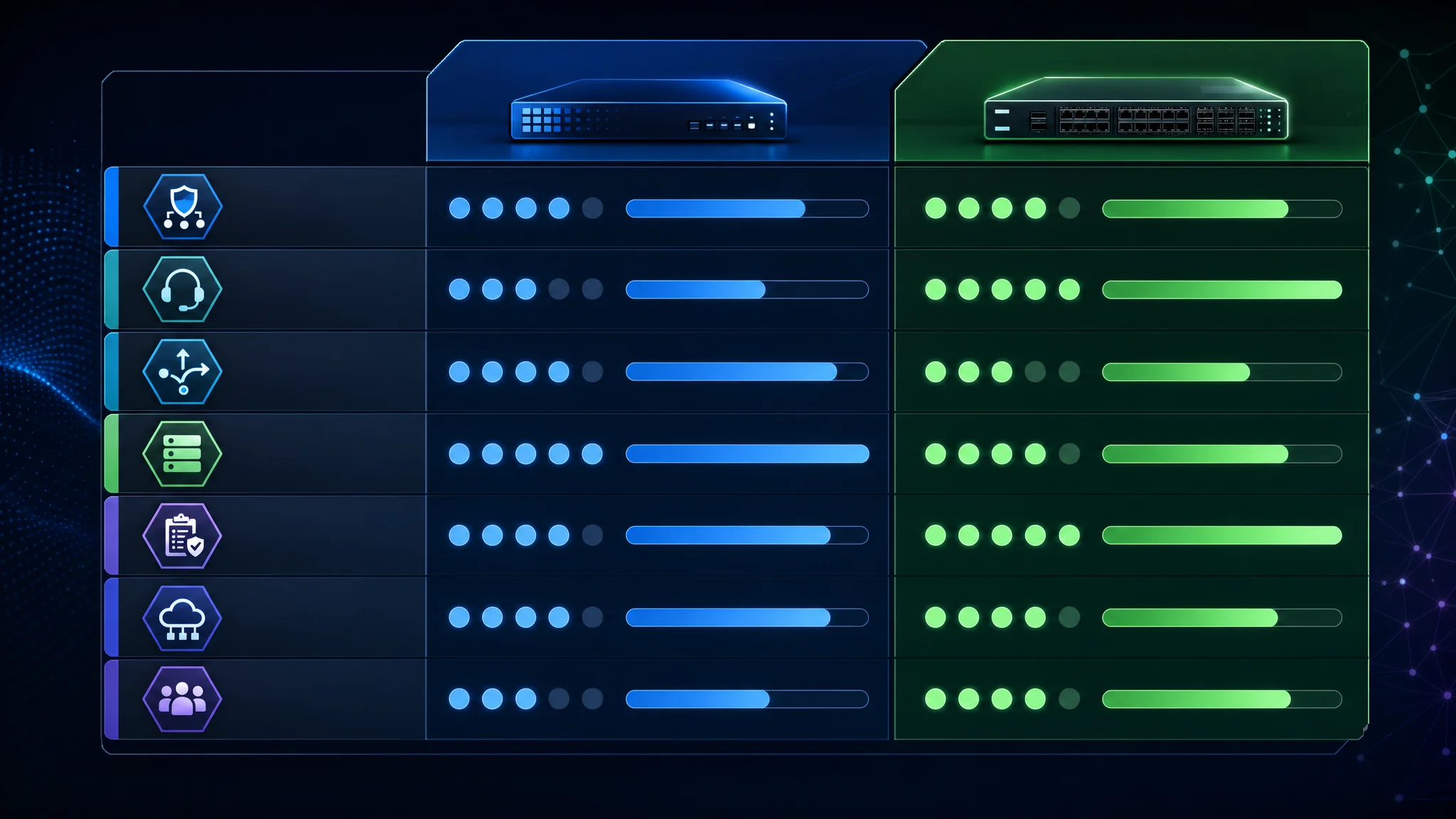
Selection Criteria Scorecard
Rate each factor from 1-5 (1=not important, 5=critical), then multiply by the vendor score:
| Criteria | Weight (1-5) | Fortinet Score | Cisco Score | Your Priority |
|---|---|---|---|---|
| Initial cost | _____ | 5 | 3 | _____ |
| TCO (5-year) | _____ | 5 | 3 | _____ |
| Performance/price | _____ | 5 | 3 | _____ |
| Raw performance | _____ | 4 | 4 | _____ |
| Management simplicity | _____ | 5 | 3 | _____ |
| Vendor ecosystem | _____ | 3 | 5 | _____ |
| Third-party integration | _____ | 3 | 5 | _____ |
| Advanced routing | _____ | 3 | 5 | _____ |
| Support quality | _____ | 4 | 5 | _____ |
| SD-WAN integration | _____ | 5 | 4 | _____ |
| Threat intelligence | _____ | 4 | 5 | _____ |
| Automation maturity | _____ | 4 | 4 | _____ |
| Cloud integration | _____ | 4 | 5 | _____ |
Scoring Instructions:
- Fill in your priority weight for each criteria (1-5)
- Multiply weight × vendor score for each row
- Sum the totals for Fortinet and Cisco
- Higher total score indicates better fit for your needs
Final Recommendations by Scenario
Choose Fortinet When:
- ✅ Budget constraints are significant (40-60% cost savings)
- ✅ Need integrated SD-WAN without separate appliances
- ✅ Simplified management is priority (small IT team)
- ✅ Deploying primarily branch offices
- ✅ No existing Cisco campus network investment
- ✅ Performance-per-dollar is key metric
- ✅ Infrastructure-as-code is critical (better Terraform support)
Choose Cisco When:
- ✅ Existing Cisco campus network with ISE deployed
- ✅ Need advanced segmentation (TrustSec/SGT requirements)
- ✅ Enterprise mandates premium vendor support (Cisco TAC)
- ✅ Complex routing requirements (full BGP tables, MPLS)
- ✅ Large-scale data center deployments (ACI integration)
- ✅ Compliance requires specific vendor certifications
- ✅ Cloud-native deployments (best AWS/Azure API integration)
- ✅ Multi-tenant service provider architecture
Consider Hybrid Approach When:
- ✅ Large enterprise with both data center and branch offices
- ✅ Need Cisco quality at headquarters, cost savings at branches
- ✅ Transitioning from one vendor to another (phased migration)
- ✅ Different security requirements for different sites
Conclusion
Both Fortinet and Cisco offer world-class network security solutions, but they excel in different scenarios:
Fortinet FortiGate delivers exceptional value, performance-per-dollar, and simplified management through the Security Fabric architecture. The integrated approach works brilliantly for organizations wanting unified security management without complexity. FortiGate is the clear winner for SMBs, branch office deployments, and budget-conscious enterprises needing modern security features without premium pricing.
Cisco Secure Firewall (Firepower) provides enterprise-grade reliability, comprehensive ecosystem integration, and advanced features that large enterprises require. The premium pricing is justified when you need ISE integration, TrustSec micro-segmentation, world-class support, or complex routing capabilities. Cisco remains the standard for large enterprises, data centers, and organizations with existing Cisco infrastructure investments.
The 60-80% TCO premium for Cisco solutions is significant and often difficult to justify unless you specifically need Cisco’s advanced capabilities or ecosystem integration. However, for organizations where those features matter, Cisco’s investment pays dividends through operational efficiency and advanced security capabilities.
Our 2026 Recommendations:
- Small Business (10-100 users): Fortinet FortiGate 60F-100F (unbeatable value)
- Mid-Market (100-1,000 users): Fortinet (unless existing Cisco infrastructure mandates Cisco)
- Enterprise (1,000-10,000 users): Cisco for headquarters/data center, consider Fortinet for branches
- Large Enterprise (10,000+ users): Cisco (proven at scale, comprehensive ecosystem)
- Service Providers/MSPs: Fortinet (better multi-tenancy and margins)
main points: Don’t choose based on brand alone. Map your technical requirements, budget constraints, and existing infrastructure to the decision framework above. Many organizations successfully deploy hybrid architectures, using Cisco where its strengths matter most and Fortinet where cost efficiency is paramount.
References
- Fortinet Official Website
- Cisco Security Official Website
- Gartner Magic Quadrant for Network Firewalls 2026
- FortiOS 7.6 Release Notes
- Cisco Secure Firewall 7.4 Documentation
- NSS Labs NGFW Comparative Report 2026
- Fortinet Security Fabric Architecture Guide
- Cisco SecureX Platform Overview
- Fortinet vs Cisco TCO Analysis - Forrester Research 2026
- IDC MarketScape: Worldwide Network Security Appliances 2026

Related Posts


This article refers to other articles we've written:
- pfSense vs Firewalla vs OPNsense
Comprehensive 2026 comparison of pfSense, Firewalla, and OPNsense firewall solutions for home and enterprise network security. Find the best option for your needs.
- Ubiquiti Unifi vs TP-Link Omada
Compare Ubiquiti Unifi and TP-Link Omada networking systems to choose the right one for your needs in terms of management, hardware, support, features, and pricing.
- Best WiFi Mesh Systems 2026: Buyer's Guide and Top Picks
Comprehensive 2026 guide to the best WiFi mesh systems for consumers. Detailed comparison of WiFi 6E and WiFi 7 mesh routers including Google Nest Wifi Pro 6E, Eero Max 7, Netgear Orbi, TP-Link Deco, and more. Performance tests, coverage analysis, setup guides, and buying recommendations.