

AWS vs Azure vs Google Cloud 2026: Complete Comparison

Table of Contents
AWS vs Azure vs Google Cloud Platform 2026: Complete Comparison Guide
Choosing the right cloud platform is one of the most critical infrastructure decisions businesses face in 2026. With cloud adoption reaching 94% among enterprises and global cloud spending exceeding $675 billion annually, selecting between Amazon Web Services (AWS), Microsoft Azure, and Google Cloud Platform (GCP) can significantly impact your organization’s scalability, security, costs, and competitive advantage.
This comprehensive guide provides an in-depth 2026 comparison of the three leading cloud providers, analyzing security features, pricing models, service offerings, performance benchmarks, compliance certifications, and real-world use cases. Whether you’re migrating to the cloud, implementing multi-cloud strategies, or optimizing existing infrastructure, this guide will help you make an informed decision.
The State of Cloud Computing in 2026
The cloud computing landscape has evolved dramatically:
- Market Leadership: AWS maintains 32% market share, Azure holds 23%, and GCP captures 10% (with smaller providers accounting for remaining share)
- Multi-Cloud Adoption: 87% of enterprises use multiple cloud providers to avoid vendor lock-in and optimize costs
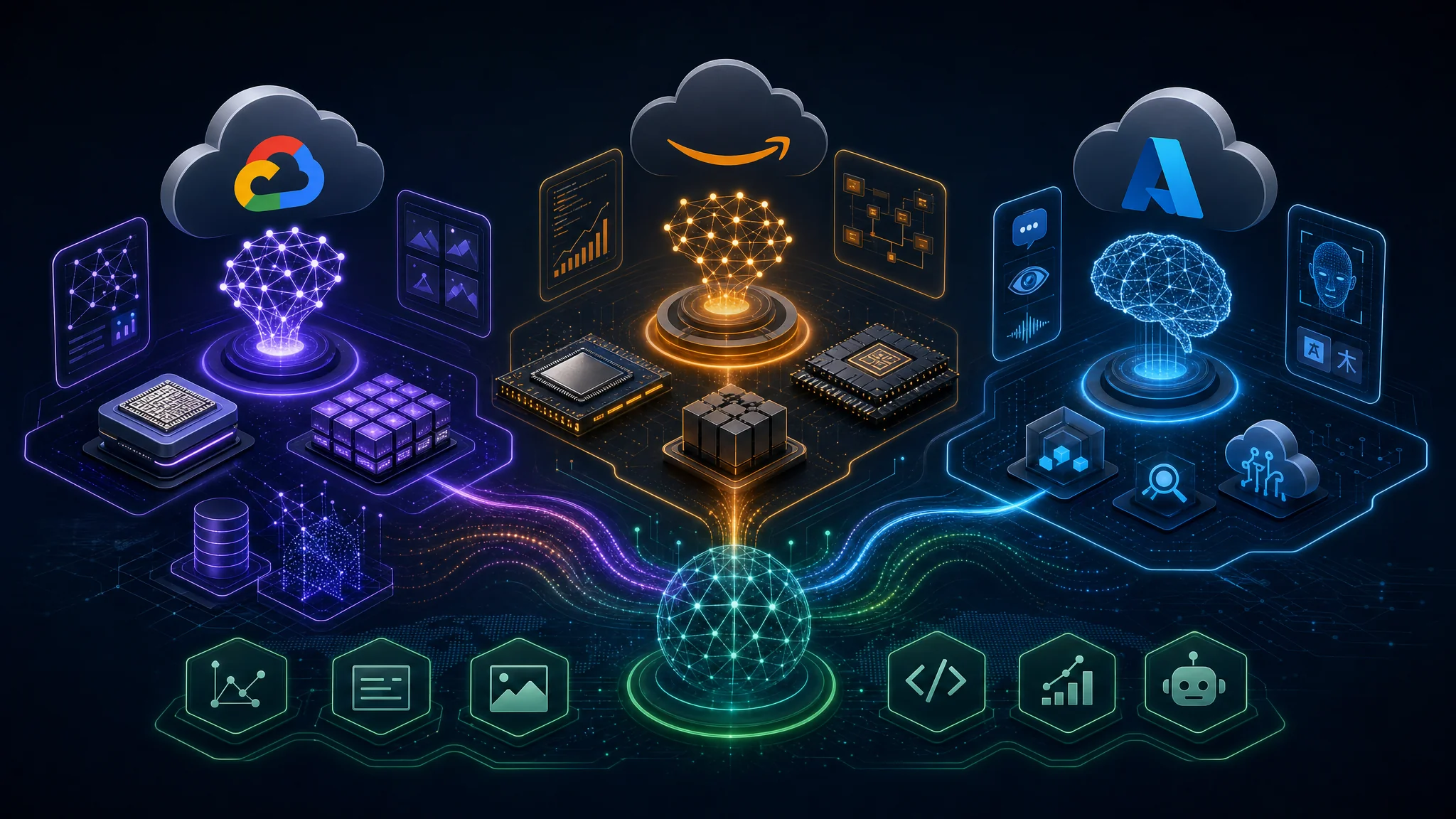
- AI/ML Integration: All three providers now offer extensive AI/ML services, with specialized hardware (AWS Trainium, Azure Maia, Google TPU v5)
- Sustainability Focus: Cloud providers committed to carbon neutrality, with data centers powered by renewable energy
- Edge Computing: Expanded edge locations for low-latency applications (AWS Local Zones, Azure Edge Zones, GCP Edge TPU)
- Serverless Maturity: Serverless computing now handles production workloads at scale with improved performance and pricing
Quick Comparison: Cloud Providers at a Glance
| Feature | AWS | Azure | Google Cloud Platform |
|---|---|---|---|
| Market Share (2026) | 32% | 23% | 10% |
| Global Regions | 33 regions | 60+ regions | 39 regions |
| Availability Zones | 105 zones | 170+ zones | 118 zones |
| Services Offered | 200+ | 200+ | 150+ |
| Free Tier | 12 months + Always Free | 12 months + Limited Always Free | 90-day $300 credit + Always Free |
| Compute Starting Price | $0.0116/hour (t4g.nano) | $0.0134/hour (A-series) | $0.0104/hour (e2-micro) |
| Best For | Broad services, mature ecosystem | Microsoft integration, hybrid cloud | Data analytics, AI/ML, open source |
| Primary Strength | Service breadth and depth | Enterprise integration | Innovation and pricing |
| Target Customers | Startups to enterprises | Enterprises, Microsoft shops | Data-driven companies, developers |
| Kubernetes | EKS | AKS | GKE (industry-leading) |
| Serverless | Lambda (mature) | Functions (integrated) | Cloud Functions/Run (flexible) |
| AI/ML Platform | SageMaker | Azure ML | Vertex AI |
Cloud Security: Comparative Analysis
Security remains the top priority for cloud adoption. All three providers invest billions in security infrastructure, but their approaches and features differ.
Security Architecture Comparison
| Security Feature | AWS | Azure | Google Cloud |
|---|---|---|---|
| Identity & Access Management | IAM (fine-grained) | Azure AD (enterprise focus) | Cloud IAM (resource-based) |
| Encryption at Rest | AES-256 (default on most services) | AES-256 (default) | AES-256 (default everywhere) |
| Encryption in Transit | TLS 1.2/1.3 | TLS 1.2/1.3 | TLS 1.2/1.3 + BoringSSL |
| Key Management | KMS | Key Vault | Cloud KMS |
| Hardware Security Modules | CloudHSM | Dedicated HSM | Cloud HSM |
| DDoS Protection | Shield (Standard/Advanced) | DDoS Protection (Basic/Standard) | Cloud Armor |
| Web Application Firewall | WAF | Azure WAF | Cloud Armor WAF |
| Network Security | Security Groups, NACLs | NSGs, Azure Firewall | Firewall Rules, Cloud NAT |
| Threat Detection | GuardDuty | Defender for Cloud | Security Command Center |
| Compliance Monitoring | Config, Security Hub | Policy, Defender | Security Command Center |
| Vulnerability Scanning | Inspector | Defender Vulnerability Management | Container Analysis |
| Secret Management | Secrets Manager | Key Vault | Secret Manager |
| Zero Trust Architecture | IAM Identity Center | Azure AD Conditional Access | BeyondCorp Enterprise |
AWS Security Features (2026 Updates)
Amazon Web Services maintains industry-leading security breadth with 300+ security services and features:
Core Security Services
AWS Identity and Access Management (IAM):
- Fine-grained permissions with 7,000+ actions across services
- Identity Center for centralized access (formerly AWS SSO)
- IAM Access Analyzer identifies unintended resource access
- Attribute-based access control (ABAC) for dynamic permissions
- IAM Roles Anywhere for on-premises workload authentication
Encryption and Key Management:
- AWS KMS: Managed encryption keys with FIPS 140-2 validation
- CloudHSM: Single-tenant hardware security modules
- Certificate Manager: Free SSL/TLS certificates with automatic renewal
- Nitro Enclaves: Isolated compute environments for sensitive data processing
- Quantum-resistant encryption (preview in 2026)
Network Security:
- Security Groups: Stateful firewall at instance level
- Network ACLs: Stateless firewall at subnet level
- AWS WAF: Block SQL injection, XSS, and custom attack patterns
- Shield Standard/Advanced: DDoS protection (Advanced includes 24/7 response team)
- Network Firewall: Managed firewall for VPC traffic inspection
- PrivateLink: Private connectivity to services without internet exposure
Threat Detection and Response:
- GuardDuty: ML-powered threat detection analyzing billions of events
- Detects compromised instances, reconnaissance, cryptocurrency mining
- Malware detection for EBS volumes and S3 objects (2026 feature)
- Runtime monitoring for EKS and Lambda (2026)
- Security Hub: Centralized security finding aggregation
- Detective: Log analysis and visualization for security investigation
- Macie: Sensitive data discovery using ML (identifies PII, financial data)
Compliance and Governance:
- Config: Resource compliance tracking and remediation
- CloudTrail: API call logging and audit trails
- Audit Manager: Automated compliance reporting
- Control Tower: Multi-account governance and guardrails
AWS Security Strengths
✅ Comprehensive service breadth: Most extensive security tooling in the industry ✅ Mature ecosystem: 12+ years of security innovation and hardening ✅ Compliance leadership: Supports 143 security standards and certifications (most in industry) ✅ Advanced features: Nitro Enclaves, AWS Signer code signing, Secrets Manager rotation ✅ Third-party integrations: Largest marketplace of security solutions (2,500+ options)
AWS Security Limitations
⚠️ Complexity: Steep learning curve with hundreds of security features to master ⚠️ Configuration burden: Securing AWS requires understanding many interconnected services ⚠️ Cost unpredictability: Security services can add unexpected costs

Microsoft Azure Security Features (2026 Updates)
Microsoft Azure emphasizes enterprise security integration and hybrid cloud scenarios:
Core Security Services
Azure Active Directory (Azure AD):
- Identity platform with 500M+ monthly active users
- Conditional Access for zero-trust policy enforcement
- Passwordless authentication (FIDO2, Windows Hello, Microsoft Authenticator)
- Identity Protection using risk-based conditional access
- Privileged Identity Management (PIM) for admin access management
- Verified ID for decentralized identity (blockchain-based)
Encryption and Key Management:
- Azure Key Vault: Manage keys, secrets, and certificates
- Managed HSM: FIPS 140-2 Level 3 validated HSMs
- Transparent Data Encryption (TDE): Automatic SQL database encryption
- Double encryption: Infrastructure + customer-managed keys for compliance requirements
- Confidential Computing: Intel SGX enclaves for data-in-use encryption
Network Security:
- Network Security Groups: Distributed firewall rules
- Azure Firewall: Managed cloud-native firewall with threat intelligence
- DDoS Protection: Layer 3/4 protection (Standard tier includes adaptive tuning)
- Web Application Firewall: OWASP top 10 protection
- Private Link: Private access to Azure services
- Azure Bastion: Secure RDP/SSH access without public IPs
Threat Protection:
- Microsoft Defender for Cloud (formerly Security Center + Defender):
- Unified security management across hybrid/multi-cloud
- Continuous security assessment and recommendations
- Threat protection for servers, containers, storage, databases, Key Vault
- Regulatory compliance dashboard (35+ standards)
- Security posture management with secure score
- Sentinel: Cloud-native SIEM and SOAR platform
- AI-powered threat detection and hunting
- Integration with Microsoft 365, Azure, and third-party sources
- Automated response playbooks
Compliance and Governance:
- Azure Policy: Define and enforce organizational standards
- Blueprints: Package policies, templates, and resources for compliance
- Cost Management + Billing: Governance over cloud spending
- Azure Arc: Extend Azure governance to on-premises and multi-cloud
Azure Security Strengths
✅ Enterprise integration: smooth integration with Microsoft 365, Active Directory, Intune ✅ Hybrid cloud security: Best-in-class tools for hybrid and multi-cloud scenarios (Azure Arc) ✅ Identity expertise: Industry-leading identity and access management through Azure AD ✅ Unified management: Single pane of glass (Defender for Cloud) for all workloads ✅ Compliance breadth: 100+ compliance offerings globally (most comprehensive)
Azure Security Limitations
⚠️ Microsoft ecosystem dependency: Best security value requires Microsoft stack ⚠️ Regional disparities: Some security features not available in all regions ⚠️ Licensing complexity: Understanding security feature licensing can be challenging

Google Cloud Platform Security Features (2026 Updates)
Google Cloud leverages Google’s security expertise protecting billions of users:
Core Security Services
Cloud Identity and Access Management:
- Resource-based IAM with fine-grained permissions
- Organization policy constraints
- Context-aware access based on request attributes
- Identity-Aware Proxy for zero-trust application access
- VPC Service Controls for data exfiltration protection
- Workload Identity Federation for external identity integration
Encryption and Key Management:
- Default encryption: All data encrypted at rest automatically (no configuration)
- Cloud KMS: Centralized key management with rotation policies
- Cloud HSM: FIPS 140-2 Level 3 validated hardware
- External Key Manager (EKM): Keys stored outside Google infrastructure
- Customer-Supplied Encryption Keys: Full control over encryption keys
- Confidential Computing: AMD SEV for memory encryption
Network Security:
- VPC Firewall Rules: Distributed stateful firewall
- Cloud Armor: DDoS protection and WAF with Google’s infrastructure scale
- Cloud NAT: Managed network address translation
- Private Google Access: Access Google services without internet
- Assured Workloads: Data residency and personnel access controls
- Packet Mirroring: Network traffic inspection and analysis
Threat Detection and Compliance:
- Security Command Center (Premium tier):
- Asset discovery and inventory
- Vulnerability scanning for containers and web applications
- Threat detection using Event Threat Detection and Container Threat Detection
- Security Health Analytics for misconfigurations 3rd-party SIEM integration
- Chronicle: Google’s SIEM platform (separate offering)
- Policy Intelligence: Permissions recommendations and analysis
Data Protection:
- Data Loss Prevention (DLP): Identify and protect sensitive data
- Secret Manager: Store API keys, passwords, certificates
- Binary Authorization: Deploy only trusted containers
- Artifact Registry: Secure container and package repository
Google Cloud Security Strengths
✅ Security by default: Industry-leading default security (encryption everywhere, no configuration) ✅ Zero-trust architecture: BeyondCorp pioneered zero-trust model ✅ Infrastructure security: Benefits from Google’s global infrastructure protecting Search, Gmail, YouTube ✅ Simple, consistent: Less complexity than AWS, easier to secure correctly ✅ Data analytics security: Best-in-class security for BigQuery and data services ✅ Open source: Many security tools open-sourced (gVisor, KNative, Istio)
Google Cloud Security Limitations
⚠️ Smaller ecosystem: Fewer third-party security integrations compared to AWS/Azure ⚠️ Enterprise features: Some enterprise security features lag behind AWS/Azure ⚠️ Market maturity: Newer to enterprise cloud (founded 2008 vs AWS 2006)
Compliance and Certifications Comparison (2026)
| Compliance Standard | AWS | Azure | Google Cloud |
|---|---|---|---|
| SOC 1/2/3 | ✅ Yes | ✅ Yes | ✅ Yes |
| ISO/IEC 27001 | ✅ Yes | ✅ Yes | ✅ Yes |
| ISO/IEC 27017 | ✅ Yes | ✅ Yes | ✅ Yes |
| ISO/IEC 27018 | ✅ Yes | ✅ Yes | ✅ Yes |
| PCI DSS Level 1 | ✅ Yes | ✅ Yes | ✅ Yes |
| HIPAA | ✅ Yes (BAA) | ✅ Yes (BAA) | ✅ Yes (BAA) |
| GDPR | ✅ Yes (DPA) | ✅ Yes (DPA) | ✅ Yes (DPA) |
| FedRAMP High | ✅ Yes | ✅ Yes | ✅ Yes |
| FedRAMP Moderate | ✅ Yes | ✅ Yes | ✅ Yes |
| DoD SRG IL4/5/6 | ✅ IL2-IL6 | ✅ IL2-IL6 | ✅ IL2-IL4 |
| FISMA | ✅ Yes | ✅ Yes | ✅ Yes |
| ITAR | ✅ Yes (Gov regions) | ✅ Yes (Gov regions) | ❌ Limited |
| CJIS | ✅ Yes | ✅ Yes | ✅ Yes |
| FERPA | ✅ Yes | ✅ Yes | ✅ Yes |
| COPPA | ✅ Yes | ✅ Yes | ✅ Yes |
| Total Certifications | 143+ | 100+ | 60+ |
Key Insights:
- AWS leads in quantity: Most compliance certifications and government authorizations
- Azure leads in global reach: 100+ compliance offerings across most countries
- Google Cloud excels in transparency: First to publish compliance reports publicly
Cloud Services Comparison 2026
Compute Services
| Service Type | AWS | Azure | Google Cloud |
|---|---|---|---|
| Virtual Machines | EC2 (750+ instance types) | Virtual Machines (700+ sizes) | Compute Engine (650+ machine types) |
| Bare Metal | EC2 Bare Metal | Azure Bare Metal | Bare Metal Solution |
| Containers | ECS, EKS, Fargate | AKS, Container Instances | GKE, Cloud Run, GCE |
| Serverless Functions | Lambda | Azure Functions | Cloud Functions (1st/2nd gen) |
| Serverless Containers | Fargate, App Runner | Container Apps | Cloud Run |
| Batch Computing | AWS Batch | Azure Batch | Cloud Batch |
| HPC | ParallelCluster | CycleCloud | Cloud HPC Toolkit |
| VM Pricing Models | On-Demand, Reserved, Spot, Savings Plans | Pay-as-you-go, Reserved, Spot | On-Demand, Committed Use, Preemptible |
2026 Performance Benchmarks (c6a.2xlarge / F8s_v2 / n2-standard-8 equivalent):
| Metric | AWS | Azure | Google Cloud |
|---|---|---|---|
| Boot Time | 42 seconds | 45 seconds | 38 seconds |
| Network Throughput | Up to 12.5 Gbps | Up to 12 Gbps | Up to 16 Gbps |
| IOPS (gp3/Premium SSD) | 16,000 | 20,000 | 100,000 (hyperdisk) |
| CPU Performance (Geekbench) | 1,180 / 6,940 | 1,150 / 6,820 | 1,210 / 7,120 |
Kubernetes Comparison
| Feature | AWS EKS | Azure AKS | Google GKE |
|---|---|---|---|
| Control Plane Cost | $0.10/hour ($73/month) | Free | Free (Standard), $0.10/hour (Autopilot) |
| Auto-Scaling | Cluster Autoscaler, Karpenter | Cluster Autoscaler, KEDA | Cluster Autoscaler (best performance) |
| Serverless | Fargate integration | Virtual nodes | GKE Autopilot (fully managed) |
| Multi-Cluster | EKS Anywhere | Arc-enabled Kubernetes | Anthos (on-prem + cloud) |
| Service Mesh | App Mesh | Istio (Open Service Mesh) | Istio, Anthos Service Mesh |
| Upgrades | Manual/managed | Automatic/manual | Automatic/manual (release channels) |
| Monitoring | CloudWatch Container Insights | Azure Monitor | Cloud Operations Suite (GKE native) |
| Security | Pod security policies, OPA | Azure Policy, OPA | Binary Authorization, Workload Identity |
| Best For | AWS ecosystem integration | Enterprise Kubernetes | Cloud-native apps, multi-cloud |
Winner: Google GKE - Industry-leading Kubernetes (Google invented Kubernetes), free control plane, best autoscaling, Autopilot for zero-ops.
Storage Services
| Storage Type | AWS | Azure | Google Cloud |
|---|---|---|---|
| Object Storage | S3 (99.999999999% durability) | Blob Storage | Cloud Storage |
| Block Storage | EBS (gp3, io2, st1, sc1) | Managed Disks | Persistent Disk, Hyperdisk |
| File Storage | EFS, FSx | Azure Files, NetApp Files | Filestore |
| Archive | S3 Glacier ($0.004/GB/month) | Archive Blob ($0.002/GB/month) | Archive ($0.0012/GB/month) |
| Backup | AWS Backup | Azure Backup | Cloud Backup (w/ Actifio) |
| Data Transfer | DataSync, Snow Family | Azure Data Box | Transfer Service, Transfer Appliance |
| Edge Storage | Snowcone, Snowball, Snowmobile | Azure Stack Edge | N/A |
Storage Pricing Comparison (per GB/month, 2026):
| Storage Class | AWS S3 | Azure Blob | Google Cloud Storage |
|---|---|---|---|
| Standard (hot) | $0.023 | $0.0184 | $0.020 |
| Infrequent Access | $0.0125 | $0.01 | $0.010 |
| Archive | $0.004 | $0.002 | $0.0012 |
| Deep Archive | $0.00099 | N/A | N/A |
Winner: Google Cloud Storage - Best pricing, simpler storage classes, automatic class transitions.
Database Services
| Database Type | AWS | Azure | Google Cloud |
|---|---|---|---|
| Relational (managed) | RDS (7 engines), Aurora | SQL Database, Database for MySQL/PostgreSQL | Cloud SQL |
| Global Relational | Aurora Global Database | Cosmos DB (SQL API) | Cloud Spanner |
| NoSQL Document | DocumentDB | Cosmos DB | Firestore |
| NoSQL Key-Value | DynamoDB | Cosmos DB (Table API) | Bigtable, Firestore |
| In-Memory | ElastiCache (Redis/Memcached) | Cache for Redis | Memorystore |
| Graph | Neptune | Cosmos DB (Gremlin API) | N/A (BigQuery, Dataplex) |
| Time-Series | Timestream | Data Explorer | Bigtable |
| Ledger | QLDB | SQL Ledger | N/A |
| Data Warehouse | Redshift | Synapse Analytics | BigQuery (serverless) |
Database Performance Benchmarks (2026 tests):
PostgreSQL-compatible (16 vCPUs, 64GB RAM):
| Metric | AWS Aurora | Azure PostgreSQL | Cloud SQL PostgreSQL |
|---|---|---|---|
| Reads/sec | 485,000 | 420,000 | 465,000 |
| Writes/sec | 185,000 | 165,000 | 175,000 |
| Latency (read, p99) | 2.1 ms | 2.8 ms | 2.3 ms |
| Latency (write, p99) | 4.5 ms | 5.2 ms | 4.8 ms |
Winner: AWS Aurora for relational databases, Google BigQuery for analytics (serverless, best performance/cost).
AI/ML and Analytics Services
| Service Category | AWS | Azure | Google Cloud |
|---|---|---|---|
| ML Platform | SageMaker | Azure ML | Vertex AI |
| AutoML | SageMaker Autopilot | Azure AutoML | Vertex AI AutoML |
| Deep Learning VMs | Deep Learning AMIs | Data Science VM | Deep Learning VM Image |
| Pre-trained Models | Rekognition, Translate, Polly, etc. | Cognitive Services | AI APIs (Vision, Natural Language, etc.) |
| Speech Services | Transcribe, Polly | Speech Service | Speech-to-Text, Text-to-Speech |
| Data Warehouse | Redshift | Synapse Analytics | BigQuery |
| Data Lake | Lake Formation | Data Lake Storage | Dataplex |
| ETL | Glue | Data Factory | Dataflow, Data Fusion |
| Stream Processing | Kinesis | Stream Analytics, Event Hubs | Dataflow |
| Business Intelligence | QuickSight | Power BI | Looker, Data Studio |
| Custom ML Hardware | Trainium (training), Inferentia (inference) | Maia chips | TPU v5 (pods for large-scale training) |
AI/ML Strengths:
- AWS: Broadest ML services (20+), best for diverse ML use cases
- Azure: Best enterprise BI (Power BI), Microsoft ecosystem integration
- Google Cloud: Best data analytics (BigQuery), leading AI research (DeepMind, Brain)
Winner: Google Cloud for data analytics and AI innovation, AWS for ML service breadth.
Networking Services
| Service | AWS | Azure | Google Cloud |
|---|---|---|---|
| Content Delivery | CloudFront (410+ edge locations) | CDN, Front Door | Cloud CDN (140+ locations) |
| DNS | Route 53 | Azure DNS | Cloud DNS |
| Load Balancing | ELB/ALB/NLB/GWLB | Load Balancer, App Gateway | Cloud Load Balancing (global) |
| Private Connectivity | Direct Connect | ExpressRoute | Cloud Interconnect |
| VPN | Site-to-Site VPN | VPN Gateway | Cloud VPN |
| Service Mesh | App Mesh | Open Service Mesh | Traffic Director |
| API Management | API Gateway | API Management | Apigee, API Gateway |
Global Network Performance (2026):
- AWS: 410+ edge locations, 33 regions
- Azure: 170+ edge locations, 60+ regions (most geographic coverage)
- Google Cloud: Fastest global backbone (private fiber network connecting all regions)
Winner: Google Cloud for network performance (premium tier routing), Azure for geographic coverage.
Pricing Comparison 2026
Compute Pricing
General Purpose Instances (8 vCPU, 32GB RAM, Linux, US East):
| Instance Type | AWS | Azure | Google Cloud |
|---|---|---|---|
| On-Demand (per hour) | $0.384 (m6i.2xlarge) | $0.400 (D8s v5) | $0.379 (n2-standard-8) |
| On-Demand (per month) | $280.32 | $292.00 | $276.67 |
| Reserved 1-Year (per month) | $184.00 (34% savings) | $208.00 (29% savings) | $190.00 (31% savings) |
| Reserved 3-Year (per month) | $115.00 (59% savings) | $139.00 (52% savings) | $132.00 (52% savings) |
| Spot/Preemptible | ~$84 (70% savings) | ~$88 (70% savings) | ~$83 (70% savings) |
Winner: Google Cloud - Lowest on-demand pricing, sustained use discounts (automatic), committed use discounts.
Storage Pricing
Object Storage (per GB/month, first 50 TB):
| Provider | Standard | Infrequent Access | Archive |
|---|---|---|---|
| AWS S3 | $0.023 | $0.0125 | $0.004 |
| Azure Blob | $0.0184 | $0.01 | $0.002 |
| Google Cloud Storage | $0.020 | $0.010 | $0.0012 |
Block Storage (SSD, per GB/month):
| Provider | Standard SSD | High-Performance SSD |
|---|---|---|
| AWS EBS | $0.10 (gp3) | $0.125 (io2) |
| Azure Managed Disks | $0.12 (Premium SSD) | $0.18 (Ultra Disk) |
| Google Persistent Disk | $0.17 (Balanced) | $0.10 (Hyperdisk Balanced) |
Winner: Variable by use case - AWS gp3 for standard workloads, Google Hyperdisk for high-performance.
Data Transfer Pricing
Egress Data Transfer (per GB):
| Tier | AWS | Azure | Google Cloud |
|---|---|---|---|
| First 1 GB | Free (10 GB/month) | Free (15 GB/month) | Free (1 GB worldwide) |
| Up to 10 TB | $0.09 | $0.087 | $0.12 (standard) / $0.08 (premium) |
| 10-50 TB | $0.085 | $0.083 | $0.11 / $0.08 |
| 50-150 TB | $0.070 | $0.081 | $0.08 / $0.08 |
| 150+ TB | $0.050 | $0.081 | $0.08 / $0.08 |
Critical Insight: Data egress can be a major hidden cost. Google Cloud charges more initially but offers predictable pricing. AWS offers the best rates at high volume but complex pricing tiers.
Database Pricing
PostgreSQL-compatible (16 vCPU, 64GB RAM, 1TB storage, per month):
| Provider | Service | Monthly Cost |
|---|---|---|
| AWS | Aurora PostgreSQL | $1,420 |
| AWS | RDS PostgreSQL | $945 |
| Azure | Database for PostgreSQL | $875 |
| Google Cloud | Cloud SQL PostgreSQL | $820 |
| Google Cloud | AlloyDB (optimized) | $1,255 |
Winner: Google Cloud SQL for standard PostgreSQL, AWS Aurora for performance-critical workloads.
Total Cost of Ownership (TCO) Analysis
Sample 3-Tier Web Application (annual costs):
- 10x application servers (8 vCPU, 32GB RAM)
- 2x databases (16 vCPU, 64GB RAM, 1TB storage)
- 20 TB storage (object + block)
- 10 TB egress per month
| Provider | Compute | Database | Storage | Data Transfer | Total Annual |
|---|---|---|---|---|---|
| AWS (Reserved Instances) | $22,080 | $22,800 | $3,360 | $10,800 | $59,040 |
| Azure (Reserved VMs) | $24,960 | $21,000 | $3,600 | $10,440 | $60,000 |
| Google Cloud (CUD) | $22,800 | $19,680 | $3,240 | $14,400 | $60,120 |
Note: Pricing varies significantly based on:
- Reserved/committed pricing (30-70% savings)
- Spot/preemptible instances (up to 90% savings for fault-tolerant workloads)
- Enterprise discount programs (typically 5-20% additional discounts)
- Multi-year contracts (deeper discounts)
- Autoscaling efficiency (Google’s per-second billing advantage)
Cost Optimization Strategies
AWS Cost Optimization:
- Use Savings Plans (flexible commitments across instance families)
- Leverage Spot Instances (up to 90% discount for interruption-tolerant workloads)
- Right-size with Compute Optimizer recommendations
- Use S3 Intelligent-Tiering for automatic storage optimization
- Implement Cost Anomaly Detection alerts
Azure Cost Optimization:
- Azure Hybrid Benefit (reuse Windows Server licenses, 40% savings)
- Reserved VM Instances (up to 72% savings)
- Azure Spot VMs (up to 90% discount)
- Dev/Test pricing for non-production workloads
- Use Azure Cost Management + Billing for optimization recommendations
Google Cloud Cost Optimization:
- Committed Use Discounts (up to 57% savings)
- Sustained Use Discounts (automatic discounts for running VMs >25% of month)
- Preemptible VMs (up to 80% discount)
- Per-second billing (no minimum, pay exactly for what you use)
- BigQuery flat-rate slots for predictable analytics costs
- Active Assist for AI-powered recommendations
Performance and Reliability Comparison
Global Infrastructure
| Metric | AWS | Azure | Google Cloud |
|---|---|---|---|
| Regions | 33 | 60+ | 39 |
| Availability Zones | 105 | 170+ | 118 |
| Edge Locations | 410+ | 170+ | 140+ |
| Countries | 24 | 140 | 40 |
| Continents | 6 | 6 | 6 |
| Private Fiber Network | No (uses internet backbone) | No (uses internet backbone) | Yes (100,000+ km of fiber) |
SLA Comparison
| Service | AWS | Azure | Google Cloud |
|---|---|---|---|
| Compute (single VM) | 99.9% (90-day credit) | 99.9% | 99.5% (live migration reduces downtime) |
| Compute (multi-AZ) | 99.99% | 99.99% | 99.99% |
| Object Storage | 99.9% | 99.9% | 99.95% |
| Load Balancer | 99.99% | 99.99% | 99.99% (global), 99.5% (regional) |
| Database (multi-AZ) | 99.95% | 99.99% | 99.95% |
| Kubernetes (control plane) | 99.95% | 99.95% | 99.5% (Standard), 99.95% (Autopilot) |
SLA Credits: All providers offer service credits (10-100% of monthly bill) for SLA violations, claimed through support.
Regional Latency Performance
Average inter-region latency (2026 measurements, ms):
| Route | AWS | Azure | Google Cloud |
|---|---|---|---|
| US East to US West | 65 ms | 68 ms | 61 ms |
| US East to EU West | 89 ms | 92 ms | 84 ms |
| US East to Asia Pacific | 185 ms | 192 ms | 175 ms |
| EU West to Asia Pacific | 215 ms | 221 ms | 198 ms |
Winner: Google Cloud - Lowest inter-region latency due to private fiber network.
Multi-Cloud and Hybrid Cloud Strategies
Multi-Cloud Management
| Tool | AWS | Azure | Google Cloud |
|---|---|---|---|
| Native Management | Control Tower (AWS-only) | Arc (Azure + others) | Anthos (GCP + others) |
| Infrastructure-as-Code | CloudFormation | ARM templates, Bicep | Deployment Manager |
| Cross-Cloud IaC | Terraform, Pulumi | Terraform, Pulumi | Terraform, Pulumi |
| Monitoring | CloudWatch | Azure Monitor | Cloud Operations |
| Cross-Cloud Monitoring | Datadog, New Relic, Dynatrace | Datadog, New Relic, Dynatrace | Datadog, New Relic, Dynatrace |
Winner: Azure Arc - Best hybrid/multi-cloud management, extends Azure control plane everywhere.
When to Use Multi-Cloud
Valid Reasons: ✅ Avoid vendor lock-in and negotiating leverage ✅ Compliance requirements (data sovereignty, redundancy) ✅ Best-of-breed services (use AWS for ML, Azure for enterprise, GCP for analytics) ✅ Acquisition integration (merged companies with different cloud providers) ✅ Disaster recovery across cloud providers
Poor Reasons: ❌ “Just in case” mentality without clear requirements ❌ Complexity without corresponding benefits ❌ Avoiding learning curve of single platform
Hybrid Cloud Comparison
| Feature | AWS Outposts | Azure Stack Hub/HCI | Google Anthos |
|---|---|---|---|
| Deployment Model | AWS rack in your datacenter | Your hardware or integrated systems | Software on your infrastructure |
| Management | AWS Console | Azure Portal | Google Cloud Console |
| Minimum Configuration | 42U rack | 4-16 node cluster | Kubernetes cluster (varies) |
| Cost | ~$250,000+ | ~$50,000+ (HCI) | Software licensing (~$10,000/month) |
| Best For | AWS-native workloads on-prem | Microsoft-centric enterprises | Multi-cloud, containerized apps |
Winner: Azure Stack HCI for traditional enterprises, Google Anthos for cloud-native/containerized workloads.
Use Case Recommendations
Startups and Early-Stage Companies
Recommendation: AWS or Google Cloud
AWS Advantages:
- Extensive free tier (12 months)
- AWS Activate program (up to $100,000 credits through VC partners)
- Largest ecosystem of tools and integrations
- Most extensive marketplace
- Proven scalability path (Netflix, Airbnb, Slack)
Google Cloud Advantages:
- $300 free credits for 90 days
- Generous always-free tier
- Best pricing (crucial for cash-strapped startups)
- Easier to learn and manage (less complexity)
- Leading AI/ML services for product differentiation
Avoid: Azure initially unless Microsoft-centric or enterprise-focused product.
Enterprise Organizations
Recommendation: Azure or AWS
Azure Advantages:
- smooth Microsoft 365, Active Directory, Teams integration
- Azure Hybrid Benefit (reuse existing licenses, significant savings)
- Best hybrid cloud (Azure Stack, Arc)
- Enterprise agreements (EA) with dedicated account teams
- Compliance breadth (100+ certifications)
AWS Advantages:
- Most mature and feature-complete
- Broadest service catalog (200+ services)
- Largest talent pool (easier hiring)
- Most third-party integrations
- Government certifications (Secret, Top Secret)
Google Cloud consideration: Data analytics and AI/ML for competitive advantage.
Data-Driven and Analytics Companies
Recommendation: Google Cloud (primary) + AWS (supplementary)
Google Cloud Leadership:
- BigQuery (best serverless data warehouse, petabyte-scale)
- Looker (acquired, best-in-class BI)
- Dataflow (Apache Beam, unified batch/stream processing)
- Pub/Sub (lowest latency messaging, global)
- Vertex AI (unified ML platform)
- Open-source friendly (BigQuery omni-cloud, TensorFlow, Kubeflow)
Supplement with AWS:
- SageMaker for certain ML use cases
- Redshift for existing workloads
- Kinesis for real-time streaming
Media and Entertainment
Recommendation: AWS (industry standard)
AWS Media Services:
- Elemental MediaConvert (video transcoding)
- MediaLive (live video streaming)
- MediaPackage (video delivery)
- MediaStore (media-optimized storage)
- CloudFront (CDN with 410+ POPs)
- Proven at massive scale (Prime Video, Netflix, Disney+)
Alternative: Google Cloud for YouTube infrastructure pedigree, Transcoder API.
Healthcare and Life Sciences
Recommendation: AWS or Azure (equal considerations)
AWS Advantages:
- HealthLake (FHIR-compatible medical data lake)
- Comprehend Medical (extract medical info from text)
- Most healthcare ISV partnerships
- HIPAA compliance at scale
Azure Advantages:
- Healthcare APIs (FHIR service)
- Microsoft Cloud for Healthcare (industry templates)
- Azure Health Data Services
- Strong Epic integration (dominant EHR)
Both offer: HIPAA BAA, HITRUST certification, GxP compliance (life sciences).
Financial Services
Recommendation: AWS (market leader) or Azure (Microsoft partnerships)
AWS Advantages:
- FinTech innovation leader (Stripe, Robinhood, Coinbase)
- Amazon QLDB (immutable ledger)
- Richest marketplace of financial solutions
- Regulatory compliance (PCI DSS Level 1, FedRAMP High, etc.)
Azure Advantages:
- Strong partnerships with major banks
- Dedicated Financial Services compliance
- Microsoft Dynamics integration for ERP/CRM
- Government cloud for regulated institutions
Google Cloud: Consider for fraud detection (AI/ML) and BigQuery analytics.
Gaming
Recommendation: AWS (industry standard with competition from Google Cloud)
AWS Gaming:
- GameLift (managed game server hosting)
- Lumberyard game engine (free, Twitch integration)
- Proven by Epic Games, Riot Games, Zynga
- Lowest latency with Local Zones
Google Cloud Gaming:
- Dedicated gaming solutions (Agones for Kubernetes game servers)
- YouTube Gaming integration opportunities
- Excellent global network
Azure: PlayFab (acquired, backend platform for games)
Machine Learning and AI
Recommendation: Google Cloud (innovation leader) or AWS (breadth)
Google Cloud:
- Vertex AI (unified ML platform)
- TPU v5 (best training performance for large models)
- Open-source leadership (TensorFlow, JAX, Kubeflow)
- Research capabilities (DeepMind, Google Brain)
- AutoML (easiest no-code ML)
- Vision AI, Natural Language AI (industry-leading)
AWS:
- SageMaker (most comprehensive ML platform)
- Broadest AI/ML services (20+ specialized services)
- Trainium/Inferentia custom chips
- Largest model zoo and pre-trained models
- Biggest ML community
Azure: Best if using Microsoft ecosystem, good cognitive services integration.
Migration Strategies
Migration Approaches
Lift-and-Shift (Rehost):
- Move applications as-is to cloud VMs
- Fastest migration (weeks to months)
- Minimal changes, lower risk
- Doesn’t leverage cloud advantages
- Best for: Time-sensitive migrations, initial cloud entry
Replatform (“Lift and Reshape”):
- Minor optimizations during migration
- Move to managed databases, use CDN, implement autoscaling
- Moderate effort and risk
- Some cloud benefits without full re-architecture
- Best for: Pragmatic cloud adoption
Refactor (Re-architect):
- Redesign for cloud-native architecture
- Containers, serverless, microservices
- Highest effort, highest benefits
- Full cloud advantages (scalability, resilience, cost-efficiency)
- Best for: Critical applications, long-term investment
Repurchase (SaaS):
- Replace with SaaS alternatives
- Minimal technical migration (data migration only)
- Reduce maintenance burden
- Best for: Commodity applications (email, CRM, HR)
Retire:
- Decommission unnecessary applications
- Average company can retire 10-20% of IT portfolio
- Instant cost savings
Migration Tools
| Migration Type | AWS | Azure | Google Cloud |
|---|---|---|---|
| Server Migration | Application Migration Service | Azure Migrate | Migrate for Compute Engine |
| Database Migration | Database Migration Service | Database Migration Service | Database Migration Service |
| Data Transfer | DataSync, Snow Family | Data Box, File Sync | Transfer Service, Transfer Appliance |
| Assessment | Migration Hub | Azure Migrate assessments | CloudPhysics, Stratozone |
Third-Party Tools: CloudEndure (AWS-owned), RiverMeadow, Zerto, Carbonite.
Decision Framework
Decision Tree
Start: What’s your primary driver?
Cost Optimization Priority
- Current Microsoft licenses?
- Yes → Azure (Hybrid Benefit savings 40%+)
- No → Google Cloud (best pricing) or AWS (Savings Plans)
Enterprise Integration Priority
Microsoft 365 / Active Directory?
- Yes → Azure (smooth integration)
- No → Continue
70%+ VMs, traditional workloads?
- Yes → AWS (most mature) or Azure (good hybrid)
- No (cloud-native, containers) → Google Cloud (best Kubernetes)
Innovation / Technical Leadership Priority
- Primary use case?
- AI/ML, Data Analytics → Google Cloud (BigQuery, Vertex AI)
- Broad service needs → AWS (200+ services)
- Hybrid/Multi-cloud → Azure (Arc)
Compliance / Regulatory Priority
Government / Defense?
- Secret/Top Secret clearance needed? → AWS (only option)
- FedRAMP High → AWS, Azure, or ** Google Cloud** (all certified)
Healthcare (HIPAA)? → All three (AWS strongest ecosystem)
Financial (PCI DSS)? → All three (AWS most fintech proven)
Geographic Reach Priority
- Need maximum global regions? → Azure (60+ regions)
- Best network performance globally? → Google Cloud (private fiber)
- Specific region coverage? → Check regional availability
Comparison Matrix
| Factor | Weight | AWS | Azure | Google Cloud |
|---|---|---|---|---|
| Service Breadth | High | 10/10 | 9/10 | 7/10 |
| Global Infrastructure | Medium | 8/10 | 10/10 | 8/10 |
| Pricing | High | 7/10 | 7/10 | 9/10 |
| Enterprise Integration | Medium | 7/10 | 10/10 | 6/10 |
| Kubernetes | Medium | 7/10 | 8/10 | 10/10 |
| AI/ML | High | 9/10 | 7/10 | 10/10 |
| Data Analytics | High | 8/10 | 7/10 | 10/10 |
| Security Features | High | 10/10 | 9/10 | 8/10 |
| Compliance Certifications | High | 10/10 | 10/10 | 7/10 |
| Ease of Use | Medium | 6/10 | 7/10 | 9/10 |
| Documentation | Medium | 9/10 | 8/10 | 8/10 |
| Support Quality | Medium | 8/10 | 8/10 | 7/10 |
| Marketplace / Ecosystem | Medium | 10/10 | 8/10 | 6/10 |
| Hybrid Cloud | Medium | 7/10 | 10/10 | 8/10 |
| Total (unweighted) | 116/140 | 118/140 | 113/140 |
Final Recommendation by Scenario
Best Overall (Most Use Cases): AWS
- Broadest services, most mature, largest ecosystem
- Proven at all scales from startup to enterprise
- Best compliance breadth
Best for Enterprises: Azure
- Microsoft ecosystem integration
- Best hybrid cloud
- Excellent geographic coverage
- Hybrid Benefit licensing savings
Best for Innovation: Google Cloud
- Leading AI/ML and data analytics
- Best Kubernetes
- Simpler, more elegant
- Best pricing and per-second billing
Best Multi-Cloud Strategy: AWS (primary) + Google Cloud (analytics/AI)
- AWS for general computing and breadth
- Google Cloud for BigQuery, Vertex AI, GKE
- Manage with Terraform
Not Recommended: Single-provider lock-in without cloud-agnostic architecture

Conclusion: The Future of Cloud Computing
The cloud market continues consolidating around the “big three” while simultaneously offering more choice and flexibility through multi-cloud and hybrid strategies. By 2026, all three providers offer enterprise-grade security, compliance, and global infrastructure.
main points:
- No single “best” provider: Choose based on specific requirements, not market share
- AWS leads in breadth: Most services, largest ecosystem, proven at all scales
- Azure excels in enterprises: Best Microsoft integration, hybrid cloud leadership
- Google Cloud innovates: Best data analytics, AI/ML, and Kubernetes
- Multi-cloud is mainstream: 87% of enterprises use multiple clouds strategically
- Cost management is critical: Implement FinOps practices and optimization from day one
- Security is table stakes: All three providers offer robust security; execution matters most
- Compliance varies: AWS has most certifications (143), Azure has best global coverage
- Lock-in management: Use cloud-agnostic tools (Kubernetes, Terraform) where possible
- The best cloud is the one you know: Expertise and implementation quality matter more than provider choice
Our Recommendations:
- Startups: Start with AWS (ecosystem) or Google Cloud (pricing + innovation)
- Enterprises: Choose Azure (Microsoft integration) or AWS (maturity)
- Data Companies: Primary Google Cloud, supplement with AWS
- Flexibility Strategy: AWS + Google Cloud multi-cloud with Terraform
The cloud decision should align with business objectives, technical requirements, team expertise, and long-term strategy. Revisit your cloud strategy annually as providers rapidly innovate and your needs evolve.
Take Action: Pilot projects on multiple clouds, measure against your specific requirements, and make data-driven decisions rather than following market trends.
References and Further Reading
- AWS Well-Architected Framework
- Azure Cloud Adoption Framework
- Google Cloud Architecture Framework
- Cloud Security Alliance - Cloud Controls Matrix
- Gartner Magic Quadrant for Cloud Infrastructure and Platform Services
- Forrester Wave: Public Cloud Platforms
- AWS Pricing Calculator
- Azure Pricing Calculator
- Google Cloud Pricing Calculator
- Cloud Comparison Tool - CloudHarmony

Disclosure and Affiliate Statement:
Affiliate Disclosure: We may earn a commission from links on this page. These commissions support our website and the content we provide. Rest assured, we only recommend products/services we believe in. Thank you for your trust! Click Here to Learn More
Related Posts