

Software Development Specializations
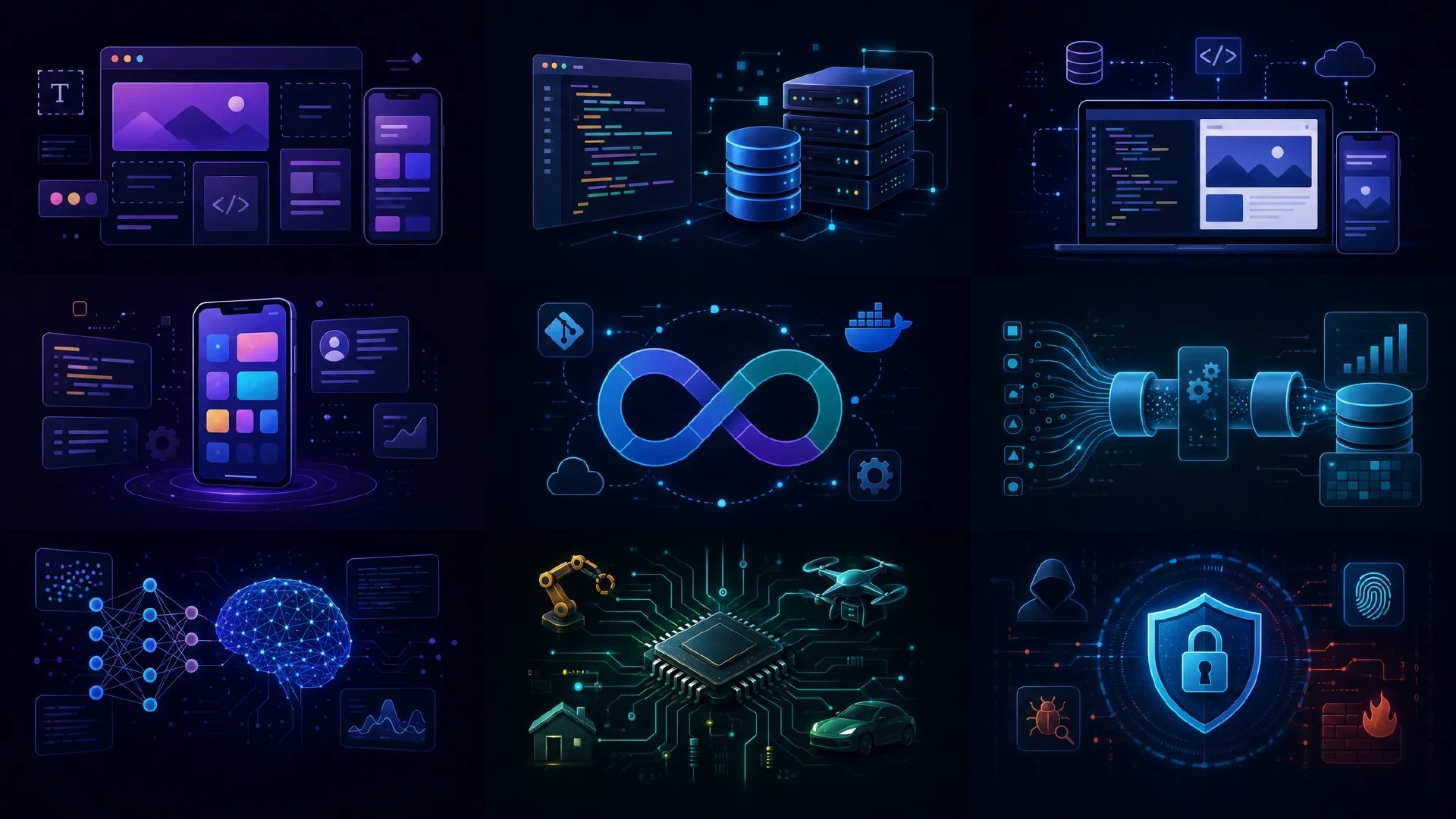
Table of Contents
Return to the Software Development Career Playbook
Software development includes many kinds of work. Compare current postings, try a small task, and review your interests, local options, accessibility needs, schedule, equipment, and support before choosing a route.
The BLS Software Developers, Quality Assurance Analysts, and Testers profile , checked 2026-10-10, gives broad U.S. occupational context. It does not define each specialty below. Use named current employer postings to verify duties, tools, location, and entry requirements.
Frontend Development
Frontend developers build the parts of software that users see and interact with. This means browser-rendered interfaces, mobile app screens, design implementation, and user experience logic.
- Core skills: HTML, CSS, JavaScript, TypeScript, React or Vue or Angular, responsive design, accessibility, browser performance.
- Typical day: translating design mockups into working interfaces, debugging browser rendering issues, building reusable component libraries.
- Good fit for: people who are visual, care about UX, and enjoy seeing immediate results from their work.
Backend Development
Backend developers build the systems that power applications behind the scenes: APIs, databases, business logic, authentication systems, and integrations with external services.
- Core skills: one backend language, data modeling, APIs, authentication and authorization, testing, logs, and failure handling.
- Typical day: designing and implementing API endpoints, debugging database query performance, building integrations with third-party services.
- Good fit for: people who enjoy systems thinking, data modeling, and solving problems that are invisible to users but critical to application function.
Full Stack Development
Full stack developers work across frontend and backend boundaries. Some employers use the title for broad product work, while others expect deeper ownership of a specific stack.
- Core skills: everything in frontend and backend, though typically at less depth in each.
- Typical day: varies widely. May build a UI one morning and an API endpoint that afternoon.
- Good fit for: early-career developers, small teams, startups that need end-to-end ownership.
Mobile Development
Mobile developers build native or cross-platform applications for iOS and Android.
| Track | Language | Framework |
|---|---|---|
| iOS native | Swift | UIKit, SwiftUI |
| Android native | Kotlin | Jetpack Compose |
| Cross-platform | Dart | Flutter |
| Cross-platform (JS) | JavaScript / TypeScript | React Native |
- Good fit for: developers who want to ship software to consumers’ hands and care about device-specific performance and UX.
DevOps and Platform Engineering
DevOps and platform engineers build and maintain the infrastructure that enables developers to deploy, monitor, and operate software reliably.
- Core skills: Docker, Kubernetes, Terraform, CI/CD pipelines (GitHub Actions, Jenkins), cloud platforms (AWS, Azure, GCP), monitoring (Prometheus, Grafana, Datadog), scripting (Python, Bash).
- Good fit for: developers who are drawn to reliability problems, automation, and infrastructure scale.
Other routes include quality engineering, test automation, developer experience, desktop applications, games, scientific software, enterprise applications, product engineering, technical writing, and support engineering. Use current postings to find the duties and tools in your target market.
Data Engineering
Data engineers build the pipelines and infrastructure that move, transform, and store data for analytics and machine learning.
- Core skills: Python, SQL, Apache Spark, dbt, Airflow, Snowflake or BigQuery, cloud data services.
- Good fit for: developers who enjoy large-scale data problems, ETL design, and supporting analytics and data science teams.
Machine Learning Engineering
ML engineers build the systems that train, serve, and monitor machine learning models in production.
- Core skills: Python, PyTorch or TensorFlow, MLflow, feature stores, model serving (FastAPI, Ray Serve, TorchServe), cloud ML platforms.
- Good fit for: developers with strong math backgrounds and interest in AI systems.
Embedded and Systems Development
Embedded developers write firmware and low-level software that runs on hardware devices with limited resources.
- Core skills: C, C++, Rust, RTOS (FreeRTOS, Zephyr), hardware debugging, UART/SPI/I2C protocols.
- Good fit for: developers interested in robotics, IoT, automotive, aerospace, and consumer electronics.
Security Engineering
Security engineers build secure software, test existing software for vulnerabilities, and create tools and systems for threat detection and response.
- Core skills: Python, Rust, SAST/DAST tools, network security, cryptography fundamentals, cloud security.
- Good fit for: developers interested in adversarial thinking and protection of systems at scale. See the Cybersecurity Career Playbook for a dedicated guide.
Next Steps
- Programming Languages to Learn First
- What Does a Software Developer Career Path Look Like?
- Software Development Career Playbook Home
Practice and Verify
Artifact: Specialization trial. Complete two routes from this table. Start from the Python Starter Lab . Keep each trial local and under one hour. Revert the working copy after each trial.
| Track | Bounded Change | Acceptance Check |
|---|---|---|
| Frontend or accessibility | Create a local HTML form with a labeled meter input, convert button, and text result. Reuse the five input cases. | Keyboard-only use reaches every control. Each label is announced by the browser accessibility tree. Five cases match the starter. |
| Backend or full stack | Add a --json option which prints {"meters":"1","feet":"3.28"}. | Existing tests pass. New tests cover valid and rejected input. No network service or personal data is used. |
| Quality engineering | Add one boundary test for a large finite value and one test for NaN. | The new test fails before the fix, passes after it, and the original five tests still pass. |
| Data engineering | Read five synthetic meter values from a local CSV and write converted values to a new CSV. | Row count stays five. Invalid input is recorded without exposing private data. Repeated runs produce the same output. |
| Platform or developer experience | Run the supplied CI commands in order and improve one error message in the README. | Compile and tests pass. The deliberate fixture blocks delivery. A fresh clone follows the revised instruction. |
| Security engineering | Write a short threat review for input abuse, command injection, data retention, and dependency risk. Add one negative test. | The review names trust boundaries and evidence. The negative test passes. No offensive action or live target is involved. |
| Mobile, desktop, game, embedded, or scientific | Recreate the converter in a supported local simulator or framework with no account or paid service. | The same five cases pass. Setup version, license, accessibility route, and cleanup are recorded. |
Expected result: Two runnable outputs pass their acceptance checks. A rubric scores interest, target-posting match, setup burden, accessibility, mentor support, safety, and cost from zero to two. Choose a route only after both trials receive at least ten of fourteen points, or record why neither route fits.
REDACTED COMPLETED EXAMPLE
Trials: tested API and keyboard-accessible form. Choice: backend. Reason: stronger interest and six matched local postings.
Pass checklist
- The artifact uses dated, role-specific evidence
- Claims, ownership, team credit, and unknown values are truthful
- Privacy, secrets, licenses, accessibility, cost, and safety received review where relevant
- A reviewer or repeatable check produced feedback
- The record names a timed next action and checkpoint
Source rule: Use official stack documentation and current target postings.