

Software Developer Resume Writing Tips
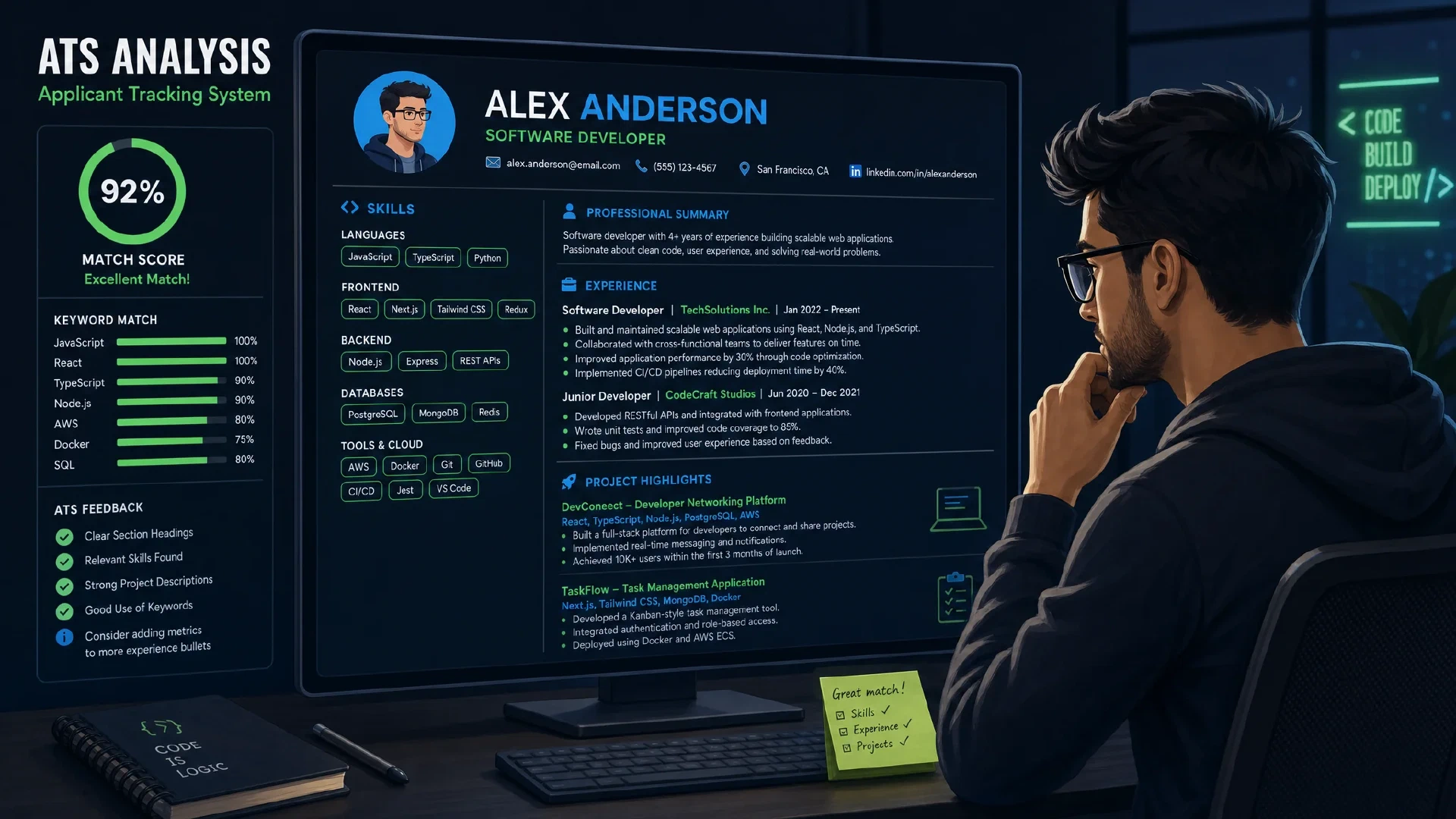
Table of Contents
Return to the Software Development Career Playbook
A developer resume gives an employer concise, truthful evidence relevant to a role. Screening methods vary. Use readable structure, job-language matches supported by your work, working links, and accessible text extraction.
For a complete deep-dive on resume writing with ATS strategy, section structure, and tailoring templates, see the Resume Optimization Course .
Resume Structure for Developers
Use this as one starting order, then follow target-employer instructions:
- Contact info, name, broad location when useful, email, and relevant professional links.
- Summary, optional concise role target and supported evidence.
- Skills, languages, frameworks, tools, and platforms organized by category.
- Experience, often reverse chronological, with title, organization, dates, scope, and relevant evidence.
- Projects, selected role-relevant work with your contribution and verified outcomes.
- Education, degree, school, graduation year. Certifications if no degree or if certification is more relevant.
- Certifications, (optional section if substantial).
For early-career candidates with no experience, move Projects above Experience.
Writing the Skills Section
List skills as a structured inventory, not a block of text. Group by category.
Languages:   Python, JavaScript, TypeScript, Go, SQL
Frameworks:  React, FastAPI, Node.js, Express
Databases:   PostgreSQL, MongoDB, Redis
Tools:       Docker, Kubernetes, Terraform, GitHub Actions, AWS
Do not pad the skills section with technologies you cannot discuss in an interview. If it is on your resume, expect to be asked about it.
Writing Experience Bullets
A useful bullet often states the action, your scope, relevant method, and a verified result or output.
- Bad: “Worked on the backend API.”
- Good: “Added two retry tests to a Redis-backed session service and documented the failure path, reducing repeated support cases during the measured release period.”
- Bad: “Helped improve the deployment process.”
- Good: “Built GitHub Actions CI/CD pipeline that automated testing and deployment, reducing release time from 3 hours to 12 minutes.”
Use strong technical action verbs: architected, implemented, optimized, automated, refactored, deployed, designed, migrated, integrated, reduced, scaled.
Writing the Projects Section
Projects are your proof of work. Format each one consistently:
Project Name | GitHub link | Live demo link
Tech stack: React, FastAPI, PostgreSQL, Docker, AWS
- Built a [what it does] for [who uses it]
- Key technical achievement (performance, scalability, novel approach)
- Usage data or outcome if available (X users, processed Y requests/sec)
For an early-career applicant, projects provide evidence when paid experience is limited. Select the strongest relevant examples instead of filling a quota.
ATS Keyword Strategy
Some employers use applicant tracking systems for storage, search, routing, or screening. Prepare a readable file without guessing at an employer’s scoring method:
- Use the posting’s technical term only when your evidence supports the same skill and context.
- Preserve official product spelling when naming a tool you used.
- Omit languages and platforms you cannot support with truthful evidence.
- Verify plain-text extraction rather than guessing how one applicant system scores keywords.
Common Developer Resume Mistakes
- Broken or unsafe links. Include a work-sample link only when it supports the role and contains no private material.
- Unfocused opening. Use a summary only when it adds role-relevant evidence.
- Unsupported impact. Replace vague responsibility or invented metrics with your actual scope, action, and verified result.
- One-size-fits-all resume. Tailor the summary and skills emphasis for each job application.
- Unfocused length. Keep evidence relevant and readable. Employer instructions and role complexity determine useful length.
Primary references, checked 2026-10-10: USAJOBS resume guidance shows one employer’s detailed requirements. Follow the target employer’s current instructions rather than a universal page or keyword rule.
- Font tricks. Tiny fonts, white text keywords, and multi-column layouts break ATS parsers. Use a clean, single-column format.
Next Steps
- Building a Developer Portfolio
- Software Developer Interview Preparation
- Software Development Career Playbook Home
Practice and Verify
Artifact: Truthful application artifact. Choose one posting. Create a tailored resume with only supported skills. Add one before-and-after bullet, project evidence, team credit, confidentiality check, plain-text extraction, link test, metadata review, and background-check consistency check. Use the revised Resume Optimization Course for its current templates and checks.
Expected result: The resume text extracts in order, links open, claims match evidence, and a reviewer finds no unsupported skill.
REDACTED COMPLETED EXAMPLE
Resume excerpt: Python unit converter | Personal learning project
Added five unit tests for normal, boundary, and rejected input. Documented setup and reproduced the test run from a clean clone.
Plain-text extraction: heading, project name, two sentences, and HTTPS link appeared in reading order.
Pass checklist
- The artifact uses dated, role-specific evidence
- Claims, ownership, team credit, and unknown values are truthful
- Privacy, secrets, licenses, accessibility, cost, and safety received review where relevant
- A reviewer or repeatable check produced feedback
- The record names a timed next action and checkpoint
Source rule: Use the original posting, target-employer instructions, and the site’s current Resume Optimization Course.