

Software Developer Interview Prep: Complete Guide
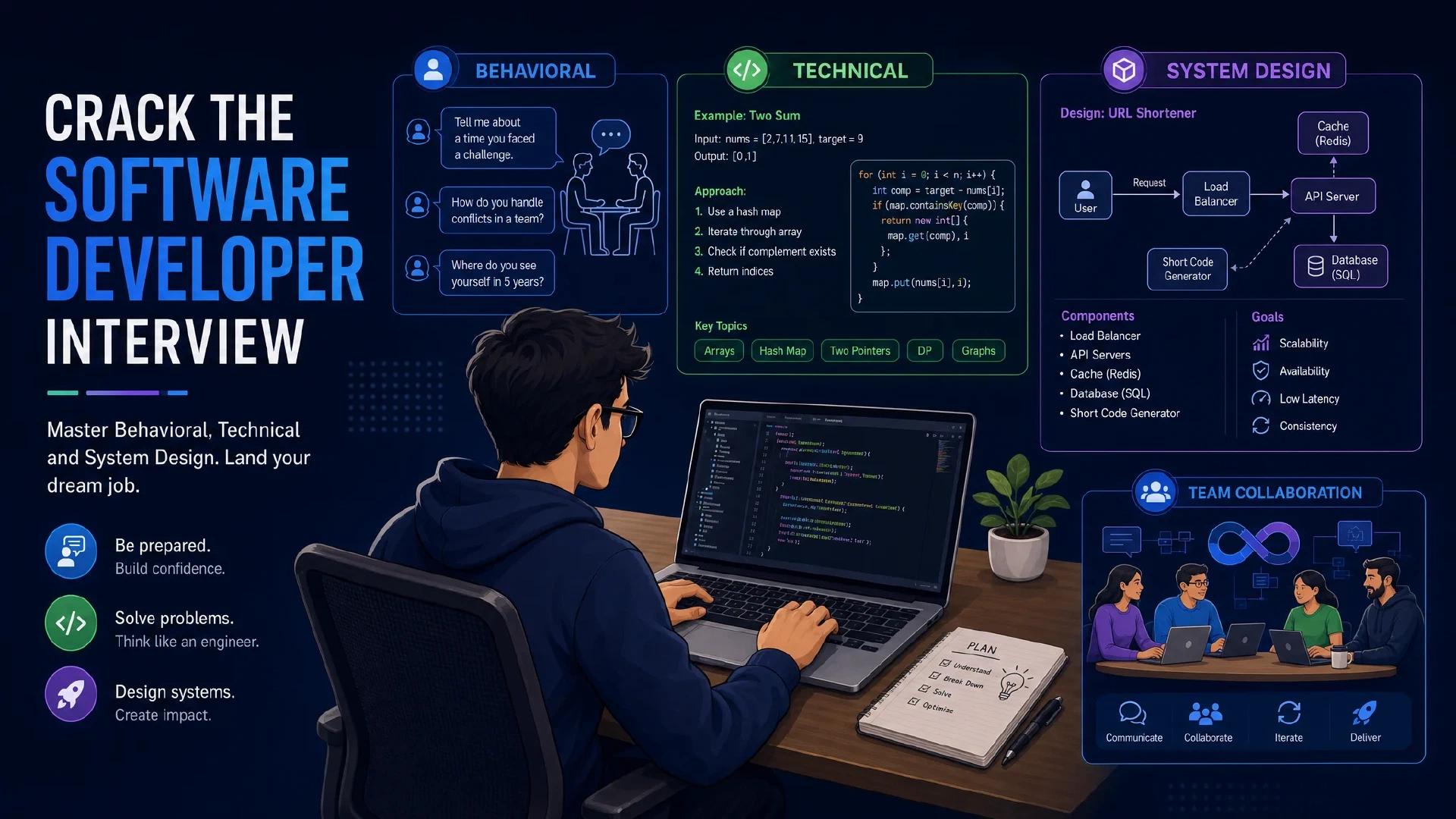
Table of Contents
Return to the Software Development Career Playbook
Software interview formats vary by employer and role. A process might include recruiter, behavioral, code-reading, debugging, coding, take-home, system-design, or work-sample review stages. Ask for the format, tools, timing, evaluation criteria, and accommodations route before practicing.
Possible Interview Stages
| Stage | Possible Format | What to Verify |
|---|---|---|
| Recruiter screen | Background and logistics | Timing, eligibility, compensation basis, and next step |
| Technical screen | Code reading, debugging, coding, testing, or domain work | Tool, timing, scoring, permitted references, and accommodations |
| Take-home assignment | A bounded work sample | Scope, time, compensation, IP, privacy, data, and permitted AI use |
| Interview loop | Behavioral, work-sample, coding, or design stages | Interviewers, breaks, scoring, access, and feedback policy |
| Offer and negotiation | Written terms and response process | Base, bonus, equity, benefits, conditions, location, and response date |
Behavioral Questions: the STAR Method
Behavioral questions often ask for past examples. Prepare several truthful stories relevant to the role. One optional structure is STAR:
Source check, 2026-10-10: Use the target employer’s recruiting material for its format. The U.S. EEOC guidance on disability discrimination explains the U.S. accommodation and employment context. Local rules differ.
- Situation: the context and background.
- Task: what you were responsible for.
- Action: what you specifically did.
- Result: measurable or observable outcome.
Common behavioral questions for developers:
- “Tell me about a time you disagreed with a technical decision. How did you handle it?”
- “Describe a project where you had to learn a new technology quickly. How did you approach it?”
- “Tell me about a time a project was at risk of missing a deadline. What did you do?”
- “Give an example of when you received critical feedback on your code. How did you respond?”
- “Describe a time when you simplified complex code or a system. What was the impact?”
Prepare your stories in advance and practice delivering them out loud. Written stories and spoken stories feel very different.
Coding Interviews
Some coding interviews test data structures or algorithms. Others use code reading, debugging, testing, domain work, or a work sample. See the Coding Interview Prep Guide after confirming the target format.
One sample sequence for a live coding task:
- Ask clarifying questions before writing a single line. What are the input types? Can the input be null or empty? What are the constraints on input size?
- Use the agreed communication mode. Speak, type, draw, or use another accessible format.
- State a simple correct approach. Improve it only when the requirements or interviewer request support the change.
- Write readable code. Use names and structure which support review.
- Test your solution with examples including edge cases before declaring it done.
- Discuss time and space complexity (Big O) after writing the solution.
System Design Interviews (Senior and Above)
A target employer might use system design for roles with architecture responsibilities. Confirm the expected scope, tools, timing, and evaluation criteria.
Common prompts include:
- Design a URL shortener.
- Design a message queue.
- Design a distributed cache.
- Design a news feed service (Twitter, Instagram).
- Design a ride-sharing dispatching system.
One sample framework:
- Clarify requirements: scale (how many users, requests per second), features (what is in scope vs. out of scope), and constraints.
- Estimate scale: rough math on storage, bandwidth, and compute needs.
- Define APIs: what endpoints or interfaces does the system expose?
- Design the high-level architecture: databases, services, message queues, CDN.
- Deep-dive on components: choose data models, discuss trade-offs (SQL vs. NoSQL, consistency vs. availability).
- Identify bottlenecks and solutions: caching, sharding, load balancing.
Score a design against the stated requirements, assumptions, units, security, privacy, abuse, failure, recovery, cost, and trade-offs.
Sample Mock-Loop Rubric
The target employer controls its own rubric. For this course, score five stages from zero to four.
| Stage | 0 | 2 | 4 |
|---|---|---|---|
| Behavioral evidence | No relevant example or unsupported claim | Relevant example with incomplete ownership or result | Truthful context, personal scope, team credit, action, result, and reflection |
| Coding or debugging | Core cases fail | Normal path passes but edge tests or explanation need work | Agreed cases pass with readable code, tests, and complexity or failure explanation |
| System or work-sample review | Requirements or major risks are missing | Main design works but one material trade-off is weak | Requirements, units, data, security, privacy, failure, recovery, cost, and trade-offs are explicit |
| Boundaries and access | Confidential material, hidden tool use, or unsafe access | Rules are followed after a prompt | Scope, IP, data, AI use, accommodations, breaks, and withdrawal conditions are confirmed first |
| Candidate questions | No questions tied to the role | One useful question | Questions cover review, deployment, on-call, safety, growth, accommodations, and decision timing |
Pass at sixteen of twenty with no zero. Repeat each stage below three after feedback. Stop and clarify when the mock requires confidential questions, unsafe access, uncompensated excessive work, or unclear IP terms.
Example accommodations request: Please share the interview stages and accessible format. I request a keyboard-accessible editor, a short break between stages, and written prompts. Who should receive supporting documentation, if required?
Before a take-home, ask: What is the expected time limit? Is it compensated? Who owns the submission? Which data, libraries, references, and AI tools are permitted? Will any part enter production? When will you delete my copy?
Next Steps
- Coding Interview Prep Guide
- Software Developer Resume Writing Tips
- Software Development Career Playbook Home
Practice and Verify
Artifact: Mock interview loop. Run a mock loop with one behavioral answer, coding task with tests, design prompt with constraints, take-home boundary review, and candidate questions about safety, on-call, review, deployment, growth, and accommodations.
Expected result: A scored record shows evidence, feedback, and one repeated stage with a higher score.
REDACTED COMPLETED EXAMPLE
First score: 14/20 with design at 2. Repeated design stage after feedback: 4. Final score: 16/20 with no zero. Result: pass.
Pass checklist
- The artifact uses dated, role-specific evidence
- Claims, ownership, team credit, and unknown values are truthful
- Privacy, secrets, licenses, accessibility, cost, and safety received review where relevant
- A reviewer or repeatable check produced feedback
- The record names a timed next action and checkpoint
Source rule: Use the target employer’s current candidate guidance and respect confidentiality.