
Developer Certifications Worth Getting in 2026
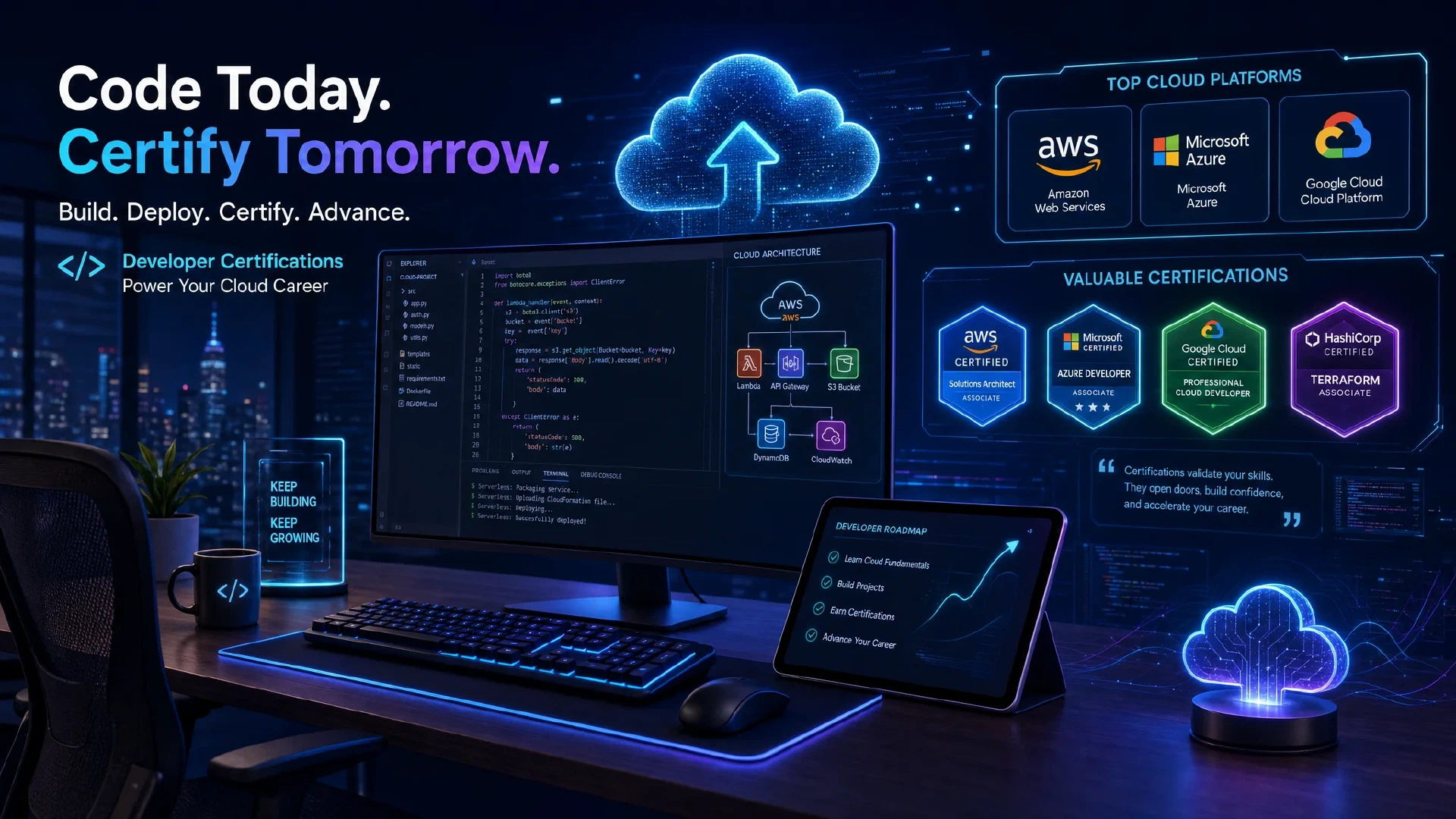
Table of Contents
Return to the Software Development Career Playbook
Certification requirements depend on the employer, contract, work role, and product stack. Read target postings before choosing an exam. Pair any credential with a hands-on artifact tied to the assessed skills.
Here is an honest assessment of which certifications are worth a developer’s time.
Cloud Certifications
Cloud certifications fit roles which name the provider, services, or credential. A no-certification route remains valid when projects and work samples demonstrate the same skills.
| Certification | Provider | Best For | Effort |
|---|---|---|---|
| AWS Cloud Practitioner | Amazon | Learners seeking broad AWS concepts | Use measured readiness |
| AWS Developer Associate (DVA-C02) | Amazon | Developers targeting AWS application work | Use measured readiness |
| AWS Solutions Architect Associate (SAA-C03) | Amazon | Developers targeting AWS architecture work | Use measured readiness |
| Azure AI Cloud Developer Associate (AI-200) | Microsoft | Developers building AI cloud solutions on Azure | Study the current objectives and assess your experience |
| Google Associate Cloud Engineer | GCP-focused developers | Use measured readiness | |
| Google Professional Cloud Developer | Developers building on GCP at production scale | Use measured readiness |
Choose a provider based on the platforms named in your target roles. Microsoft retired AZ-204 on July 31, 2026 . The AI-200 study guide covers a different, AI-focused role. A credential does not replace a project that demonstrates the work.
DevOps and Platform Certifications
| Certification | Provider | Best For | Effort |
|---|---|---|---|
| Certified Kubernetes Application Developer (CKAD) | CNCF/Linux Foundation | Developers targeting Kubernetes application work | Use measured readiness |
| HashiCorp Terraform Associate | HashiCorp | Developers targeting Terraform-based infrastructure work | Use measured readiness |
| GitHub Actions certification | GitHub | Developers targeting GitHub Actions workflow work | Use measured readiness |
Security Certifications
Secure development matters without a certificate. Choose a security credential only when the target work or qualification framework names one. Build threat-modeling and secure-coding evidence either way.
| Certification | Provider | Best For |
|---|---|---|
| CompTIA Security+ | CompTIA | Roles which name the credential or map the certification to a current DoD 8140 work-role qualification matrix |
| GIAC GWEB | GIAC | Web developers focused on application security |
| Certified Secure Software Lifecycle Professional (CSSLP) | ISC2 | Senior developers moving into security-aware engineering roles |
See the Cybersecurity Career Playbook for deeper security credential guidance.
Database and Specialty Certifications (Situational)
| Certification | Best For |
|---|---|
| MongoDB Associate Developer | Backend developers using MongoDB |
| Databricks Certified Associate Developer for Apache Spark | Roles using Apache Spark where target postings value the credential |
| dbt Analytics Engineering Certification | Data engineers working with dbt |
| Salesforce Platform Developer | Developers in Salesforce-heavy enterprise environments |
Certifications With Conditional Relevance
- CompTIA A+: relevant when the role includes endpoint or support work.
- CompTIA Network+: relevant when the role includes network-heavy development or operations.
- ITIL Foundation: relevant when the employer uses IT service-management practices.
- Vendor-specific advanced credentials early in your career: consider associate-level study and hands-on evidence first. Check the selected vendor because advanced exams do not share one universal prerequisite.
How to Use Certifications Strategically
- Earn a cloud certification when target postings or a current employer value the credential enough to justify cost and renewal.
- Use certifications to validate knowledge in an area where you lack production experience.
- Place certifications where their relevance is clear. Do not rank them above stronger role evidence by default.
- Certification renewal rules differ. Check the official policy before purchase and record the next renewal date.
Primary sources, checked 2026-10-10: DoD Cyber Workforce Qualification Program , AWS Certification , Microsoft credentials , and Google Cloud certifications .
Next Steps
- AWS and Cloud Developer Certifications
- Software Developer Resume Writing Tips
- Software Development Career Playbook Home
Practice and Verify
Artifact: Certification value check. Sample ten target postings. For each candidate credential, record current exam scope, price, renewal, experience guidance, accommodations, and one hands-on artifact. Include a no-certificate route.
Expected result: The decision ties a credential to target-role evidence and a practical artifact.
REDACTED COMPLETED EXAMPLE
Credential: CKAD. Posting mentions: 1 of 10. Decision: build deployment lab first and recheck in six months.
Pass checklist
- The artifact uses dated, role-specific evidence
- Claims, ownership, team credit, and unknown values are truthful
- Privacy, secrets, licenses, accessibility, cost, and safety received review where relevant
- A reviewer or repeatable check produced feedback
- The record names a timed next action and checkpoint
Source rule: Use official vendor pages and current DoD 8140 matrices where a defense work role is relevant.

Disclosure and Affiliate Statement:
Affiliate Disclosure: We may earn a commission from links on this page. These commissions support our website and the content we provide. Rest assured, we only recommend products/services we believe in. Thank you for your trust! Click Here to Learn More