

Module 4: Secure Messaging
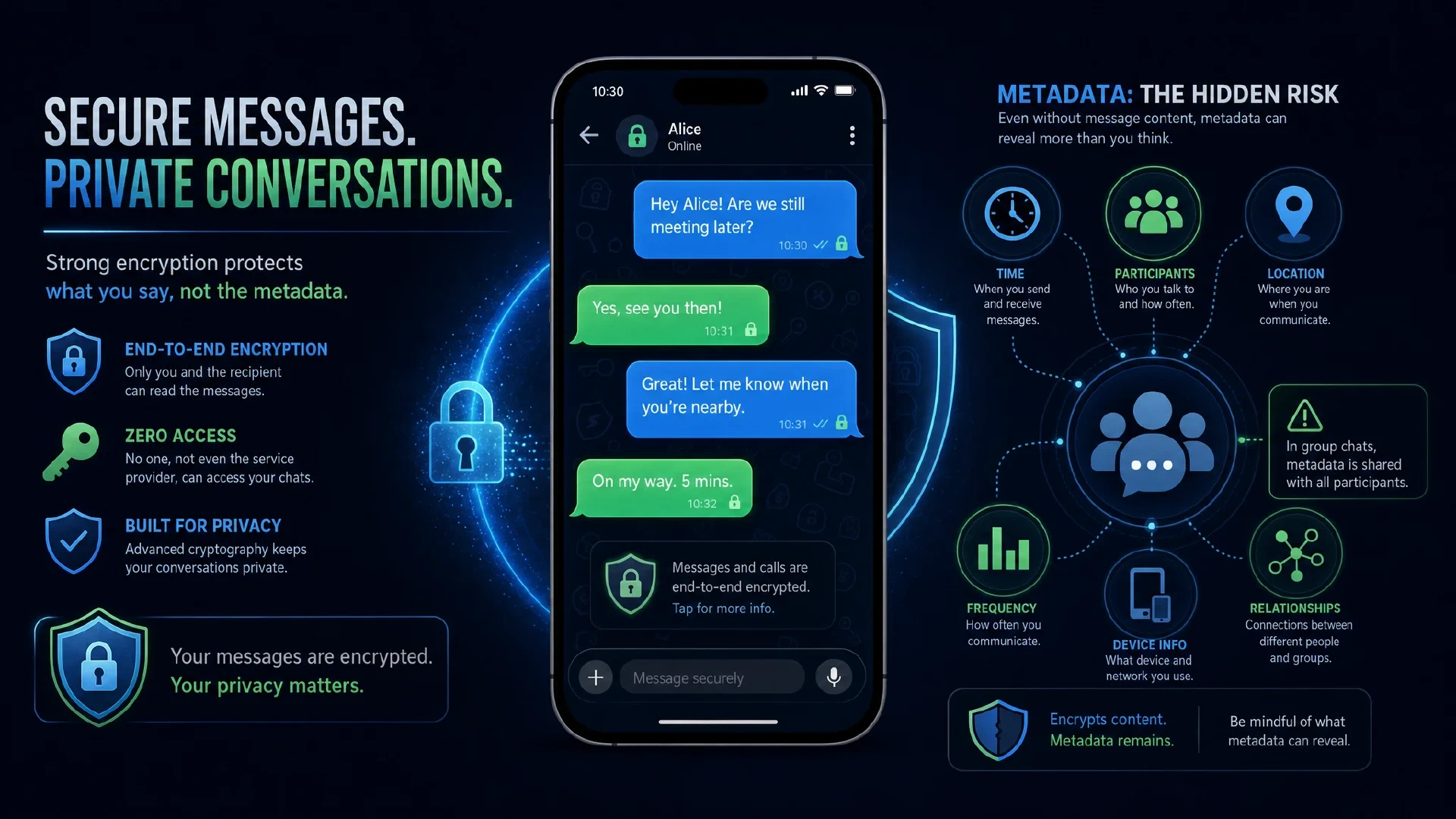
Table of Contents
← Return to the Personal Security Course
End-to-end encryption protects what you say, not who you spoke to. This distinction defines the whole module. A messenger which encrypts every message perfectly still hands your provider a record of every conversation partner, every timestamp, and every group you belong to.
This module covers how to evaluate a messenger on properties rather than reputation, why metadata deserves separate attention, and why group chats raise risk faster than message content ever does.
Budget about 20 minutes. Messenger choice is a single decision with long-lasting consequences.
What You Will Learn
- Distinguish transport encryption, encryption at rest, and end-to-end encryption
- Evaluate a messenger against open source, maintenance, and default-encryption criteria
- Explain what metadata reveals even when message content stays private
- Assess why each additional group participant increases exposure
- Apply hygiene to shared links and media before sending
- Produce a messaging record listing your primary messenger and its security settings
| Term | Meaning |
|---|---|
| End-to-end encryption | Content encrypted on your device and decrypted only on the recipient’s |
| Transport encryption | Protection between you and the server, which the server reads past |
| Metadata | Information about a message rather than its content, including participants and timing |
| Forward secrecy | A fresh key per message, so a stolen key does not expose earlier traffic |
| Ephemeral message | Content configured to delete itself after a set period |
| Cloud companion | A web or desktop client which keeps message history on a server |
The Three Properties of a Secure Messenger
A messenger earns trust through three properties, and a failure in any one of them undermines the other two.
| Property | Why It Matters | How to Verify |
|---|---|---|
| End-to-end encryption by default | Opt-in encryption means most conversations are unprotected | Check whether the app encrypts without configuration |
| Open source | Independent review is the only way to find backdoors and flaws | Look for a public repository and recent commits |
| Actively maintained | Unpatched software becomes the vulnerability | Check release dates within the last year |
Default matters more than capability. A messenger which supports end-to-end encryption but leaves it off for ordinary conversations protects almost nobody, because almost nobody enables it.
Ask the second question before the first. A platform is sometimes open source and abandoned, which is worse than closed and maintained, because you see the flaws and cannot get them fixed.
Metadata Is the Unencrypted Part
Your provider does not need to read your messages to learn a great deal about you. The delivery record is enough.
| Metadata | What It Reveals |
|---|---|
| Participants | Your social graph, including relationships you keep separate |
| Timing | When you are awake, working, travelling, or asleep |
| Frequency | Which relationships are active and which have lapsed |
| Duration | Whether a conversation was a message or a call |
| Group membership | Associations you have not disclosed elsewhere |
This is why anonymous platforms matter for some users and not others. If your threat model includes an adversary able to compel the provider, metadata is the exploitable part, because providers hold it in plaintext to route messages at all.
A provider cannot route a message without knowing the destination. This is the structural reason metadata survives every encryption improvement.
Evaluating a Platform
Work through this rather than adopting whatever your contacts happen to use.
| Criterion | Strong Answer | Weak Answer |
|---|---|---|
| Encryption | On by default, for all conversations | Opt-in, or unavailable for groups |
| Source | Public repository, protocol documented | Closed client, unpublished protocol |
| Maintenance | Releases within months | No update in over a year |
| History storage | Message content stays on devices | Server-side history by design |
| Registration | No phone number required | Mandatory phone number |
| Group behaviour | Membership changes visible to members | Silent participant additions |
| Metadata retention | Minimized and documented | Undisclosed |
A funded, open protocol maintained by a nonprofit holds the strongest structural position, because it has no advertising incentive to profile you and no shareholder pressure to monetize metadata.
Group Chats Multiply Risk
Risk scales with participants, and it scales faster than linearly.
A two-person conversation requires both parties to be trustworthy. A ten-person group requires all ten, plus everyone who has ever left it, plus everyone who photographed a message before leaving.
Practical rules:
- Verify membership periodically and remove inactive participants
- Prefer smaller groups over one large channel
- Assume anything shared in a group is permanent, regardless of the ephemeral setting
- Check whether history is shared with new members when they join
Ephemeral messages protect against device seizure. They do not protect against a participant photographing a screen, which is the far more common leak.
Practical Hygiene Before You Send
Two habits remove real risk and take seconds:
Defang links before sharing them. A URL shared in a chat is often auto-previewed, which means the service fetches the page on your behalf and associates your account with the visit. Converting https:// to hxxps:// and dots to [.] prevents the preview while leaving the destination readable to a human.
Strip metadata from media. A photograph carries GPS coordinates, a timestamp, and often a device identifier. This matters most for images taken at home.
Both are covered by local tools which never upload the content:
| Task | Tool |
|---|---|
| Defang a link safely | IOC Defang, Refang, and Extractor |
| Check what an image exposes | EXIF Viewer |
| Inspect a link before opening it | URL Parser and Query Analyzer |
A preview request is an outbound connection attributable to your account. Defanging prevents it without hiding anything from the recipient.
The Messaging Record
MESSAGING RECORD
Primary messenger:      ______________________
Encryption:             default / opt-in / none
Open source:            yes / no / partial
Registration method:    phone number / email / none

Security settings:
  Contact verification:  enabled / disabled
  Read receipts:         off / on
  Typing indicator:      off / on
  Last seen:             off / on
  Disappearing messages: ______ (duration, or off)
  Cloud companion:       enabled / disabled / unavailable

Groups I belong to (review membership):
  - ______________________  participants: ______
  - ______________________  participants: ______

Next Steps
- Continue to Module 5 and reduce what your public profile reveals: Social Media Privacy
- Turn on disappearing messages for conversations which do not need history
- Verify contacts in your primary messenger, which is the step most people skip
- Defang your next shared link with the IOC Defang tool
- Check photo metadata before posting with the EXIF Viewer
- Review your group memberships and remove anyone inactive