

Technical vs. Management Track in IT
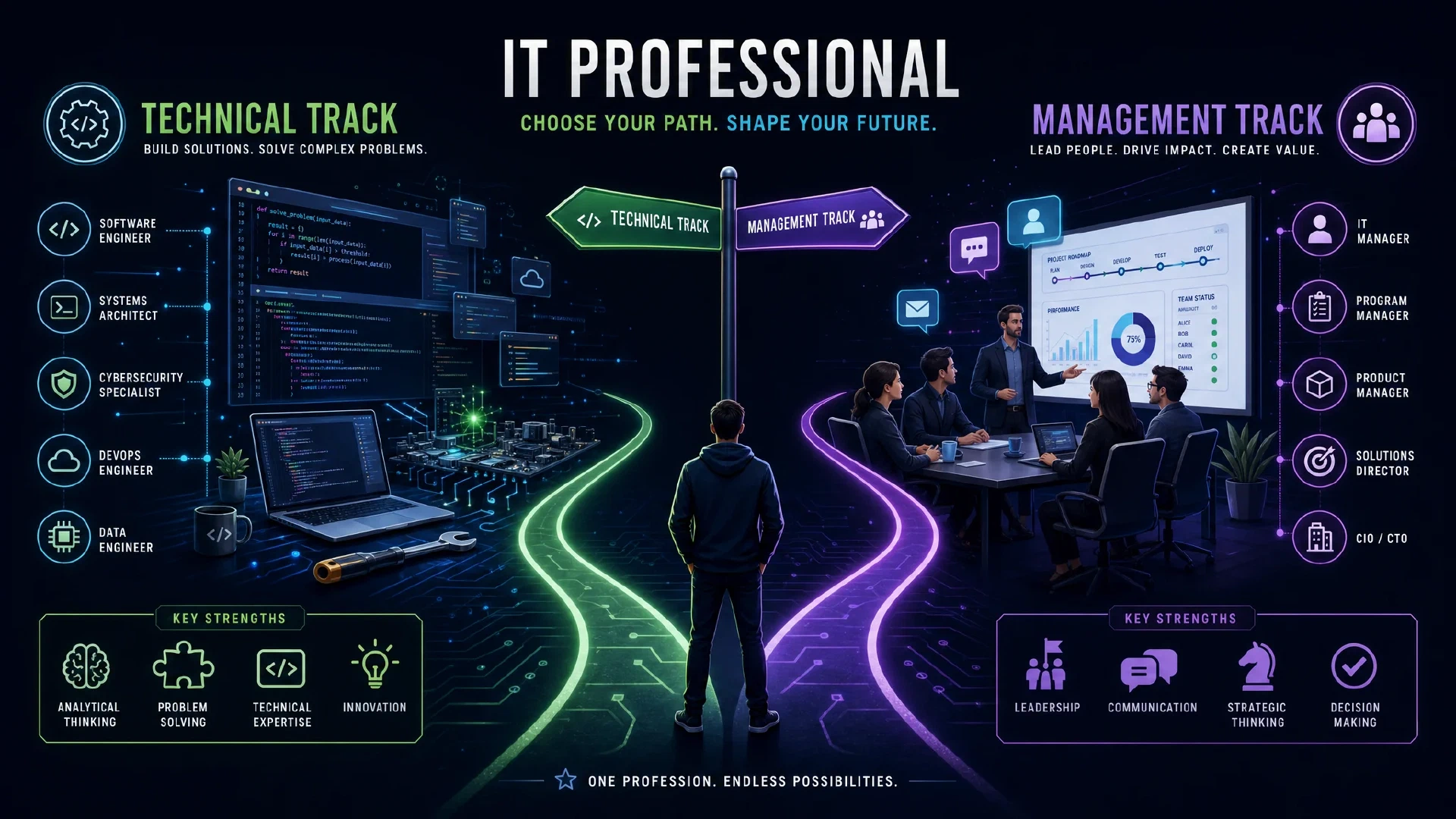
Table of Contents
Click Here to Return To the IT Career Playbook
Every IT professional who progresses far enough eventually faces a fork: stay technical or move into management. This is not a one-time, irreversible decision, but it does shape your day-to-day work, compensation ceiling, and career satisfaction for years. Choose based on what energizes you daily, not just what pays more right now.
Both paths are legitimate and well-compensated at senior levels. The mistake is drifting into management because it appeared to be the only way up, without understanding what the role actually requires.
The Two Tracks Defined
The individual contributor (IC) technical track keeps you hands-on with technology. You grow from junior engineer to senior, then to staff, principal, or distinguished engineer. Your value is deep expertise, architectural decisions, and technical mentorship.
The management track moves you into people leadership. You transition from senior engineer to team lead, then to engineering manager, director, VP, and beyond. Your value shifts to hiring, developing teams, removing blockers, and aligning work to business goals.
| Dimension | Technical Track | Management Track |
|---|---|---|
| Day-to-day work | Code, architecture, systems | 1:1s, planning, hiring, reviews |
| Success metric | Technical output and quality | Team performance and retention |
| Ceiling | Principal / Fellow / CTO track | VP / CTO / CIO track |
| Reversibility | Can move to management later | Can return to IC, but harder after 3+ years |
| Compensation | High at staff+ levels, equity-heavy | High at director+, often higher total at VP |
Signs You Should Stay on the Technical Track
- You find deep technical problems more engaging than organizational problems.
- You dislike performance reviews, headcount planning, and budget conversations.
- Your identity is tied to building and shipping, not coordinating others who build and ship.
- You want to be the best at something specific: cloud architecture, security engineering, kernel dev.
The IC ladder at large tech companies now compensates staff and principal engineers above most middle managers. “Individual contributor” does not mean “career plateau.”
Signs You Should Move to the Management Track
- You spend more energy thinking about how to unblock your team than about your own tasks.
- You enjoy coaching junior engineers and watching them grow.
- You are frustrated when organizational dysfunction slows the team and you want to fix the structure.
- You are more interested in shipping a product than in engineering any specific component.
Management means your job is your team, not your code. If that trade feels like a loss, stay technical.
The Hybrid: Tech Lead
Many organizations use a tech lead role that sits between the two tracks. A tech lead carries a subset of the codebase or architecture as their technical domain while also coordinating work for a small team. This is a good way to sample management responsibilities without formally crossing over.
Tech lead is not a permanent destination. After 12 to 18 months you will know whether the management responsibilities energized or drained you.
Transitioning Between Tracks
Moving from IC to management is common and well-supported at most companies. Moving from management back to IC is harder because your technical skills atrophy during management years. If you think you want management, pilot it as a tech lead or interim manager before fully committing.
If you tried management and want to return to IC, rejoin with your management experience as a differentiator. A senior engineer who understands budgets, staffing, and roadmap pressure is more valuable than one who does not.