

What Does an IT Career Path Look Like? From Entry Level…
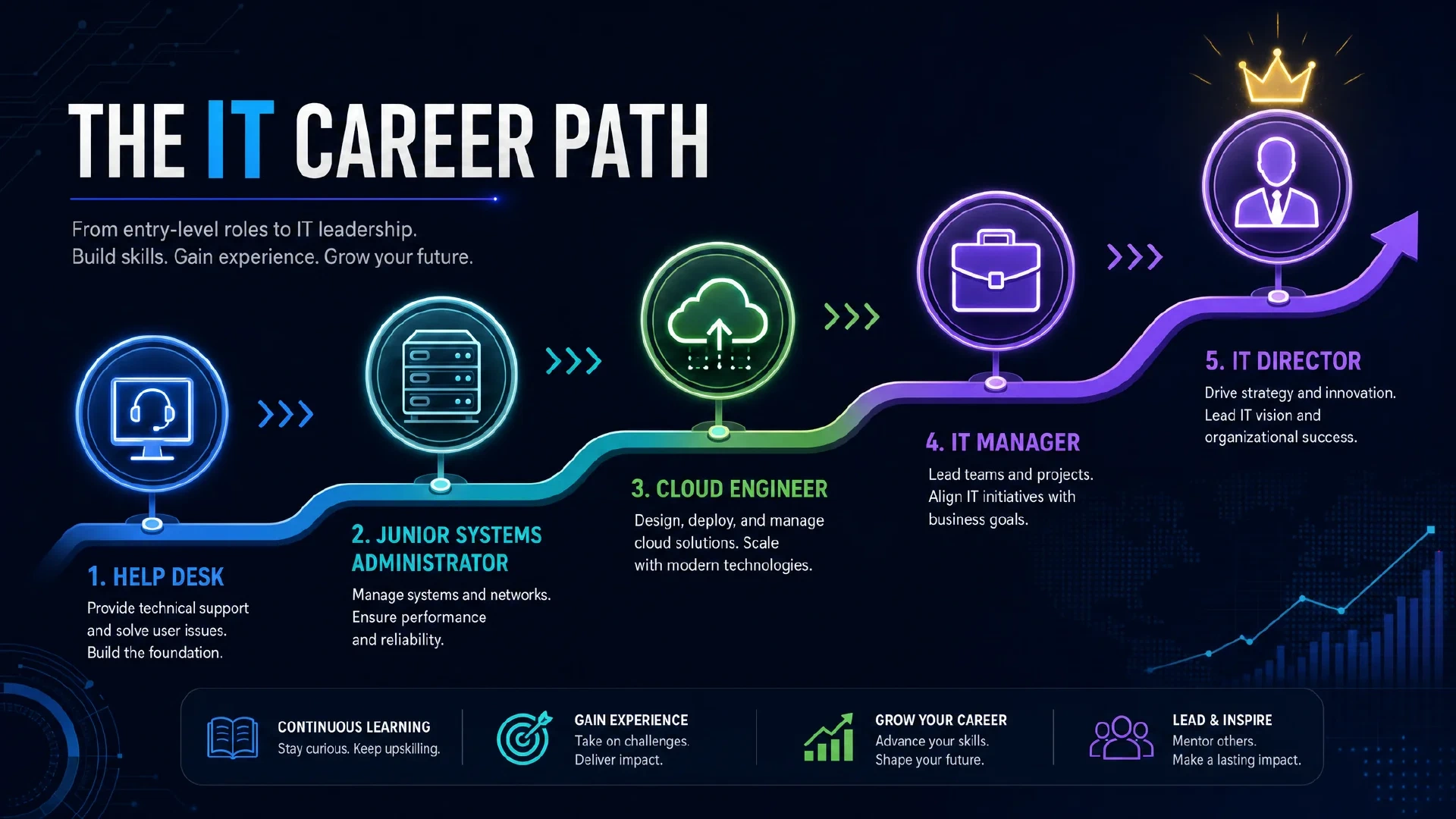
Table of Contents
Click Here to Return To the IT Career Playbook
Most IT careers follow a recognizable arc, but the pace and direction depend almost entirely on deliberate choices — certifications earned, home labs built, projects volunteered for, and specializations pursued. Understanding the common path helps you plan rather than drift.
Time-in-role is not what drives IT advancement. Skills and credentials drive it. A motivated professional can compress a five-year progression into two.
The Classic IT Career Arc
Most IT careers start broad and narrow into a specialization over the first five to ten years. Here is the most common trajectory:
Stage 1: Help Desk / Desktop Support (Years 0–2)
The standard entry point. You handle user-facing problems — hardware failure, software issues, account access, basic networking. This stage teaches:
- Windows and macOS administration
- Active Directory and basic identity management
- Ticket management and prioritization
- Communication with non-technical users
- Systematic troubleshooting
How to advance: Earn CompTIA Network+ while in this role. Build a home lab with Windows Server and Active Directory. Apply for sysadmin or junior systems engineer roles after 12–18 months.
Stage 2: Junior Systems Administrator / Junior Network Admin (Years 1–3)
The first step into infrastructure. You manage servers, handle patching, support backup systems, and troubleshoot network issues. This stage teaches:
- Windows Server and Linux administration
- Virtualization (VMware, Hyper-V)
- Backup and disaster recovery
- Scripting (PowerShell, Bash)
- Network fundamentals in production
How to advance: Earn CompTIA Security+ and either a Linux+ or cloud foundational cert. Volunteer to be involved in infrastructure projects above your current scope.
Stage 3: Systems Administrator / Network Engineer / Cloud Engineer (Years 3–7)
The fully competent individual contributor. You own systems and are trusted to design and implement infrastructure changes without oversight. This stage deepens specialization.
Key decision point here: Do you continue deepening technical skills (toward senior engineer, architect, or principal engineer) or do you move toward a team lead or management track?
Stage 4a: Senior Engineer / Architect (Years 6–12+)
The technical individual contributor track. Senior engineers own domains of expertise. Architects design systems at org-wide scale. This path emphasizes:
- Deep specialization in cloud, networking, security, or infrastructure
- System design and capacity planning
- Technical leadership without management authority
- Advanced certifications (CCIE, AWS Professional, CISSP, CKA)
Compensation ceiling: $150K–$250K+ at principal/architect level at large organizations.
Stage 4b: IT Manager / IT Director (Years 5–12)
The management track. You transition from managing systems to managing people. This path requires:
- ITIL 4 Foundation and project management skills
- Budget management and vendor negotiation
- Hiring, performance reviews, and team development
- Communicating technical needs to executive leadership
Compensation ceiling: $135K–$250K for IT Directors; $200K–$400K+ for VPs and CIOs at large organizations.
Typical Salaries by Stage
| Stage | Typical Salary Range | Variance Factors |
|---|---|---|
| Help Desk / Desktop Support | $40K–$60K | Location, company size |
| Junior Sysadmin / Junior Network | $55K–$75K | Certifications held |
| Sysadmin / Network Engineer | $75K–$115K | Specialization, cloud skills |
| Cloud Engineer / DevOps/SRE | $100K–$160K | Cloud platform, years of exp. |
| Senior Engineer / Architect | $130K–$220K+ | Specialization depth, org size |
| IT Manager | $95K–$145K | Team size, company size |
| IT Director | $135K–$200K | Region, industry, budget responsibility |
| VP of IT / CIO | $175K–$350K+ | Large company, P&L responsibility |
Government IT roles add clearance bonuses of 20–30% at qualifying positions. Remote roles at large tech firms push ranges higher.
Career Pivots Within IT
IT professionals regularly pivot specialization without leaving the field:
| From | To | What Makes the Pivot Work |
|---|---|---|
| Sysadmin | Cloud Engineer | AWS/Azure fundamentals cert + home lab cloud projects |
| Network Eng. | Cloud Networking/SDN | Cloud networking certs (AWS Advanced Networking, Azure Network Engineer) |
| Sysadmin | DevOps | Git, CI/CD pipeline experience, Docker/Kubernetes knowledge |
| Help Desk | IT Security | CompTIA Security+ + CySA+, hands-on with SIEM in lab |
| IT individual contributor | IT Manager | ITIL 4, PMP, demonstrating leadership in current role |
Pivots take 6–18 months of deliberate learning alongside current work. They are very achievable.
Next Steps
- IT Salary and Job Outlook
- IT Career Specializations
- Moving Up in Your IT Career
- IT Career Playbook Home