

Mining Pearl (PRL) in 2026: Setup, Profitability, and Whether the Chain Is Useful

Table of Contents
Pearl is the first proof-of-useful-work chain to reach real production scale, and the work it pays miners for is matrix multiplication rather than hashing. Mainnet launched on April 27, 2026, and within weeks it triggered a GPU mining rush built on a claim of securing a blockchain while producing AI compute in the same pass.
The claim is technically real and economically unproven, and the gap between those two things is the whole story.
This guide covers how to mine PRL, what the miner computes, why the margins compressed so quickly after launch, and a direct answer to whether the chain produces anything of value.
The Short Answer
Pearl is a genuine technical achievement wrapped around a mining economics problem which every new coin faces.
| Question | Short Answer |
|---|---|
| What is it? | A Bitcoin-derived L1 secured by proof-of-useful-work, where miners run noisy matrix multiplication instead of SHA-256 |
| How do you mine it? | SRBMiner-MULTI with --algorithm pearlhash against a pool, or Pearl’s own vLLM miner against your own node |
| Why was it profitable? | Launch-era emissions outpaced difficulty for a few weeks, then difficulty caught up |
| Is it still profitable? | Hardware dependent, and the window is narrowing. See the margins section below |
| Is the chain useful? | The mechanism is, the marketplace is not yet. Details in the verdict section |
The single most important thing to understand before you build a rig for this: the miner developer’s own release notes for version 3.6.8 state Pearl has an upgrade coming which will make consumer-grade GPUs “pretty much useless” for mining it. This is not an outside critic. This is the person writing the miner.
What Pearl Actually Is
Pearl is an L1 blockchain built by Pearl Research Labs and described in its own repository as follows:
“Pearl is an L1 blockchain based on the Proof-of-Useful-Work protocol, where mining is done as a by-product of arbitrary matrix multiplication.”
The repository ships a full node, a wallet daemon, an SPV light client, a zero-knowledge proving system, and a GPU miner. It is licensed under the ISC License, a permissive copyfree license, and the chain infrastructure was forked from well-tested Bitcoin projects: btcd for the node, btcwallet for the wallet, and neutrino for the light client.
The design borrows deliberately from Bitcoin, down to a 2.1 billion PRL maximum supply, exactly 100 times Bitcoin’s 21 million, with a declining block reward and roughly two-minute blocks.
The plumbing is conservative on purpose. The novelty is entirely in the work function.
Proof-of-Useful-Work, Explained
Proof-of-useful-work is an old idea with a poor track record. The pitch has always been to replace Bitcoin’s deliberately wasteful hashing with computation producing something valuable on the side. Almost every previous attempt failed for the same reason: the “useful” work turned out to be either not useful, or not verifiable cheaply enough to secure a chain.
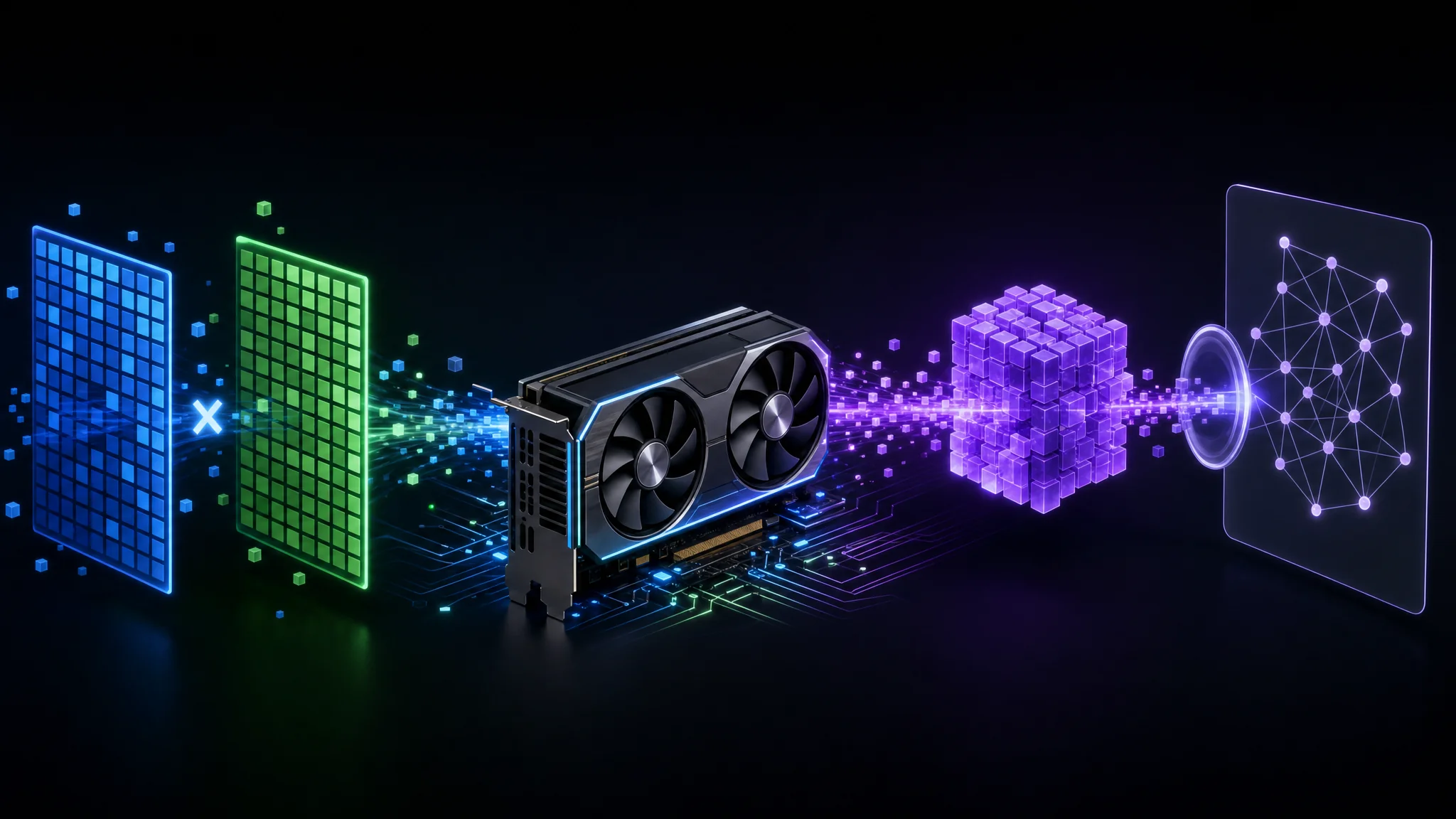
Pearl implements it through a routine it calls NoisyGEMM. Mechanically, a miner runs noisy matrix multiplications on a GPU, hashes the result into a commitment, and wraps the work in a zero-knowledge proof so the chain verifies it cheaply.
The scheme rests on a 2025 cryptography paper, “Proofs of Useful Work from Arbitrary Matrix Multiplication” by Komargodski, Schen, and Weinstein. The paper claims an overhead of roughly 1 + o(1) against a naive matrix multiply, which is the load-bearing claim of the entire project. If securing the chain costs almost nothing on top of the underlying compute, then the compute is nearly free to produce.
The pitch is 2-for-1. One GPU pass, two outputs.
The claim is what separates Pearl from a decade of failed PoUW concepts. Most of them had no such bound.
What the Miner Actually Computes
There are two paths, and they are not equivalent.
The official path ships in Pearl’s own repository. It has two components: pearl-gateway, which bridges to your node, and vllm-miner, which does the GPU work through vLLM. The gateway talks to a local pearld node over JSON-RPC and exposes a mining interface on a Unix socket or TCP port 8337.
The pool path is what most people run. SRBMiner-MULTI implements Pearl as the pearlhash algorithm, and you point it at a pool.
The difference matters for the usefulness argument. The official miner loads a real language model. Pearl’s own documentation example runs pearl-ai/Llama-3.3-70B-Instruct-pearl inside Docker with GPU passthrough. This is a 70-billion-parameter model serving inference while the same pass secures the chain.
Producing inference is genuine capability. Producing inference nobody buys is a cost centre with a blockchain attached. Keep those two ideas separate.
Why It Was Profitable, and Why That Changed
Pearl’s initial profitability was not a mystery, and it was not about AI. It was the standard new-coin emission curve.
| When | What Happened |
|---|---|
| April 27, 2026 | Mainnet launch |
| Late May 2026 | A GPU mining rush begins, five weeks into the chain’s life |
| June 2026 | Estimated RTX 5090 daily revenue roughly halved as difficulty climbed |
| Mid to late 2026 | Miner software efficiency improves sharply, partly offsetting the decline |
The compression mechanism is mechanical:
- Launch emissions are large and difficulty is low. Early miners collect outsized rewards per unit of hashrate.
- Those rewards attract hashrate. More GPUs point at the chain.
- Difficulty rises to match. Reward per GPU falls.
Pearl adds a second downward force, because its block reward declines by design. Revenue has two reasons to fall and difficulty has one reason to rise.
The Countervailing Force: Software Efficiency
Margins did not collapse uniformly, because the miners kept getting faster. SRBMiner’s pearlhash changelog tracks the improvement:
| Version | Pearlhash Change |
|---|---|
| 3.6.1 | Added B300 support. B300 SXM6 at --gpu-cclock 1600 reported around 706 TH/s at 920W |
| 3.6.2 | Improvements for H100, H200, and 4000 series |
| 3.6.8 | Hashrate improvement, mostly 3000 series |
| 3.6.9 | Huge efficiency improvements. Same or better hashrate at much lower power across most architectures |
For a home miner, electricity is the dominant operating cost. A release which holds hashrate while cutting power improves margin directly, with no change in token price or network difficulty. This is why a rig which looked marginal in June looks reasonable in September on identical hardware.
Efficiency gains are a real tailwind and a temporary one, because the same improvements are available to everyone else pushing difficulty alongside you.
The Rank Penalty Softfork
On the night of August 6, 2026, a softfork activated on Pearl at approximately 02:00 UTC, block 96251. Many miners learned about it the next morning when their hashrate dropped.
Pearl’s protocol has a noise rank parameter, and a higher rank made it easier to win a jackpot for the same amount of work. Some miners mined deliberately at high ranks and collected disproportionately large effective hashrate and rewards. The team investigated what it described as abnormal mining optimizations and responded with a penalty mechanism.
| Rule Change | Effect |
|---|---|
| Minimum allowed rank | 128 |
| Jackpot bound | Now scaled by the formula 128 / rank |
| Advantage of high ranks | Removed entirely |
Impact on miners:
- Mining above rank 128 cost those operators 50% to 87.5% of effective hashrate
- Mining at or below rank 128 cost almost nothing
Two lessons apply to anyone starting now.
Your hashrate is a function of software and network rules, not only your GPU. A configuration that benchmarked well in July was not measuring what the operator assumed it was.
Update the miner when the network changes. Older versions either lose significant efficiency or stop working correctly under the new rules. Pool software was updated ahead of the fork, including PearlFortune v2.1.0 and Krig (Kryptex) v1.1.0, alongside miners such as Tw-pearl-miner v3.3.0 and Wildrig 0.49.8.
A softfork which cuts a reward by up to 87.5% is the clearest possible argument for watching project announcements rather than only reading a payout dashboard.
The Two Ways to Mine Pearl
| Pool Mining | Official vLLM Miner | |
|---|---|---|
| Software | SRBMiner-MULTI | pearl-gateway plus vllm-miner |
| Algorithm | pearlhash | NoisyGEMM through vLLM |
| Node required | No | Yes, a synced pearld |
| Payout | Pool, PPLNS or solo | Direct to your mining address |
| Runs a real model | No | Yes, for example Llama-3.3-70B-Instruct |
| Setup effort | Low | High, needs the CUDA toolkit and Python 3.12 |
| Best for | Getting hashrate on the network quickly | Contributing compute to the network directly |
Start with pool mining. It requires no node, no sync, and no model download, and it gets you hashrate and a payout address in minutes. Move to the official miner only if you specifically want to serve inference or run a node.

Hardware Notes for Consumer GPUs
Pearl is notable for what it does not demand. Hashrate Index noted the hardware profile is unusually light: low RAM, low storage, low CPU, and none of the expensive multi-fiber networking a real training cluster needs. One analyst described it as “a great way to use up equipment.”
This is the honest appeal. Existing GPUs, including older ones, earn something.
| GPU Class | Observation |
|---|---|
| RTX 5090 and 4090 | Highest revenue per card, and the segments where the early revenue halving was measured |
| RTX 3000 series | Specifically targeted by the 3.6.8 hashrate improvement. Still viable, efficiency matters more than raw speed |
| Data center accelerators | H100, H200 and B300 were added and improved through 2026. This is where the hashrate race is heading |
| Older or low-VRAM cards | Marginal. Check a live profitability calculator before building anything |
The pattern across every release in 2026 is the same. Flagship accelerators were added first and improved most, because the hashrate is worth the most there. Consumer cards got attention when the 3000 series had headroom to recover.
Efficiency tuning produces more revenue than chasing clock speed. This is the opposite of what most mining guides teach.
Setting It Up on Linux
The pool route needs four things: the SRBMiner binary, a Pearl wallet address, a pool endpoint, and a service to keep it running.
Get a Wallet Address First
Pearl mining addresses start with prl1. The official wallet is Oyster, the HD wallet daemon in Pearl’s repository, which exposes JSON-RPC and gRPC interfaces. Generate a Taproot mining address from it.
Do not skip this step or reuse an address from another chain. Rewards sent to an address you do not control are gone.
Pool, Ports, and Merge Mining
The largest Pearl pool is LuckyPool, which offers ports tiered by expected hashrate:
| Port | Starting Difficulty | Recommended Hashrate |
|---|---|---|
| 3360 | 2M | Under 500 TH/s |
| 3361 | 4M | 500 to 1000 TH/s |
| 3362 | 8M | Above 1000 TH/s |
Choose the port matching your rig’s actual hashrate. A single consumer GPU belongs on 3360. Sending a small rig to a high-difficulty port means long gaps between shares and worse variance without any benefit.
Two pool features are worth knowing about:
- Solo mining works on any port by prefixing the wallet with
solo:. You keep the whole block reward when you find one, and you earn nothing when you do not. With consumer hashrate, expect a long wait. - Nockchain merge mining earns NOCK alongside PRL for the same hashrate, by appending
+NOCK_ADDRESSto your Pearl wallet. The pool pays NOCK on Nockchain itself, so a wrapped token address starting0xcannot receive it. Your miner must support merge mining, and a miner without it still mines Pearl normally.
The pool publishes both luckypool.io hosts and lproute.com route hosts. If your network blocks direct mining traffic, keep the port and swap the domain.
A Working Install Script
The script below provisions SRBMiner as a systemd service on a Debian or Ubuntu host. It detects every GPU, applies per-card overclock flags, verifies the download against the published MD5, writes the unit and a logrotate policy, and restarts the service.
#!/usr/bin/env bash
# install-pearl-miner.sh -- provision SRBMiner (Pearl / PRL) as a systemd service.
# Run:  sudo bash install-pearl-miner.sh
set -euo pipefail

ALGO="pearlhash"
POOL="${POOL:-pearl-us-east.luckypool.io:3360}"
WALLET="${WALLET:-<YOUR_PR1_ADDRESS>}"   # prl1...  add +NOCK_ADDRESS to merge mine
WORKER="${WORKER:-rig-1}"
SRB_VERSION="${SRB_VERSION:-3.6.9}"
MINER_DIR="/opt/srbminer"
UNIT="/etc/systemd/system/pearl-miner.service"
SVC="pearl-miner.service"
LOG="/var/log/pearl-miner.log"

# RTX 3070-class tuning. MCORE is an absolute memory-clock lock, well below the
# card's stock 7001 MHz, so it is a deliberate efficiency underclock rather than
# a performance overclock. Set any value to "" to disable that flag.
CCLOCK="${CCLOCK:-1560}"
MCLOCK="${MCLOCK:-5001}"
COFFSET="${COFFSET:-150}"
PLIMIT="${PLIMIT:-180}"
FAN="${FAN:-}"
THERMAL="${THERMAL:-88}"
The tuning block deserves a note, because it looks wrong at a glance. MCORE=5001 sits below the stock memory clock on a 3070. This is intentional. Pearl rewards memory efficiency, and locking memory lower cuts power draw more than it cuts hashrate. Do not copy overclock numbers from a hashrate database row without checking which GPU the row was benchmarked on. Benchmark rows are frequently captured on a different card than the one in your machine.
[ "$(id -u)" -eq 0 ] || { echo "run me as root (sudo)"; exit 1; }
command -v nvidia-smi >/dev/null || { echo "nvidia-smi missing - install the driver first"; exit 1; }

GPU_N=$(nvidia-smi --query-gpu=index --format=csv,noheader | wc -l)
echo "== detected $GPU_N NVIDIA GPU(s) =="
nvidia-smi --query-gpu=index,name,memory.total,power.limit --format=csv,noheader

# Build one overclock flag set per detected GPU
OC=""
for i in $(seq 0 $((GPU_N - 1))); do
    [ -n "$COFFSET" ] && OC="$OC --gpu-coffset$i $COFFSET"
    [ -n "$CCLOCK" ]  && OC="$OC --gpu-cclock$i $CCLOCK"
    [ -n "$MCLOCK" ]  && OC="$OC --gpu-mclock$i $MCLOCK"
    [ -n "$PLIMIT" ]  && OC="$OC --gpu-plimit$i $PLIMIT"
    [ -n "$FAN" ]     && OC="$OC --gpu-fan$i $FAN"
done
THERMAL_ARG=""
[ -n "$THERMAL" ] && THERMAL_ARG=" --shutdown-temperature $THERMAL"

# Fetch and verify the release
STEM="SRBMiner-Multi-$(echo "$SRB_VERSION" | tr . -)-Linux"
BASE="https://github.com/doktor83/SRBMiner-Multi/releases/download/$SRB_VERSION"
TMP=$(mktemp -d); trap 'rm -rf "$TMP"' EXIT
curl -fsSL -o "$TMP/$STEM.tar.gz"  "$BASE/$STEM.tar.gz"
curl -fsSL -o "$TMP/$STEM.tar.md5" "$BASE/$STEM.tar.md5"
(cd "$TMP" && md5sum -c <(tr -d '\r' < "$STEM.tar.md5"))

# Stop the service before replacing the binary: it holds the file open
systemctl stop "$SVC" 2>/dev/null || true
tar -xzf "$TMP/$STEM.tar.gz" -C "$TMP"
SRC=$(find "$TMP" -maxdepth 1 -type d -name 'SRBMiner-Multi-*' | head -1)
mkdir -p "$MINER_DIR"
[ -f "$MINER_DIR/SRBMiner-MULTI" ] && \
    cp -a "$MINER_DIR/SRBMiner-MULTI" "$MINER_DIR/SRBMiner-MULTI.bak-$(date +%F-%H%M%S)"
cp -a "$SRC"/. "$MINER_DIR"/
chown -R root:root "$MINER_DIR"
chmod 755 "$MINER_DIR/SRBMiner-MULTI"
Verify the MD5 before running any mining binary. The releases publish per-file hashes, and a miner runs with root privileges reading your GPU. Skipping the check means trusting a download you never inspected.
Two operational details in the service unit:
cat >"$UNIT" <<EOF
[Unit]
Description=Pearl (PRL) SRBMiner v$SRB_VERSION - $WORKER
After=network.target

[Service]
Type=simple
User=root
WorkingDirectory=$MINER_DIR
ExecStart=$MINER_DIR/SRBMiner-MULTI --algorithm $ALGO --pool $POOL --wallet $WALLET --worker $WORKER --disable-cpu --gpu-reset-oc$OC$THERMAL_ARG --api-enable --api-port 21550 --api-rig-name $WORKER
Restart=always
RestartSec=10
StandardOutput=append:$LOG
StandardError=append:$LOG
LimitNOFILE=65536

[Install]
WantedBy=multi-user.target
EOF
--disable-cpukeeps the miner off the CPU, which matters on a machine doing anything else.--shutdown-temperature 88stops the miner rather than cooking a card when a fan fails.--gpu-reset-occlears any previous clock settings before applying yours, which prevents stale settings from a prior run carrying over.Restart=alwayswithRestartSec=10survives driver hiccups, which are common on multi-GPU rigs.--api-enableopens a monitoring port. Confirm which interface port 21550 binds to and keep it off any untrusted network. A rig monitoring endpoint does not need to be reachable from outside the machine.
Finally, log rotation, because mining logs grow without limit:
cat >/etc/logrotate.d/pearl-miner <<EOF
$LOG {
    weekly
    rotate 4
    compress
    delaycompress
    missingok
    notifempty
    copytruncate
}
EOF

systemctl daemon-reload
systemctl enable "$SVC" >/dev/null 2>&1 || true
systemctl restart "$SVC"
copytruncate matters here. SRBMiner holds the log open, and a rotation which renames the file leaves the miner writing to a deleted inode, so the disk fills anyway.
Monitor progress with a filtered tail rather than the raw log:
grep -aE 'Hashrate|accepted|Pool:' /var/log/pearl-miner.log | tail -20
What Has Gone Wrong
A Pearl mining guide has to start with the problems, because all of them affect your payout. Four things went wrong between July and September 2026.
The Market Is One Exchange Deep
On July 23, 2026 PRL printed an all-time low of $0.1399, down from roughly 87 cents in June. It fell 24.2% in a single day and 26.7% over the week, while the broader crypto market rose about 2% in the same window.
The cause was not news. It was depth.
- 95.17% of all reported volume sat on one exchange called SafeTrade, which carries no CoinGecko trust score. A single PRL/USDT pair accounted for $738,399 of roughly $775,000 traded in 24 hours.
- Both SafeTrade pairs reported $0.00 order book depth.
An ordinary sell order moves a market like that by double digits. That is a structural fact about the token rather than a temporary condition.
The supply picture amplifies it:
| Metric | Value |
|---|---|
| Market cap | $55.7 million |
| Fully diluted valuation | $458.6 million |
| Ratio | Over 8x |
| Circulating supply | 255 million of 2.1 billion, under 13% |
A token priced on one thin book, with 87% of supply still locked or unissued, has a wide range of plausible prices. Plan what you do with payouts accordingly, and do not treat a spot price as a reliable revenue estimate.
A Pool Was Hacked
An issue opened on September 18, 2026 reports that Pearl wallet 2.0.5 “still suspended sending and receiving after its pool hack from month ago.”
Read that twice, because it carries two facts. A Pearl pool was compromised around August 2026, and the official wallet responded by suspending transfers. The suspension was still in place a month later.
The pool you choose holds your payout. Verify its incident history before pointing a rig at it.
The Project Website Is Unreachable
At the time of writing, pearlresearch.ai does not reach a server. Every public resolver returns a null route, 0.0.0.0, for the apex domain and for subdomains including compute and explorer. Domain registration reports ACTIVE, so this is a deliberate DNS state rather than an expiry.
Three links a mining guide would normally send you to are dead, including the block explorer. Mining Pool Stats still lists them, which is how readers end up chasing an address that never loads.
Use prlscan.com for block exploration instead. I confirmed it returns a working page.
The Software Still Has Open Bugs
The public issue tracker shows unresolved problems as of late September 2026. Issue creation is restricted, so this is a partial view.
| Issue | Date | What It Means |
|---|---|---|
| Desktop wallet RPC code inactive | Sep 22 | The wallet cannot reach a node |
| Testnet cannot sync from scratch, nodes wedge at height 36760 | Sep 22 | Sync logic has a blocking defect |
| Wallet send and receive still suspended after the pool hack | Sep 18 | Transfers are affected |
| macOS ARM64 release has an invalid code signature | Sep 17 | Will not run without bypassing Gatekeeper |
| Prune mode drops certificates needed to verify headers | Aug 30 | A validation defect |
| Node wedges indefinitely when no connected peer is a sync candidate | Aug 30 | Sync fragility |
| pearl-gemm fails on RTX 5070, hash kernels work but GEMM kernels fail | Aug 31 | Newest consumer cards are unsupported |
The RTX 5070 entry is the one to notice if you planned to buy a current card for this. The newest consumer architecture did not work with the official GEMM path.
What this adds up to: the mining software is actively maintained while the user-facing and market layers are the weak parts. SRBMiner shipped 3.6.9 with major efficiency gains the day before those wallet complaints landed.
Is the Chain Useful?
This question deserves a careful answer, because “useful work” does double duty in most coverage. It describes a consensus mechanism and an economic claim, and those two things have sharply different answers.
Functionally Useful: Partly
The chain runs. The surrounding product does not fully work.
What holds up:
- Mainnet launched April 27, 2026 and has produced blocks since.
- The full stack ships and is real: a node, a wallet daemon, an SPV light client, a zero-knowledge proving system, and a GPU miner, all in one repository.
- The plumbing is proven at the code level. The node, wallet, and light client fork from btcd, btcwallet, and neutrino, Bitcoin projects with years of adversarial testing behind them.
- The codebase is a serious effort. 315 stars, 76 forks, more than 6,800 commits, and a public tracker where contributors file precise bug reports.
- The mining side works. SRBMiner shipped 247 releases and optimized
pearlhashrepeatedly. Multiple pools run. Nockchain merge mining works.
What does not:
- Transfers are suspended in the official wallet following the pool hack.
- The desktop wallet cannot reach a node as of late September, per its own tracker.
- Sync logic has blocking defects on both testnet and mainnet paths.
- The project website is unreachable.
- The newest consumer GPUs fail the GEMM path.
The honest summary is that Pearl is functional at the protocol layer and unreliable at the product layer. For someone studying proof-of-useful-work, that is worth attention. For someone expecting to mine and get paid reliably, it is a warning.
Technically Useful: The Mechanism Yes, The Marketplace No
Here the honest answer splits in two, and conflating the halves is what most coverage gets wrong.
The mechanism is genuinely novel. Pearl’s NoisyGEMM routine runs noisy matrix multiplications on a GPU, hashes the result into a commitment, and wraps the work in a zero-knowledge proof so verification stays cheap. The construction rests on a real paper, “Proofs of Useful Work from Arbitrary Matrix Multiplication” by Komargodski, Schen, and Weinstein, which claims overhead of roughly 1 + o(1) against a naive matrix multiply.
If the bound holds, the chain secures itself at almost no cost above the underlying compute. This is the thing previous PoUW attempts never managed. The math is not decorative.
The marketplace is not established. Hashrate Index described it directly: “today most of the useful work is inference nobody bought, which makes the bulk of current mining AI-shaped proof-of-work.” This is a fair summary. The compute is the right shape, and nobody is paying for most of it.
The exception matters and it is real. Pearl landed an exclusive partnership with Together AI, which put a discounted Pearl-powered inference endpoint into production. This is the first customer, and it is why the project deserves more credit than the average AI-branded coin.
One customer is a proof of concept. It is not a market.
Practically Useful: For Now, With a Closing Window
For a miner, the practical picture is mixed and time-limited.
Working in Pearl’s favour:
- Existing GPUs earn something, including older cards, because the hardware profile is light
- Continuous miner efficiency improvements improve margin directly on hardware you already own
- Merge mining with Nockchain stacks a second revenue stream on the same hashrate
- Overhead near zero means the chain does not burn your electricity on pointless hashing
Working against it:
- The block reward declines by design. This is Bitcoin’s model, and emissions shrink whether or not the price rises.
- Difficulty only goes up. Revenue per GPU has one direction available to it.
- Liquidity is thin. Hashrate Index flags whether PRL earns liquidity beyond minor exchanges as a thing to track. Thin liquidity means wider spreads and worse realized prices.
- The protocol upgrade. SRBMiner’s 3.6.8 release notes state a coming Pearl upgrade will make consumer-grade GPUs “pretty much useless.” Take it seriously. It comes from the developer who benefits from people continuing to mine.
The Verdict
Pearl is the most credible proof-of-useful-work implementation yet built, and it has not proven its work is useful in the economic sense.
Four claims, in order of confidence:
The consensus mechanism works and the cryptographic claim is real. Pearl solved the hard technical problem, which was making PoUW cheap to verify. This is a genuine contribution regardless of what happens to the token.
The compute is a promise rather than a product. Producing inference is not the same as selling it, and today the paid share is one partnership against a network full of speculative hashrate. The flywheel is designed. It is not turning.
The window for consumer GPU mining is narrowing, and the protocol will close it. A falling reward, rising difficulty, a stated upgrade which removes consumer viability, and a softfork which already cut some miners by up to 87.5% add up to a time-boxed opportunity rather than an income stream.
The operational and market layers are the real risk, not the cryptography. A hacked pool, suspended wallet transfers, an unreachable website, unresolved sync defects, and 95% of volume sitting on one exchange with no order book depth are the things which decide whether mining pays. The protocol is the part that works.
The sharpest way to put it: Pearl solved the hard problem and has not yet solved the easy-sounding one. Making matrix multiplication provably useful is cryptography. Finding a buyer for the output is sales.
If you are here to mine, treat it as a short-horizon use of hardware you already own. Do not buy GPUs for Pearl. Do not build a rig on the assumption current numbers persist, because the emission schedule and the miner developer’s own release notes both say they will not.
If you are here to understand proof-of-useful-work, Pearl is the most important implementation to study right now. It is the first to reach real scale, which means the next two years of evidence will show whether “useful work” is a genuine primitive or a recurring failure with better cryptography.

Key Takeaways
- Pearl is a Bitcoin-derived L1 secured by proof-of-useful-work, where miners run noisy matrix multiplication instead of hashing. Mainnet launched April 27, 2026.
- Mine it two ways: SRBMiner with
--algorithm pearlhashagainst a pool, or Pearl’s ownvllm-mineragainst a synced node. - Early profitability was a launch emission curve, not an AI demand story. Estimated RTX 5090 daily revenue roughly halved within weeks of the rush.
- Miner efficiency releases partly offset the decline. Version 3.6.9 delivered the same or better hashrate at much lower power.
- A rank-penalty softfork on August 6, 2026 cut effective hashrate by 50% to 87.5% for miners running above rank 128. Update your miner when network rules change.
- The token trades one exchange deep. 95.17% of volume sat on SafeTrade with zero order book depth, and under 13% of supply circulates.
- A pool was hacked around August 2026, and official wallet transfers were still suspended a month later.
- The project website does not resolve. Use
prlscan.comfor block exploration instead. - Tune for efficiency, not clock speed. Pearl rewards memory efficiency, and underclocking memory cuts power more than it costs hashrate.
- Use port 3360 on a single consumer GPU, and append
+NOCK_ADDRESSto merge mine Nockchain. - Verify the MD5 on any miner download before running it as root.
- Mine with hardware you already own. The chain is functional at the protocol layer, unreliable at the product layer, and the paid compute market is one partnership deep.
Next Steps
- Read the source repository for the node, wallet, and official vLLM miner: pearl-research-labs/pearl
- Check the miner changelog before tuning anything, since efficiency changes between versions: SRBMiner-Multi releases
- Pick a pool port matching your actual hashrate: LuckyPool Pearl
- Compare pool hashrate distribution before committing: Mining Pool Stats - Pearl
- Estimate your power cost first, since electricity decides whether any of this is profitable: Build a Profitable Passive Income Box
- Apply the multi-GPU tuning discipline from our other useful-work mining guide: Efficient Spacemesh Mining on Multiple GPUs
Related Articles
| Article | What It Covers |
|---|---|
| Efficient Spacemesh Mining on Multiple GPUs | Multi-GPU tuning and power management on a different useful-work chain |
| Build a Profitable Passive Income Box | Sizing mining hardware against electricity cost before you buy |
| Local AI in 2026: A 27B Model Beats Sonnet 4.6 | What the same GPUs do when you point them at local inference instead of mining |
| Mine Verus on Android: Easy Guide to Smartphone Mining | CPU mining on hardware you already own |
References
- pearl-research-labs/pearl - network monorepo
- pearl-research-labs/pearl - open issues
- Pearl (PRL): Inside the AI-Compute Cryptocurrency Turning Matrix Math Into Mining - Hashrate Index
- Rank-penalty softfork activated on the Pearl (PRL) network - Cryptoage
- Pearl Hit a Fresh All-Time Low Today - CryptoNewsLive
- SRBMiner-Multi releases - doktor83
- LuckyPool - Pearl and Nock merge mining pool
- Mining Pool Stats - Pearl (PRL) PearlHash
- prlscan.com - PRL block explorer
Note on the official domain: pearlresearch.ai and its compute and explorer subdomains return a null route at the time of writing. This article deliberately omits them rather than publishing dead links, and points block exploration at prlscan.com instead.

This article refers to other articles we've written:
- Efficient Spacemesh Mining with Multiple GPUs
Learn how to optimize your Spacemesh mining using multiple GPUs with the eco-friendly PoST algorithm and maximize your rewards.
- Local AI in 2026: A 27B Model Beats Sonnet 4.6, and the Hardware Window Is Closing
Qwen3.8 27B and its ternary repack Bonsai 2 27B now outscore Claude Sonnet 4.6 on the aggregate intelligence index while running on one consumer GPU. What changed, what the benchmarks show, and why memory pricing makes waiting the most expensive option.