
Meshtastic vs MeshCore vs Reticulum

Table of Contents
The Short Answer
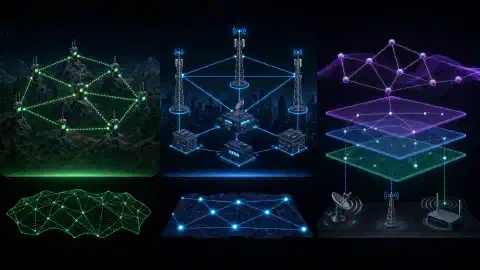
These three projects do not all solve the same problem. Meshtastic and MeshCore are LoRa mesh networking systems with different routing philosophies. Reticulum is broader. It is a transport-independent networking layer running over LoRa, packet radio, Wi-Fi, Ethernet, serial links, and the internet at the same time.
The right question is not “which is best?” It is “which architecture fits the network I am trying to build?”
Meshtastic fits ad hoc and roaming use. MeshCore fits deliberately built, fixed infrastructure. Reticulum fits networks needing to bridge different transports or connect otherwise separate networks. Most people building one regional LoRa mesh only need one of the first two.
Define the Network You Are Building
Before comparing protocols, write down what the network needs to do. A useful target for most community and emergency-communications deployments looks like this:
- License-free operation, so anyone participates without a ham license
- Low-cost hardware affordable for a community to deploy at scale
- Low power consumption, ideally solar or battery sustainable
- Long-range communication without cellular or internet dependency
- Infrastructure independence from the grid, ISPs, and carriers
- Easy enough for non-radio experts to set up and use
- Suitable for community deployment, not only a single operator’s basement
- Able to grow beyond a handful of nodes without falling apart
- Useful during infrastructure failures, when cell towers and internet are down
- Reliable delivery matters more than record-setting distance
Keep this list in mind through the rest of the article. Every architectural tradeoff below gets evaluated against it.
Meshtastic
Meshtastic is the most mature and widely deployed option here. It gets a lot right for the median user.
- Mature ecosystem with years of active development
- Large user community, active Discord, and extensive documentation
- Broad hardware support across LILYGO, Heltec, RAK, and Seeed boards
- Good mobile applications for iOS and Android
- Easy entry point, first-time setup takes under 20 minutes
- Strong support for portable and roaming users who join and leave the mesh unpredictably
- GPS and telemetry features with a developed ecosystem around them
- Existing deployments in most metro areas make adoption easier, since you are joining a network instead of building one from nothing
For a full breakdown of Meshtastic’s routing, hardware compatibility, and setup process against MeshCore specifically, see the MeshCore vs Meshtastic comparison guide . This article focuses on the architectural question mattering most for larger deployments: managed flooding and hop limits.
Managed Flooding and Why Hop Limits Matter
Meshtastic broadcasts use managed flooding. When a node sends a message, every node hearing it rebroadcasts the packet, up to a configured hop limit. No node needs to know the network topology. New nodes join with zero configuration, and dead nodes get bypassed automatically since the flood routes around them.
The default hop limit is 3. The maximum is 7. The framing worth avoiding is “Meshtastic only goes seven hops.” The real question is what raising this number costs you.
Each additional hop means every node within range of the message rebroadcasts it again. More forwarding produces:
- More airtime consumed per message
- More duplicate transmissions, since every node in range of a rebroadcast repeats it
- More contention for the shared channel
- Greater collision risk as more radios try to transmit in the same window
- Higher battery consumption on every node receiving and retransmitting
- Less available channel capacity for actual message traffic
LoRa capacity is bounded by airtime and regional duty cycle limits, not by node count. A network with ten chatty nodes sending frequent GPS and telemetry broadcasts saturates a channel fifty quiet sensor nodes would never touch. This is why a dense mesh with a high hop limit degrades faster than the same node count spread across a lower hop limit and disciplined telemetry intervals. Meshtastic 2.6 improved this for direct messages by switching to next-hop routing after route discovery, so point-to-point traffic no longer floods the whole hop radius. Broadcasts still flood.
For a small or medium hiking-club-sized mesh, this rarely matters. For a regional network meant to cover a city or a multi-town area, it becomes the central design constraint.
MeshCore
MeshCore takes a different architectural bet: instead of treating every device as an equal participant in message propagation, it builds a deliberate infrastructure layer and routes traffic toward it.
Node Roles
MeshCore deployments are built around distinct roles rather than one flat set of equivalent nodes:
- Companion or client nodes carry a LoRa radio paired to a phone or laptop and talk through nearby infrastructure when it is present
- Repeaters exist specifically to forward traffic between clients and other infrastructure, and do most of the actual routing work
- Room servers (optional) hold group conversations and deliver stored messages to clients when they reconnect
Route discovery happens first, then traffic moves through the discovered path toward its destination rather than fanning out to every node in range. Channel occupancy scales with active conversations, not total node count, which is a meaningfully different growth curve than Meshtastic’s flooding model.
Why This Fits Static Infrastructure
This is the core argument for MeshCore. Meshtastic’s flooding model has real advantages for ad hoc and roaming networks: no planning required, no infrastructure to maintain, and graceful handling of nodes coming and going. MeshCore’s routing model has the advantage when users intentionally deploy infrastructure.
A network built around known, elevated repeaters gives you the ability to design coverage on purpose, rather than depending on whichever nodes happen to be in range of each other on a given day. This difference matters for:
- Permanent rooftop nodes with reliable power
- Towers and existing communications infrastructure
- Solar repeaters at unattended sites
- Mountain or elevated relay sites
- Community-owned infrastructure shared across multiple groups
- Regional networks spanning more than a single neighborhood
- Emergency communications where predictable coverage matters more than flexibility
Tie this back to RF fundamentals: reliable links between properly placed infrastructure matter more than maximizing antenna gain, transmit power, or theoretical range. A protocol built around dedicated repeaters rewards you for doing the RF engineering work of siting those repeaters well. A protocol built around flooding rewards you less for this work, since every node does roughly the same job regardless of where you put it.
The Roaming-Node Argument, and Why It Is Not Free
A common suggestion goes like this: “Meshtastic is better for roaming nodes, MeshCore is better for static nodes, so run Meshtastic for users and MeshCore as the backbone.”
This sounds attractive on paper. In practice, mixing the two does not automatically produce the strengths of both, since Meshtastic and MeshCore use different routing and network architectures, and they do not exchange messages with each other. Bridging them means adding a translation layer between two incompatible systems, not simply picking the best parts of each.
Once you bridge them, you are running:
- Two separate networks, each with its own topology and behavior
- Two routing models sharing no state
- A translation layer between them, requiring ongoing build and maintenance
- More infrastructure to host the bridge
- More configuration across two firmware ecosystems instead of one
- More failure points, since the bridge itself fails independently of either mesh
- Harder troubleshooting, since a delivery failure lives in either network or in the bridge connecting them
Before adopting this design, ask a direct question: does the added complexity solve a problem a single, well-tuned mesh protocol fails to solve on its own? Often the honest answer is a properly configured MeshCore deployment with a few roaming-friendly companion nodes, or a Meshtastic deployment with a couple of well-placed high-hop-limit relays, delivers most of the practical benefit without running two networks glued together.
Reticulum
Reticulum deserves its own category rather than a slot as “a third LoRa mesh option,” because it is not primarily a LoRa mesh protocol at all. Its defining feature is transport independence.
Reticulum is a cryptography-based networking stack. It does not use source addresses, so packets carry no information about where they originated. Every address is self-sovereign: once generated, it becomes globally reachable within seconds to minutes and stays reachable even after physically moving to a different part of the network. All communication is encrypted by default with ephemeral keys and forward secrecy. Reticulum drops unencrypted packets rather than deliver them. None of this requires kernel drivers. It runs in userland on any system running Python 3, including a Raspberry Pi Zero.
The interfaces Reticulum supports include:
- LoRa, using RNode-compatible hardware (a defined open-source LoRa transceiver design, buildable, flashable onto common boards, or purchased ready-made)
- Packet radio, through any TNC running in KISS mode, which fits VHF and UHF amateur radio well
- Wi-Fi and wired Ethernet, using automatic peer discovery with no router or DHCP server required
- Serial links, for direct device-to-device connections
- TCP and UDP over existing IP networks, including the internet
- The I2P network, and custom interfaces for anything else with a Python bridge
On top of Reticulum sit applications like LXMF (a delay-tolerant messaging protocol), and end-user tools such as Sideband, NomadNet, and community MeshChat clients, which give Reticulum networks a messaging and browsing layer comparable to what Meshtastic and MeshCore ship out of the box.

Where Reticulum Makes Sense
Reticulum’s value shows up clearly in a heterogeneous setup, for example:
LoRa mesh to Reticulum node to IP link to Reticulum node to radio network
Here Reticulum is doing something neither Meshtastic nor MeshCore does: connecting two otherwise distinct communications systems into one addressable network. This is a real and specific requirement, not a generic upgrade. Good fits include:
- Linking geographically separated networks lacking a direct radio path between them
- Bridging different physical transports, such as a LoRa mesh on one end and a packet radio network on the other
- Radio-to-IP gateways handing traffic between a field radio network and the internet
- Experimental and research networking, where the flexibility to mix transports matters more than deployment simplicity
- Networks where no single transport covers the entire requirement, so something has to stitch the pieces together
Where Reticulum Adds Unnecessary Complexity
If everyone in a deployment uses compatible LoRa hardware and the actual goal is one regional LoRa mesh, adding Reticulum on top provides little benefit and a real cost. Every additional layer in a network stack means more:
- Configuration to get right and keep consistent across nodes
- Software to install, update, and troubleshoot
- Hardware in some configurations, depending on how interfaces are bridged
- Troubleshooting surface when something does not deliver
- Knowledge required of operators who now need to understand a third networking model
Use Reticulum when transport independence solves a requirement you genuinely have, not because it supports more interface types than the alternative. A single LoRa mesh with a hop-limit problem is a Meshtastic or MeshCore tuning problem. It is not a transport-independence problem, and Reticulum will not make it one.
Build One Healthy Mesh Before You Build Three Fragmented Ones
If one protocol already meets your requirements, build one healthy network instead of several smaller networks stitched together through bridges. This is the “one mesh first” principle, and it should govern most of the decisions above.
For a community network, interoperability among the people already using it usually matters more than architectural flexibility. A large, functioning single-protocol network holds more practical value than three technically interesting but fragmented ones only partially talking to each other.
Existing Meshtastic Networks Matter
Do not dismiss Meshtastic simply because MeshCore has architectural advantages for fixed infrastructure. If a city already has dozens or hundreds of Meshtastic nodes, this installed base represents real infrastructure and a real community, and migration carries a cost a spec-sheet comparison fails to capture:
- Installed hardware needing reflashing or replacement
- Existing users already knowing how to operate the network
- Community knowledge built up around the existing deployment
- Repeaters already deployed and sited, sometimes on hard-won rooftop or tower access
- Configuration experience accumulated by whoever runs the network
- Established channels people already monitor
- Training requirements for anyone learning a second system
Protocol selection here is partly an engineering problem and partly a community adoption problem. The better architecture on paper does not automatically win if it means asking an existing, working community to start over.
The Regional-Network Problem
Consider a hypothetical multi-city deployment:
City A, repeater, repeater, rural relay, repeater, City B, repeater, City C
Ask how each architecture handles this as it grows. A flooding-based mesh with a hop limit of 7 struggles to span this kind of chain reliably, since every hop compounds airtime cost and every additional active node along the way adds contention. A structured, repeater-based architecture like MeshCore’s is built for exactly this shape: known relay points, deliberate placement, and routing scaling with active conversations rather than total node count.
This is the scenario where hop limits, airtime budget, routing behavior, and infrastructure design stop being theoretical and start determining whether the network works end to end. Geographic scale is where the architectural differences between Meshtastic and MeshCore stop being academic.

RF Still Matters More Than Protocol
No amount of clever routing software creates an RF path where none physically exists. Before blaming a protocol for a coverage problem, check the fundamentals:
- Antenna height above obstructions
- Line of sight between the two ends of a link
- Fresnel zone clearance, distinct from visual line of sight
- Feed-line losses from cheap or overly long coax
- Antenna quality and whether it matches the band in use
- Noise floor at the receiving site
- Terrain between nodes
- Node placement, including the realistic room for improvement
- Link margin, the buffer between signal received and the minimum needed to decode
A well-positioned 2 dBi antenna on a good mast often outperforms a poorly positioned high-gain antenna in a basement window. Protocol choice determines how the network handles the links you have. It does not create links where the physics will not support them.
Reliability Over Maximum Range
Do not design a network around the absolute edge of what a link occasionally achieves. Design around links working consistently.
For a community or emergency-communications network, predictable delivery at 15 miles carries more practical value than a link occasionally completing at 40 miles and failing the rest of the time. Build overlapping coverage with reliable infrastructure rather than chasing record-setting single links. This principle holds regardless of which protocol carries the traffic.
Which One to Choose
Meshtastic makes sense when you value ecosystem maturity, ease of adoption, portable and roaming users, and compatibility with an existing Meshtastic community. It is the right default for most people starting from nothing.
MeshCore becomes compelling when you are intentionally building persistent LoRa infrastructure and want dedicated repeaters to form a larger, structured network. It rewards planning and rewards good repeater placement more directly than a flooding-based design does.
Reticulum makes sense when the problem extends beyond one LoRa mesh, and you need to connect different transports or otherwise separate networks into a single addressable system.
For a license-free, low-power, long-range community infrastructure network built primarily around fixed repeaters, lean toward MeshCore. If a healthy Meshtastic network already exists in your area, replacing it needs enough benefit to justify fragmenting the existing community. Reticulum enters the picture when one mesh protocol, or one physical transport, no longer meets the requirement, not simply because it does more things.
References
- Meshtastic Mesh Broadcast Algorithm
- Meshtastic LoRa Configuration (hop_limit)
- MeshCore Official Site
- Reticulum Network Stack
- What is Reticulum?
- Reticulum Configuring Interfaces
- MeshCore vs Meshtastic Comparison Guide

Related Posts


This article refers to other articles we've written:
- MeshCore vs Meshtastic
Compare MeshCore and Meshtastic by routing, range, airtime, infrastructure, device support, and deployment fit.
- Field-Deployable Connectivity and Data Security for Edge Nodes
A guide to connecting and securing field edge-compute nodes with cellular, satellite, LoRa, VPN, MFA, segmentation, logging, encryption, and theft response.