
MeshCore vs Meshtastic
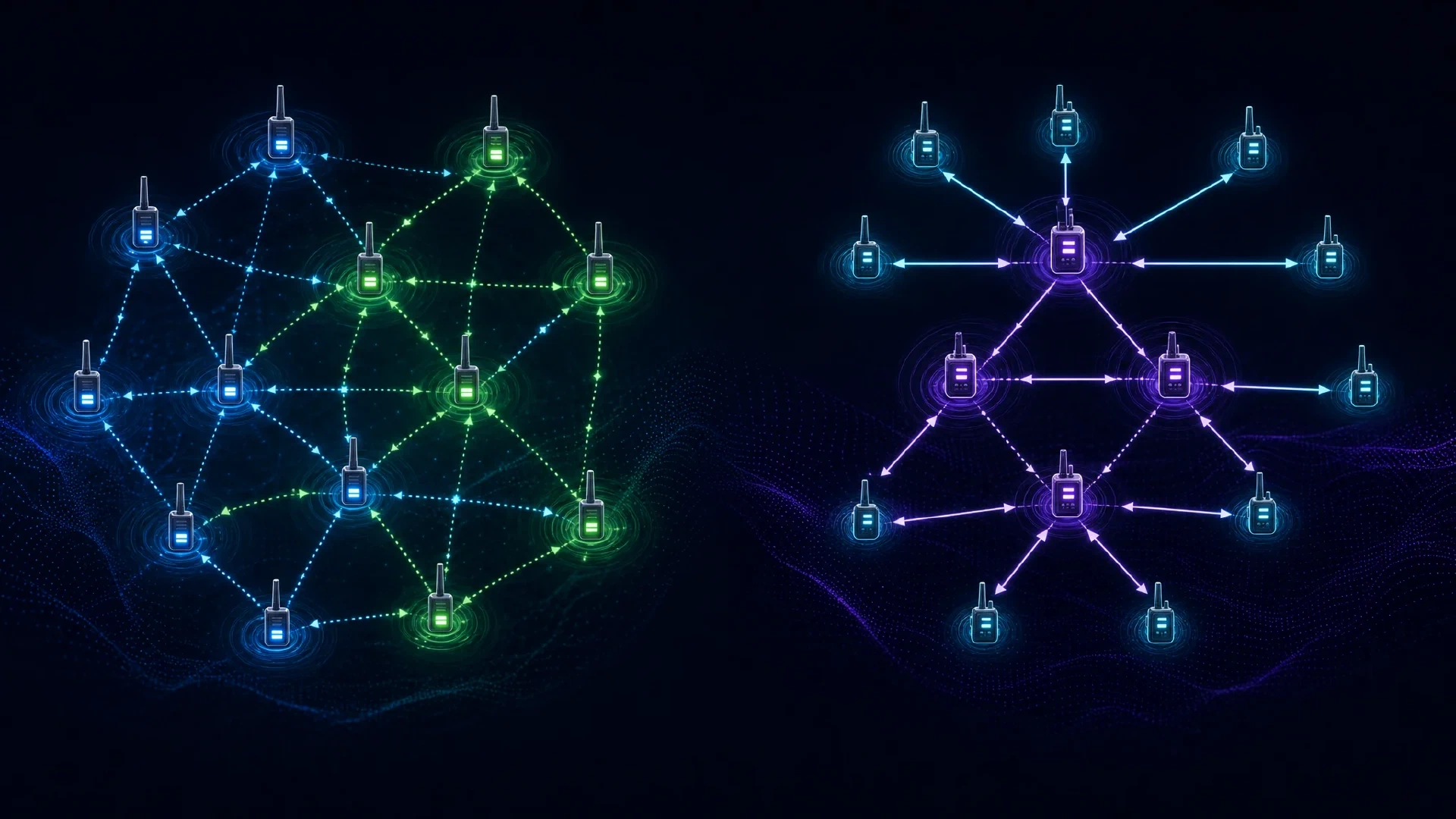
Table of Contents
The Short Answer
Meshtastic and MeshCore both run on the same cheap LoRa hardware. Both let you send encrypted messages without cellular or internet infrastructure. The two protocols are not compatible with each other.
The routing philosophy differs. Meshtastic floods packets to all nearby nodes. MeshCore routes traffic through planned infrastructure. Those different approaches produce different performance at scale.
Meshtastic works for most people. The mobile app is polished, the community is large, the documentation is solid, and setup takes under 20 minutes. MeshCore works better for planned deployments where airtime efficiency matters more than spontaneous self-organization.
RF fundamentals matter more than firmware. Neither protocol rescues a poorly placed antenna.
What Each System Does
Meshtastic
Meshtastic is an open-source project launched in 2020 by Kevin Hester. The firmware turns commodity LoRa hardware into a text-messaging mesh network with no internet or cellular dependency. Broadcasts use managed flooding: each node rebroadcasts packets up to a configurable hop limit. Since version 2.6, direct messages use next-hop routing after route discovery instead of flooding, which reduces airtime for point-to-point traffic.
The firmware runs on hardware most LoRa users already own or purchase inexpensively. LILYGO T-Beam, Heltec WiFi LoRa 32, RAK WisBlock, and Seeed SenseCAP Indicator all flash Meshtastic without specialized tooling. The iOS and Android apps are well-maintained. Non-technical users get on the network in under ten minutes. The ecosystem includes MQTT bridging, Home Assistant integration, and ATAK plugins.
MeshCore
MeshCore gained traction in 2023-2024. The firmware runs on much of the same LoRa hardware but uses a hybrid routing architecture. Route discovery happens first. After discovery, traffic moves through repeaters toward the destination rather than fanning out to everyone. This is not pure store-and-forward in the delay-tolerant networking sense.
Repeaters do most of the forwarding. Room servers are optional. They store group messages for clients to retrieve on reconnect. Clients carry a companion LoRa radio and connect through infrastructure when present, or communicate directly with nearby nodes when no repeater exists.
The Core Technical Difference
How Meshtastic Routing Works
Broadcasts use managed flooding. Each node rebroadcasts a packet up to the hop limit. No node needs to know the topology. New nodes join without configuration. Dead nodes get bypassed automatically. Since version 2.6, direct messages use next-hop routing after discovery, which cuts airtime for point-to-point traffic.
The actual constraint is airtime, not node count. LoRa operates on shared ISM bands with regional duty cycle limits, typically 1% in Europe. A network with frequent GPS beacons, telemetry packets, and active channel traffic saturates airtime before hitting any absolute node limit. Ten active nodes sending frequent telemetry create more contention than fifty quiet sensors. Dense meshes with several dozen active users often see increased airtime contention, but no hard ceiling exists. The threshold depends on spreading factor, airtime preset, telemetry intervals, terrain, and repeater placement.
Meshtastic generates overhead from node info broadcasts, battery telemetry, GPS packets, and neighbor discovery. Recent firmware versions reduced this overhead. Tuning those settings often solves performance problems before a protocol change becomes necessary.
How MeshCore Routing Works
MeshCore performs route discovery, learns routes, then routes traffic toward infrastructure rather than rebroadcasting to everyone. Repeaters forward traffic between nodes. Room servers optionally host group conversations and store messages for clients reconnecting later.
Channel occupancy scales with active conversations, not total node count. A large deployment with many quiet nodes does not degrade performance the way a dense flooding network with high overhead does. MeshCore targets significantly larger deployments by design, though actual performance depends on deployment quality.
Without a repeater, client nodes communicate directly when in range. Infrastructure is where the architecture performs best. Infrastructure is not a hard requirement.
Hardware
Both protocols run on the same popular LoRa boards.
| Board | Meshtastic | MeshCore |
|---|---|---|
| LILYGO T-Beam (ESP32 + SX1276/SX1262) | Yes | Yes |
| LILYGO T-Echo (nRF52840 + SX1262) | Yes | Yes |
| Heltec WiFi LoRa 32 V3 | Yes | Yes |
| RAK WisBlock 4631 | Yes | Yes |
| Seeed SenseCAP Indicator | Yes | Partial |
| Station G2 | Yes | Yes |
You flash the same physical device with either firmware. Switching protocols requires no new hardware. Experimenting costs nothing beyond your time.
Ease of Setup
Meshtastic Setup
- Download firmware from meshtastic.org
- Flash using the web flasher at flasher.meshtastic.org, no drivers needed
- Install the Meshtastic app on your phone
- Pair over Bluetooth
- Join or create a channel with a shared name and password
Total time for a first-time user: under 20 minutes. Channel encryption uses AES-256 pre-shared keys. The default public channel connects you to any Meshtastic node in range immediately. The app shows GPS positions on a map when nodes have GPS enabled.
MeshCore Setup
- Flash your infrastructure node (repeater or room server) using PlatformIO or prebuilt binaries
- Flash your client companion radio
- Install the MeshCore app
- Configure the app with the address and credentials for your infrastructure
- Connect your companion radio over Bluetooth
Setup requires more planning. You need to understand node roles before deploying. Room servers are optional but add message persistence for offline clients. Two friends who want to communicate quickly should use Meshtastic. A team deploying a base station with a rooftop repeater should use MeshCore.
Airtime Is the Real Constraint
Both protocols run on LoRa. LoRa capacity comes from airtime and duty cycle budget, not node count.
The variables determining network performance:
- Spreading factor. Higher values improve range but slow data rate, reducing total capacity.
- Airtime preset. Long-range presets consume more duty cycle per message.
- Telemetry interval. GPS, battery, and environment packets from Meshtastic add continuous overhead.
- Message rate. Active users sending frequently affect performance more than passive nodes.
- Repeater placement. A well-placed repeater spreads load. A poorly placed one adds to congestion.
- Terrain. Nodes unable to hear each other add traffic without causing contention. Nodes within range of many others simultaneously create contention.
Meshtastic minimizes planning and accepts some airtime overhead as the cost of self-organization. MeshCore requires planning and rewards planning with more predictable airtime efficiency. Switching from Meshtastic to MeshCore without improving network planning does not reliably improve performance.
Regulatory Considerations
Performance comparisons vary by region because regulations differ:
- 915 MHz (US): no hard duty cycle cap under FCC Part 15, but power limits apply
- 868 MHz (EU): 1% duty cycle under ETSI, meaning 36 seconds of transmit time per hour per channel
- 433 MHz (EU/Asia): stricter limits in many regions, often 10% on certain sub-bands
The 1% duty cycle restriction in Europe is a hard regulatory constraint. Dense Meshtastic meshes in EU deployments hit duty cycle limits faster than equivalent US deployments. MeshCore’s more efficient airtime use produces a proportionally larger benefit in duty-cycle-restricted regions.
Privacy and Security
Meshtastic
Meshtastic encrypts non-public channel traffic with AES-256 pre-shared keys. All messages on a channel share the same key. Anyone holding the channel key reads all messages, including GPS positions. The default public channel uses a well-known key distributed with the firmware, so public channel traffic offers no confidentiality from anyone running Meshtastic nearby.
GPS positions on a private encrypted channel are only visible to nodes holding the key. On the public channel, position broadcasts are visible to anyone. For use cases where tracking has operational consequences, this matters.
Meshtastic 2.6 improved direct message routing. Group traffic still uses channel PSK. Direct messages offer better isolation but are not end-to-end encrypted in the Signal Protocol sense.
MeshCore
MeshCore’s hybrid routing means a passive listener cannot reconstruct the full network topology by monitoring. Traffic routes toward specific infrastructure rather than fanning out. Direct messages use per-contact encryption rather than a shared channel key. Other nodes on the same infrastructure cannot decrypt your direct conversation even when sharing the same repeater.
Infrastructure nodes relay encrypted traffic. For direct messages with per-contact encryption, the repeater forwards ciphertext without decrypting. For room traffic, room servers observe message content for rooms they host. The relevant question is whether you control the room server.
MeshCore is not end-to-end encrypted in the strict Signal Protocol sense. Per-contact encryption for direct messages is a meaningful improvement over channel PSK. High-stakes operational use cases should evaluate the implementation details carefully.
Power Consumption
MeshCore generates less radio transmission overhead than Meshtastic with default settings. Less transmitting means better battery life on client nodes. Meshtastic’s telemetry packets, GPS broadcasts, and managed flooding each consume transmit time. You reduce Meshtastic’s overhead significantly by tuning telemetry intervals and disabling GPS broadcast on nodes without GPS. Default-for-default, MeshCore transmits less.
A well-tuned Meshtastic deployment with minimal telemetry matches MeshCore battery performance closely. Defaults favor MeshCore for battery life.
Network Resilience
Meshtastic’s managed flooding is resilient. Losing a relay node often has little operational impact because other nodes reroute naturally. No advance knowledge of available nodes is required. The mesh heals passively.
MeshCore relies more heavily on repeater placement. A well-designed MeshCore network with good repeater coverage performs predictably. A MeshCore network losing its only repeater in a coverage area loses connectivity for nodes depending on the repeater for routing. MeshCore rewards upfront planning. Meshtastic is more forgiving of node failures.
Meshtastic accepts airtime overhead in exchange for resilience. MeshCore accepts infrastructure dependency in exchange for efficiency.
GPS and Position Tracking
Meshtastic has a stronger GPS ecosystem. The mobile app includes a map view. Community nodes feed public tracking maps like meshmap.net via MQTT gateways. GPS telemetry is a first-class feature. Position sharing for hiking groups, search-and-rescue coordination, and event tracking is well-developed.
MeshCore does not focus on position tracking. If GPS awareness is a primary requirement, Meshtastic’s ecosystem is more developed and more mature in 2026.
Ecosystem and Community
Meshtastic has a larger community:
- Active Discord with thousands of members
- Active subreddit at r/meshtastic
- Extensive documentation at meshtastic.org
- Third-party integrations including MQTT, Home Assistant, Node-RED, ATAK, and Python libraries
- Regular firmware releases
- Large base of community-contributed hardware guides
MeshCore is growing but remains smaller. Fewer forum posts, fewer tutorials, fewer third-party integrations exist. When something breaks, you solve problems from the firmware source or the project’s Discord rather than finding existing answers.
Both projects are open source. Their licenses differ. Meshtastic uses a BSD-style license. MeshCore uses GPL. Some organizations care about this for deployment and distribution purposes.
When Meshtastic Wins
Small informal groups. A hiking club wanting off-grid text messaging and position sharing should use Meshtastic. Setup is easy, the map view works well, and the network self-organizes.
Mobile deployments. Users moving through terrain and joining or leaving unpredictably work well with Meshtastic’s self-organizing flooding. No pre-planned infrastructure needs to accommodate moving nodes.
Consumer-facing deployments. Non-technical people self-provisioning without your help. Meshtastic’s onboarding is approachable.
Quick single-event deployment. Festival comms, race coordination, or search-and-rescue setups deployed today and torn down next week. Fast setup and zero infrastructure dependency make Meshtastic practical.
GPS tracking. For position awareness as a primary use case, Meshtastic is the right choice in 2026.
When MeshCore Wins
Planned infrastructure deployments. You have a repeater on a rooftop or a room server running on reliable power. MeshCore’s hybrid routing takes advantage of fixed infrastructure.
Large networks with dedicated infrastructure. Deployments where airtime efficiency and predictable performance at scale matter more than spontaneous self-organization.
Message persistence for intermittent connectivity. Room servers store messages and deliver them when clients reconnect. This is one of MeshCore’s most concrete practical advantages over Meshtastic.
Fixed versus mobile separation. You need some nodes to be infrastructure and others to be clients. MeshCore’s node role model was built for this separation.
Duty-cycle-constrained regions. European deployments under ETSI 1% duty cycle limits benefit more from MeshCore’s efficient airtime use.
Per-contact encryption. For direct message encryption requirements, MeshCore’s model is meaningfully better than Meshtastic’s channel-PSK approach.
When Each One Falls Apart
Meshtastic Weaknesses
- Airtime contention at scale. Dense meshes with high-overhead defaults, frequent GPS broadcasts, and active channels degrade. Configuration addresses this before a protocol switch becomes necessary.
- No message persistence without infrastructure. Without an MQTT gateway, missed messages stay missed.
- Position privacy on the public channel. Any listener sees all GPS broadcasts. Acceptable for casual use, wrong for operational security requirements.
- Major firmware releases occasionally introduce compatibility issues until networks upgrade to a matching version.
MeshCore Weaknesses
- Setup complexity. You need to understand infrastructure roles before deploying meaningfully.
- Smaller community. Meshtastic’s documentation, tutorials, and third-party integrations remain more developed.
- Less hardware variety. MeshCore targets a smaller supported hardware list.
- Less mature mobile apps. Functional but not as polished as Meshtastic’s iOS and Android apps.
- Infrastructure dependency for optimal performance. Without repeaters, clients communicate directly but routing efficiency disappears. If your group does not commit to fixed infrastructure, the architecture advantage does not materialize.
- Network healing. Losing a repeater in a coverage area causes connectivity loss for dependent nodes. Meshtastic’s flooding is more forgiving of node failures.
- Zero protocol interoperability. MeshCore and Meshtastic do not exchange messages. The same hardware runs either firmware, but you manage two separate networks when running both.
RF Matters More Than Firmware
Antenna quality, antenna height, feedline loss, terrain, and radio settings have a larger impact on network performance than the choice of firmware.
A well-placed Meshtastic node on a hilltop with a good antenna outperforms a poorly placed MeshCore repeater in a metal enclosure in a basement. The protocol comparison assumes roughly equivalent physical deployment quality.
Before switching protocols to solve a performance problem, verify:
- Antenna connections are clean and low-loss
- Nodes are as high as physically practical
- Airtime preset matches your distance requirements
- Telemetry intervals are not saturating the channel
- Spreading factor fits your node density
Side-by-Side Summary
| Factor | Meshtastic | MeshCore |
|---|---|---|
| Network model | Managed flooding plus next-hop DM routing | Hybrid route discovery plus directed forwarding |
| Setup difficulty | Easy | Moderate to hard |
| Scale design intent | Flexible, degrades with airtime contention | Designed for larger planned networks |
| Mobile app quality | Excellent | Functional |
| Community size | Very large | Growing |
| GPS/position tracking | Strong, ecosystem developed | Minimal focus |
| Message persistence | No. Requires MQTT gateway | Yes via room servers (optional) |
| Direct message encryption | Channel PSK | Per-contact encryption |
| Infrastructure need | None required | Optimized for infrastructure nodes |
| Network healing | Resilient, self-healing | Depends on repeater placement |
| Hardware support | Broad | Focused subset |
| Best for | Mobile, ad hoc, small groups | Planned, fixed-infrastructure deployments |
Which One to Choose
Start with Meshtastic. You will be on the air in an afternoon. You will find people to test with. The app works. The documentation is excellent. Meshtastic 2.6’s next-hop routing for direct messages narrows the efficiency gap for point-to-point traffic.
Move to MeshCore when Meshtastic’s defaults do not fit your deployment. If you have dedicated repeater infrastructure, need message persistence for intermittent users, or are building a large planned network where airtime efficiency matters more than self-organization, MeshCore’s architecture fits and the setup investment pays off.
Before switching protocols, tune your Meshtastic deployment. Reduce telemetry intervals. Disable GPS broadcast on nodes without GPS. Adjust the airtime preset for your node density. Many networks with performance problems have configuration problems, not protocol problems.
The two protocols serve different points on the planning-versus-spontaneity tradeoff. Meshtastic minimizes planning and accepts the airtime overhead of self-organization. MeshCore requires planning and rewards planning with more predictable performance. Neither protocol will replace the other because the use cases differ.
Building a network needing to bridge LoRa with packet radio, Wi-Fi, or the internet rather than staying on one LoRa mesh? See the Meshtastic vs MeshCore vs Reticulum comparison guide for where transport-independent networking fits and where it adds complexity nobody needs.

Related Posts

This article refers to other articles we've written:
- Meshtastic vs MeshCore vs Reticulum
A practical comparison of Meshtastic, MeshCore, and Reticulum for off-grid and community mesh networking. Covers routing architecture, hop limits and airtime, static infrastructure versus roaming nodes, and when transport-independent networking with Reticulum genuinely solves a real problem.