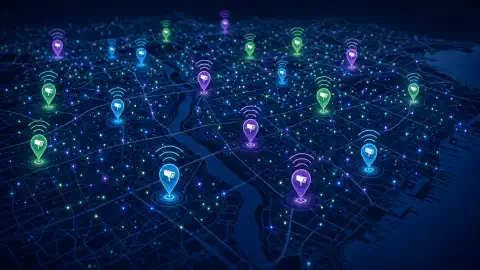
Flock Cameras: Public Safety Tool or Warrantless Surveillance Machine?

Table of Contents
The debate over Flock Safety cameras divides people in a way that almost nothing else does in technology policy. Those who have had a car stolen tend to love them. Those who study constitutional law tend to hate them. Both are reacting to something real.
This is an independent analysis of what these systems actually do, what the evidence says about their accuracy and misuse, and why the most important question is not whether cameras can photograph public streets — it is whether the government should build a searchable, warrantless database of everyone’s movements.
This topic generated significant public discussion in mid-2026. The video above covers a range of viewer perspectives and counterarguments worth considering alongside the analysis here.
Why Flock Cameras Are Different From Your Phone
The most common defense of Flock Safety cameras goes like this: your phone already tracks you everywhere. Police can get your GPS data with a warrant. Flock cameras are less precise than that. So why worry?
The argument is superficially reasonable and fundamentally wrong.
Your phone tracks you. Flock cameras track everyone. When police obtain your cell tower location data or GPS history, they need a warrant, a specific target, and probable cause. When an officer queries the Flock database, they do not need any of those things. They can search by plate number, time window, location, or vehicle description — without a warrant, without a named suspect, without any suspicion at all.
The result is warrantless mass surveillance of an entire population, not targeted surveillance of a specific individual. The Fourth Amendment was specifically designed to prevent exactly this kind of general search.
Cell phone tracking also does not build a permanent, queryable record of every vehicle that passed every intersection in your city over the last 30 days. Flock does. That persistent, structured database is what makes it qualitatively different from a cop writing down a plate number or a business installing a security camera.
A photograph is not a surveillance system. A searchable, timestamped database of photographs linked by vehicle identity across hundreds of cameras is.
What “Convoy Analysis” Actually Means
Flock Safety markets a feature called convoy analysis — the ability to track multiple vehicles that are traveling together as a group. The marketing language is bland. The implications are not.
Convoy analysis means Flock can identify when two or more specific vehicles are moving together, correlate their travel patterns over time, and flag when a historically associated group reconvenes. In a law enforcement context, this could mean tracking protest organizers who drive to the same locations, identifying which cars attend political meetings, or monitoring people who regularly gather in the same neighborhood.
None of these people need to have done anything illegal for their convoy associations to be recorded and stored.
The feature has legitimate applications — tracking a suspected criminal organization’s vehicles, for instance. But the same feature applied to a database with no warrant requirement means it can be used on anyone. It is the infrastructure for political surveillance, whether or not that is the intent today.
What Flock Cameras Collect Beyond License Plates
The license plate is the most visible data point, but it is not the only one. Here is what the evidence shows about the broader signal collection by these camera networks.
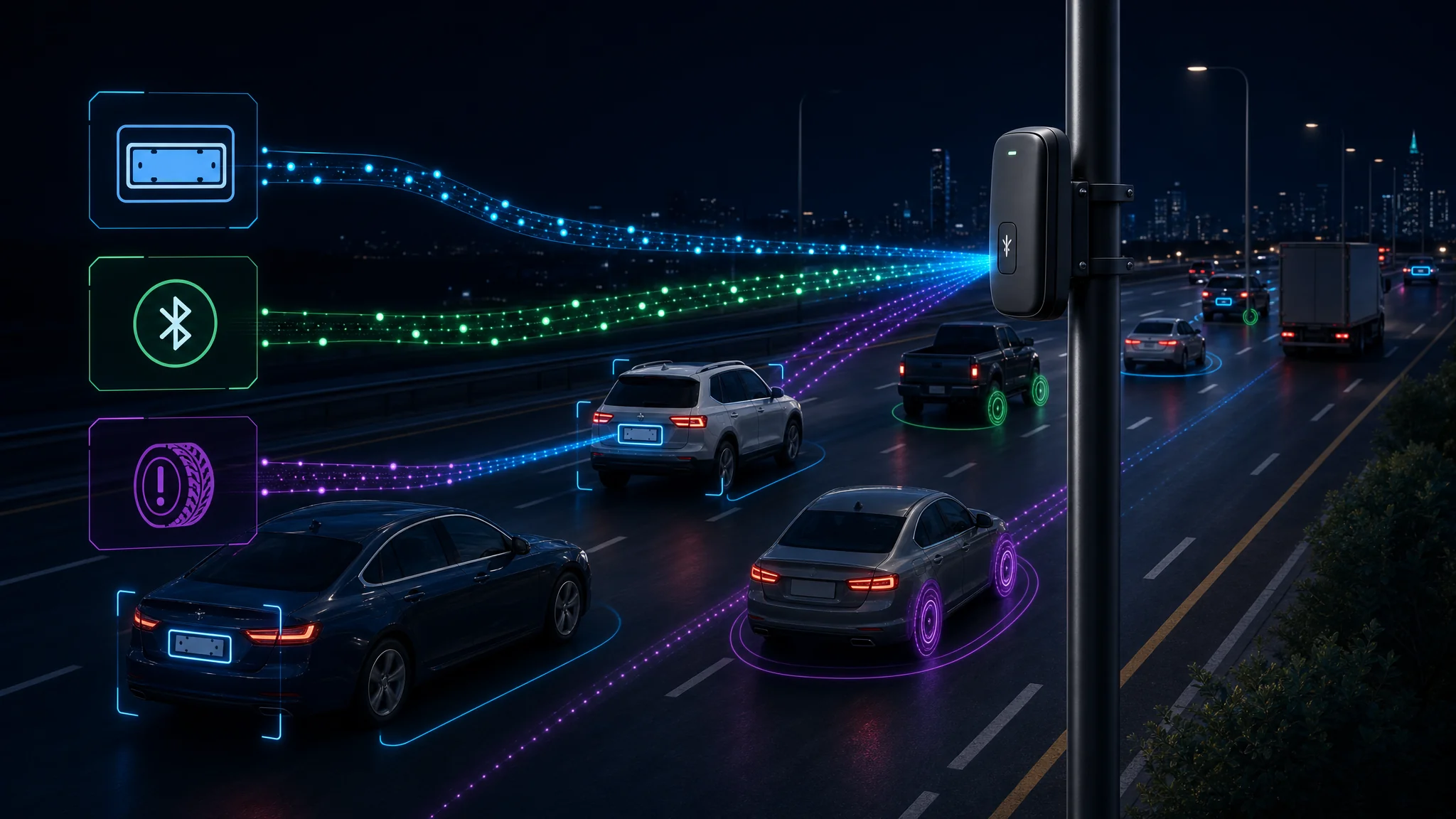
Bluetooth and WiFi MAC Address Sniffing
This is real, documented, and frequently underreported.
Many ALPR deployments — not just Flock — include WiFi and Bluetooth scanning capability. When your phone’s WiFi or Bluetooth is enabled and not connected, it broadcasts probe requests that include your device’s MAC address. A camera with a WiFi radio can passively log these addresses alongside the license plate read.
This matters enormously: your MAC address is linked to you, not your car. If you ride in someone else’s vehicle, rent a car, or drive a borrowed car, your phone still broadcasts your identity. Convoy analysis can now include the device-level identities of every passenger, not just the driver.
Even if the deployment you’re concerned about does not currently do this, the hardware and software capability often exists. The question of what data is collected and what data is retained are separate questions, and auditing compliance is effectively impossible without a public warrant requirement.
TPMS Sensor Tracking
Tire Pressure Monitoring System (TPMS) sensors transmit a unique identifier on UHF radio frequencies. These IDs are not encrypted and are broadcast whenever the tire is rolling. Researchers have demonstrated that passive TPMS sniffers alongside roadways can log vehicle identities — and unlike license plates, TPMS IDs are not visible to the public and cannot be changed without replacing the sensors.
A TPMS ID correlates to a specific set of tires. When those tires are mounted on a vehicle, the TPMS ID is functionally equivalent to a license plate that you did not know you had and cannot display differently.
This is not a hypothetical future capability. RTL-SDR receivers that can log TPMS signals cost around $40. The technical barrier to deploying passive TPMS monitoring alongside an ALPR network is very low.
The Real Problem: Photography vs. Database
Taking a photo of a car on a public street is legal. A police officer writing down a license plate is legal. A neighbor’s security camera recording traffic is legal.
None of those activities are the same as building a centralized, searchable, indefinitely retained database of every vehicle movement across an entire city.
The legal right to observe public spaces does not automatically extend to the right to aggregate those observations into a surveillance infrastructure that functions like a 30-day continuous tail on every person who drives.
The Supreme Court has recognized this distinction. In Carpenter v. United States (2018), the Court held that even though cell tower data consists of records already provided to a third party, the aggregation of that data over time into a comprehensive record of a person’s movements requires a warrant. The Court explicitly noted that pervasive tracking changes the constitutional calculus.
Flock Safety cameras are doing exactly what Carpenter warned about — at scale, automatically, without warrants, on the entire population.
Data Sharing and the Shadow National Network
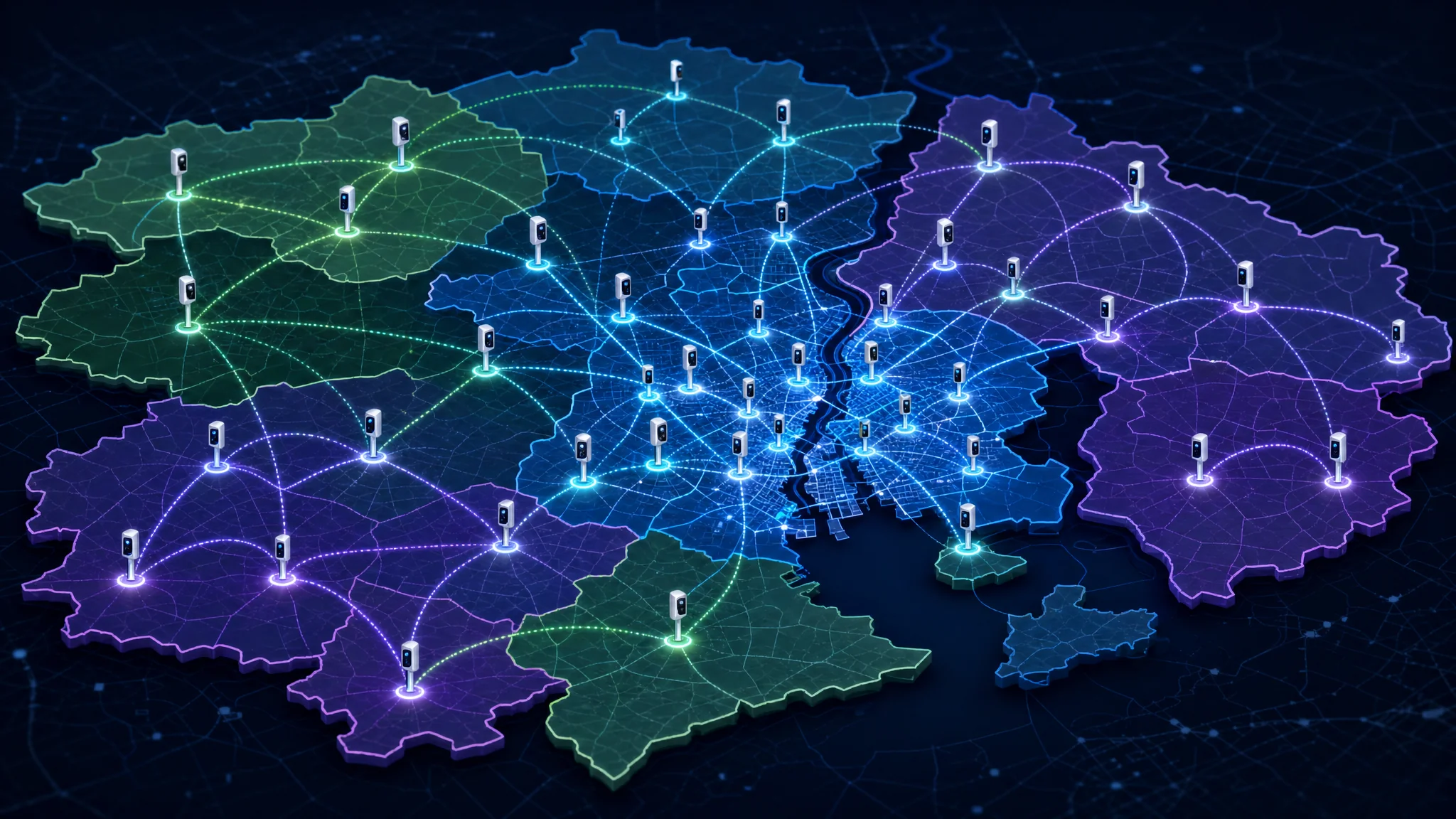
Individual Flock camera networks are not isolated. Cities and counties enter data-sharing agreements with neighboring jurisdictions, meaning that a query in one city can pull records from dozens of others. Some of these sharing agreements are permissive enough that a single agency can effectively access a regional or quasi-national database.
This is how a local camera network becomes a de facto national surveillance system without Congress ever voting on it.
The data sharing is voluntary and legally murky. There is no federal statute authorizing it. There are no standardized data retention limits. There are no mandatory audit requirements. And there is no mechanism for a citizen to find out whether their vehicle’s movements have been queried.
DeFlock.org, which crowdsources Flock camera locations, has mapped over 124,000 suspected LPR deployments across the United States. The coverage in urban and suburban areas is dense enough that driving across most American cities generates a near-continuous surveillance record.
Ring Cameras, Flock, and Warrants
Flock Safety and Amazon Ring are different products, but they share a critical characteristic: both can provide law enforcement access to data without requiring a warrant.
Ring created significant controversy when it became public that Amazon had given footage to law enforcement agencies thousands of times — in many cases without the knowledge or consent of the camera owner. Amazon eventually changed some of its policies after public pressure, but the underlying legal framework has not changed.
Flock operates on a similar model. The cameras are typically installed by municipalities or HOAs, but the data infrastructure is controlled by a private company. When police request data, they may get it through emergency access provisions, law enforcement portals, or simply through the fact that the local agency already has access.
The absence of a warrant requirement is not a bug in these systems. It is the business model.
Public records requests (FOIA in the US, FOI in Canada) can sometimes reveal what agencies have queried Flock systems, but many agencies treat Flock query logs as internal investigative records and deny access to them.
Debunking “Nothing to Hide”
The “nothing to hide” argument is the most common response to surveillance concerns, and it reflects a genuine misunderstanding of what privacy is for.
Privacy is not about hiding guilt. It is about preserving autonomy.
People have legitimate privacy interests in activities that are not criminal: attending political meetings, visiting doctors, going to religious services, speaking to journalists, or simply driving wherever they want without a permanent record being made. The fact that all of those activities are legal does not mean the government has a legitimate interest in cataloguing them.
History provides a direct answer to “nothing to hide.” Japanese Americans who were interned during World War II were not criminals. Activists surveilled by COINTELPRO were not criminals. People on No-Fly lists who turned out to be there by bureaucratic error were not criminals. The data that enabled those abuses was gathered on exactly the same rationale — public safety, threat assessment, efficient law enforcement.
Surveillance infrastructure built today will be used by whoever holds power tomorrow. The question of whether the current government is trustworthy is irrelevant. The question is whether you would be comfortable with the most adversarial future government imaginable having access to a permanent record of everywhere you have driven for the last decade.
When License Plate Recognition Gets It Wrong
ALPR systems are not perfectly accurate, and the consequences of an error are serious.
License plate recognition errors fall into several categories:
- Misread characters — letters and numbers that look similar under poor lighting or at speed (0/O, 1/I, 8/B, M/N/H)
- Partial reads — dirty, obscured, or damaged plates that only partially match
- Database errors — plates flagged as stolen that have since been cleared
- Regional plate collisions — two states or countries can issue the same plate combination, and a hit on a California plate may incorrectly flag a vehicle from a state with the same alphanumeric string
Real-world examples document all of these. People have had guns drawn on them during traffic stops because their vehicle was incorrectly matched to a stolen car. People have received toll bills for roads they never drove on. A person driving a powder-blue Hyundai received a toll bill for a Harley-Davidson ridden by someone with a plate that differed by two letters.
The error rate multiplied by the volume of reads produces a significant number of real people who will be incorrectly flagged, stopped, searched, or worse.
Because most of these queries happen without warrants, there is no judicial check on the accuracy of the underlying data before action is taken.
Security Failures: MFA and Shared Logins
Flock Safety’s security practices have been publicly criticized on multiple grounds:
- No mandatory multi-factor authentication for law enforcement accounts in many deployments
- Shared login credentials among multiple officers at some agencies
- No automatic session timeouts in some configurations
- No alerting when accounts are accessed from unusual locations or times
These are not minor implementation details. They mean that a single compromised credential — obtained through phishing, social engineering, or simple password reuse — could give an attacker access to query a regional Flock network covering millions of license plate reads.
For domestic abuse survivors, stalking victims, or journalists, the existence of a shared, minimally secured database of their vehicle movements is not an abstract concern. It is a direct physical safety risk.
The argument that “the cameras are just public data” ignores the security requirement for the database layer that aggregates that data. Even if every individual photograph is legal to take, the aggregated database requires stronger protection than a shared password.
Could the System Be Designed Better?
Technical controls alone are not sufficient, but they are worth considering.
Several proposals have been discussed for making ALPR systems harder to abuse:
Data minimization by design: Instead of storing full license plate images with timestamps and GPS coordinates, the system could store a cryptographic hash of the plate paired with approximate location and time. A law enforcement query would confirm whether a specific plate was seen in a specific area in a specific time window, but could not retrieve a list of everywhere that plate has been seen. This limits the utility for general fishing expeditions while preserving the ability to answer targeted investigative questions.
Time-limited retention: Plates not associated with any open investigation could be automatically deleted after 24-72 hours rather than retained for 30 days or more. Most legitimate investigative uses require near-real-time data. Long-term retention creates disproportionate civil liberties risk.
Warrant requirements with judicial review: The most important control is legal rather than technical. Requiring a warrant for any query of a named individual’s plate history would not prevent emergency uses (exigent circumstance exceptions already exist in law) but would prevent the routine warrantless data mining that currently has no check.
Audit logging with public transparency: Every query should be logged, those logs should be auditable by oversight bodies, and aggregate statistics should be publicly reported.
These measures would not make ALPR risk-free, but they would dramatically reduce the potential for routine abuse while preserving the investigative utility that proponents value.
The Debate Doesn’t Have to Be All-or-Nothing
The discussion around Flock cameras often collapses into two extreme positions: cameras are essential crime-fighting tools and any criticism helps criminals, or cameras are an unconstitutional surveillance state and must be removed immediately.
Both of these positions are wrong, and the polarization makes it harder to have the conversation that actually matters.
The cameras can photograph public streets. The data must be governed by law.
The technology is not going away. The legitimate public safety applications are real. But the current deployment model — in which a private company builds and controls a near-national surveillance database that law enforcement can query without a warrant — is constitutionally suspect and historically dangerous.
The path forward is not to destroy the cameras. It is to require warrants for individual searches, mandate short data retention windows, prohibit open-ended data sharing without case-specific justification, and create enforceable audit and oversight mechanisms.
That is a boring, procedural answer. It does not generate outrage on either side. But it is the only answer that takes both public safety and constitutional liberty seriously.
If you want to know when you are near one of these cameras rather than waiting on policy reform, dedicated detection hardware exists today.

Related Articles
| Article | What You’ll Learn |
|---|---|
| Flock Safety Camera Surveillance: Prevalence, Privacy Concerns, and Protection Strategies | Full deep-dive on the Flock network, documented abuse cases, and practical protection steps |
| Flock Finder: Map Every Suspected Flock Camera Near You | How to use the open-source tool to visualize 40,000+ suspected cameras using WiGLE data |
| Flock-You Detection Hardware Guide | Build or buy an ESP32-based device to detect Flock cameras in real time |
| How to Flash Rayhunter on IMSI Catcher Detection Devices | Detect stingrays and IMSI catchers — the cellular equivalent of ALPR tracking |
| Rayhunter Device Comparison 2026 | Choose the right hardware for a full counter-surveillance toolkit |
References
- Carpenter v. United States, 585 U.S. 296 (2018)
- ACLU — Automatic License Plate Readers
- Electronic Frontier Foundation — What Is ALPR?
- DeFlock
- DeFlock Interactive Map
- Flock Safety Official Site
- Security and Privacy Vulnerabilities of In-Car Wireless Networks: A Tire Pressure Monitoring System Case Study
- FBI Vault — COINTELPRO
- MuckRock — Flock Safety
- Flock Finder GitHub
- Flock Finder Interactive Map

Disclosure and Affiliate Statement:
Affiliate Disclosure: We may earn a commission from links on this page. These commissions support our website and the content we provide. Rest assured, we only recommend products/services we believe in. Thank you for your trust! Click Here to Learn More
Related Posts