
2x RTX 5060 Ti vs GB10: Five-Model Local AI Benchmark at 256K Context
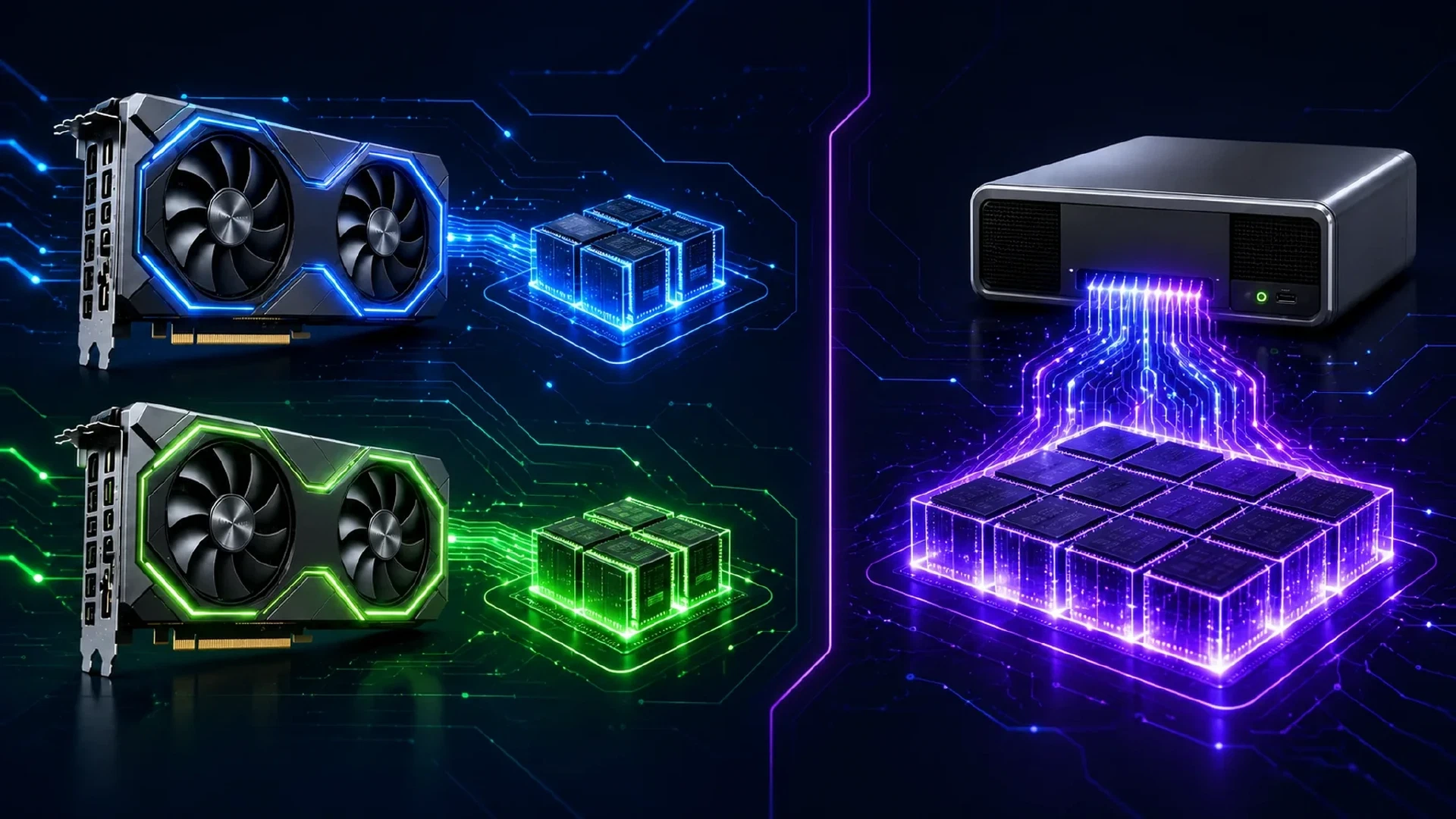
Table of Contents
Two RTX 5060 Ti 16 GB cards provide 32 GB of aggregate VRAM. An NVIDIA GB10 system provides 128 GB of coherent unified memory. The new five-model benchmark shows a more balanced result than the earlier Qwen-only test.
The dual-card system leads on generation speed for four of the five models at the 256K setting. The GB10 leads clearly on Qwen3.8 27B and keeps a larger memory reserve for models, context, and runtime allocations. The best choice depends on the model and workload.
The NVIDIA GB10 uses 128 GB of coherent unified memory. NVIDIA lists the GB10 platform with 128 GB of LPDDR5x unified memory and a 140 W chip TDP. The RTX 5060 Ti uses 16 GB of GDDR7 per card, a 128-bit memory interface, and a 180 W total graphics power rating. NVIDIA RTX 5060 Ti specifications and NVIDIA GB10 specifications describe the hardware difference.
The two systems do not expose memory in the same way. Two cards create two separate 16 GB pools. The GB10 places the model, context data, runtime buffers, and operating-system allocations in one shared address space.
The memory comparison
| System | Memory | Memory model | Reported power figure |
|---|---|---|---|
| 2x RTX 5060 Ti 16 GB | 32 GB aggregate | Two separate GPU memory pools | 360 W GPU total |
| GB10 system | 128 GB | Coherent unified system memory | 140 W GB10 TDP |
The GB10 does not win every throughput test because LPDDR5x memory matches discrete GPU bandwidth. Its advantage comes from capacity and placement. The CPU and GPU share the same address space, so the working set does not need to fit inside two isolated 16 GB devices.
The dual-card system faces a placement problem. The model must split across both cards. The runtime must move data between them. PCIe traffic adds latency and consumes bandwidth. The RTX 5060 Ti also does not support NVLink, according to NVIDIA’s specifications.
The five-model benchmark
The updated run used the same request matrix on both systems. It covered five Ollama models at 4K, 16K, 32K, 64K, 128K, and 256K context settings. Each request generated 128 tokens with temperature 0.
The tested model tags were:
- Qwen3.8 27B:
qwen3.8:27b - GPT-OSS 20B:
gpt-oss:20b - Qwen3.6 35B-A3B:
qwen3.6:35b - Qwen3.5 35B-A3B:
qwen3.5:35b-a3b-q4_K_M - Nemotron 3.5 Lightning 30B-A3B:
nemotron-3.5-lightning:30b-a3b-q4_K_M
The dual-card system used two RTX 5060 Ti 16 GB cards. The GB10 system used 128 GB of unified memory. The runs used Ollama, with version 0.34.2 on the dual-card system and version 0.40.2 on the GB10 system.
Generation speed
Generation speed measures the tokens produced after prompt processing. This metric matters most during an interactive conversation.
Dual RTX 5060 Ti system:
| Context | GPT-OSS 20B | Nemotron 3.5 | Qwen3.5 35B | Qwen3.6 35B | Qwen3.8 27B |
|---|---|---|---|---|---|
| 4K | 91.518 | 162.027 | 117.547 | 156.104 | 55.654 |
| 16K | 87.176 | 161.377 | 112.903 | 140.596 | 51.656 |
| 32K | 82.372 | 157.055 | 106.455 | 144.833 | 47.369 |
| 64K | 74.661 | 135.106 | 95.979 | 125.008 | 38.863 |
| 128K | 62.767 | 130.924 | 79.572 | 115.352 | 26.399 |
| 256K | 67.853 | 106.221 | 58.947 | 67.159 | 1.079 |
GB10:
| Context | GPT-OSS 20B | Nemotron 3.5 | Qwen3.5 35B | Qwen3.6 35B | Qwen3.8 27B |
|---|---|---|---|---|---|
| 4K | 62.199 | 98.648 | 72.405 | 100.906 | 32.985 |
| 16K | 56.764 | 94.366 | 69.782 | 95.448 | 32.939 |
| 32K | 53.257 | 98.175 | 64.055 | 95.025 | 29.772 |
| 64K | 49.201 | 96.132 | 58.428 | 84.528 | 25.625 |
| 128K | 40.637 | 80.238 | 48.108 | 74.579 | 22.294 |
| 256K | 43.688 | 68.043 | 36.649 | 62.115 | 22.371 |
At 256K, the dual-card system generated faster on GPT-OSS, Nemotron, Qwen3.5, and Qwen3.6. The GB10 generated faster on Qwen3.8 by a wide margin. Qwen3.8 dropped to 1.079 tokens per second on the dual-card system while the GB10 produced 22.371 tokens per second.
The Qwen3.6 result is close. The dual-card system reached 67.159 tokens per second and the GB10 reached 62.115. The result does not support a universal claim that unified memory always wins or that two discrete GPUs always win.
Prompt processing speed
Prompt processing measures how fast the runtime reads the input context before generation. It matters for long documents and repeated context reloads.
Dual RTX 5060 Ti system:
| Context | GPT-OSS 20B | Nemotron 3.5 | Qwen3.5 35B | Qwen3.6 35B | Qwen3.8 27B |
|---|---|---|---|---|---|
| 4K | 4745.9 | 2409.0 | 2701.7 | 464.3 | 783.9 |
| 16K | 7617.0 | 3031.8 | 4175.3 | 2654.0 | 840.1 |
| 32K | 8099.5 | 3074.2 | 4335.8 | 2623.2 | 811.2 |
| 64K | 6809.5 | 2893.0 | 4129.9 | 2400.4 | 727.8 |
| 128K | 5089.9 | 2362.7 | 3084.0 | 1723.6 | 546.1 |
| 256K | 5838.3 | 1813.2 | 2229.1 | 1011.0 | 251.3 |
GB10:
| Context | GPT-OSS 20B | Nemotron 3.5 | Qwen3.5 35B | Qwen3.6 35B | Qwen3.8 27B |
|---|---|---|---|---|---|
| 4K | 3295.5 | 576.0 | 2067.9 | 628.8 | 756.9 |
| 16K | 4675.5 | 3006.7 | 2691.2 | 2556.3 | 812.6 |
| 32K | 4571.4 | 3077.9 | 2691.7 | 2563.9 | 794.1 |
| 64K | 3704.7 | 3066.9 | 2585.3 | 2444.9 | 714.0 |
| 128K | 2857.0 | 2802.9 | 2360.4 | 2229.9 | 655.5 |
| 256K | 3243.4 | 2325.4 | 1938.5 | 1817.6 | 535.1 |
At 256K, the dual-card system led on GPT-OSS and Qwen3.5 prompt processing. The GB10 led on Nemotron, Qwen3.6, and Qwen3.8. Model architecture and runtime behavior matter as much as the memory interface.
Actual prompt lengths matter
The requested context is not the same as the number of prompt tokens processed. At the 256K setting, the Qwen3.5, Qwen3.6, Nemotron, and Qwen3.8 runs processed about 171,359 to 171,365 actual prompt tokens on both systems.
GPT-OSS processed 65,538 actual prompt tokens at the 256K setting on both systems. Its 256K row therefore does not represent the same input length as the other models.
The 256K Qwen3.8 result is the clearest split. The dual-card system processed 171,359 prompt tokens at 251.3 tokens per second and generated at 1.079 tokens per second. The GB10 processed the same number of prompt tokens at 535.1 tokens per second and generated at 22.371 tokens per second.
A context setting proves the requested limit. The actual prompt-token count proves the workload completed by the runtime.
Why aggregate VRAM still matters
1. The model does not see one 32 GB card
Two GPUs do not merge their memory into a single local address space. A model-parallel runtime divides layers or tensors across devices. Each device still needs room for its assigned weights, temporary buffers, and part of the context state.
The usable capacity is lower than the simple sum suggests. The exact overhead depends on the model format, quantization, inference backend, tensor split, and context length.
2. Context memory grows during generation
The model weights are only one part of the memory budget. The key-value cache, or KV cache, stores attention data for prior tokens. Longer contexts require more cache memory. A 4K test does not predict a 128K or 256K deployment.
The new results show different failure points by model. Qwen3.8 suffers a severe generation collapse on the dual-card system at 256K. The other four models keep usable generation speed on both systems. Memory capacity remains important because it determines which model and context combinations fit with room for runtime allocations.
3. PCIe transfers add a tax
When the runtime moves activations or tensors between GPUs, the transfer crosses the host interconnect. This creates synchronization points and adds latency to each step. The penalty depends on tensor placement, model architecture, quantization, and context length.
This does not make a dual-GPU system useless. It means the runtime configuration and model determine the result. A benchmark reporting only prompt processing at 4K misses this cost.
4. Power efficiency remains a system-level advantage
The GB10 uses less reported chip or GPU power while providing more memory capacity. Two RTX 5060 Ti cards carry a 360 W combined GPU power figure before the rest of the system. NVIDIA lists the GB10 TDP at 140 W.
The GB10 trades peak throughput on several models for capacity, a shared working set, and lower reported GPU power. The dual-card system delivers higher measured throughput on several newer MoE models.
The 5060ti-x2 system costs far less
A complete dual RTX 5060 Ti 16 GB workstation was listed at $3,479 on October 10, 2026. The configuration includes an Intel Ultra 7 265K, Z890 motherboard, 32 GB of DDR5, 1 TB storage, a 1,000 W power supply, and both GPUs. View the complete dual-GPU workstation listing .
NVIDIA’s US marketplace lists the 128 GB DGX Spark at $6,950. The listing includes 128 GB of coherent unified memory and 4 TB of NVMe storage, but shows the system as out of stock. Check NVIDIA’s current DGX Spark listing .
The AMD Ryzen AI Halo Developer Platform provides another comparison point. This Strix Halo system lists for $3,999.99 at Micro Center with 128 GB of LPDDR5x unified memory and 2 TB of storage. Strix Halo often lands in the same practical local-AI class as GB10 systems, although independent testing frequently measures GB10 ahead in throughput and software maturity. Check the current Micro Center Linux listing and read the Strix Halo versus GB10 review .
| Complete system | Listed price on October 10, 2026 | Price difference |
|---|---|---|
| 5060ti-x2 workstation | $3,479 | Baseline |
| AMD Ryzen AI Halo, Strix Halo | $3,999.99 | $520.99 more |
| 128 GB GB10 DGX Spark | $6,950 | $3,471 more |
The GB10 provides a larger unified memory pool and lower reported GPU power. The AMD system provides the same 128 GB memory class for around $4,000. The 5060ti-x2 workstation remains about 50% of the listed GB10 price, before tax and shipping.
These are listed prices from different vendors, not a controlled retail basket. The comparison also leaves the 5060ti-x2 system with less system memory and storage. Current RTX 5060 Ti 16 GB card listings sit near $789 to $830 each, far above the $429 launch MSRP, so the dual-card price advantage survives during the current GPU price spike. Current RTX 5060 Ti price checks .
What this means for local AI workloads
A two-card 16 GB setup runs several quantized 27B to 35B models at long context settings. The benchmark does not support a single winner for every model.
Choose the dual-card system when you value:
- Higher generation speed on GPT-OSS, Nemotron, Qwen3.5, and Qwen3.6 in this test.
- Higher short-context throughput across the five models.
- Lower purchase cost than the listed GB10 system.
- NVIDIA discrete-GPU software compatibility and future model experimentation.
Choose the GB10 when you value:
- Qwen3.8 27B at 256K, where the GB10 is over 20 times faster in generation.
- A single 128 GB memory pool with more room for model weights, KV cache, and runtime buffers.
- Lower reported GPU or chip power than two discrete cards.
- Fewer multi-device placement constraints for models that stress the dual-card setup.
This matches the sizing guidance in Is 16GB VRAM Enough for Serious Local LLM Work? , which treats weights, context, and runtime allocations as one budget. The 32GB VRAM guide for Qwen 27B reaches the same conclusion for two-card builds. Aggregate capacity does not equal usable headroom.
For any long-context deployment, ask four questions before buying hardware:
- Does the requested quantization fit with runtime buffers? Model weights alone do not define the memory requirement.
- Does the context fit without severe KV-cache pressure? Long prompts change the result.
- Does the runtime use an efficient device split? PCIe transfers and tensor placement affect every generated token.
- Does the system complete the target context? A fast 4K result does not offset a failed 256K workload.
The new benchmark answers these questions by model. Qwen3.8 strongly favors the GB10 at 256K. The other four models favor the dual-card system for generation speed in this specific setup. The larger unified-memory pool still provides more capacity headroom, even when it does not deliver the highest measured throughput.
Verdict
The dual RTX 5060 Ti system is faster for four of the five tested models at 256K generation. It also costs about half as much as the listed GB10 system. The GB10 remains the better choice for Qwen3.8 27B at 256K, for capacity headroom, and for workloads that benefit from one coherent memory pool.
The earlier Qwen-only result suggested a simple GB10 win. The updated five-model run shows why that conclusion was too broad. Model architecture, runtime version, tensor placement, and context behavior affect the result.
If you run GPT-OSS, Nemotron 3.5 Lightning, Qwen3.5, or Qwen3.6, the dual-card system produced higher generation speed in this benchmark. If you run Qwen3.8 27B at 256K, the GB10 produced usable generation speed while the dual-card system nearly stalled.
Memory capacity and throughput are separate buying criteria. The GB10 offers four times the aggregate memory and a simpler shared working set. The dual-card system offers higher observed throughput on most tested models at a much lower listed system price.
Benchmark limits
The benchmark records the model tags, requested contexts, actual prompt tokens, prompt-processing speed, generation speed, Ollama versions, and the 128-token generation target. It does not record resolved manifest digests, CPU power, wall power, fan speed, or cooling setup.
The GPT-OSS 256K rows processed 65,538 actual prompt tokens on both systems. The other 256K rows processed about 171K actual prompt tokens. Treat the figures as an observed system comparison, not a universal ranking of every RTX 5060 Ti pair and every GB10 implementation.
The hardware specifications above come from NVIDIA. The performance figures come from the controlled benchmark run for this article.
References
- Ollama Qwen3.8 model library
- Ollama Qwen3.5 model library
- Ollama Qwen3.6 model library
- Ollama Nemotron 3.5 Lightning model library
- Ollama GPT-OSS model tags
- Is 16GB VRAM Enough for Serious Local LLM Work?
- 32GB VRAM for Qwen 27B
- Local AI GPU Context Guide
- Qwen3.8 27B GPU Benchmarks on Vast.ai
- Complete dual RTX 5060 Ti 16 GB workstation listing
- NVIDIA DGX Spark US marketplace listing
- AMD Ryzen AI Halo 128 GB Linux listing
- Tom’s Hardware Strix Halo versus GB10 review
- RTX 5060 Ti current price checks

Related Posts